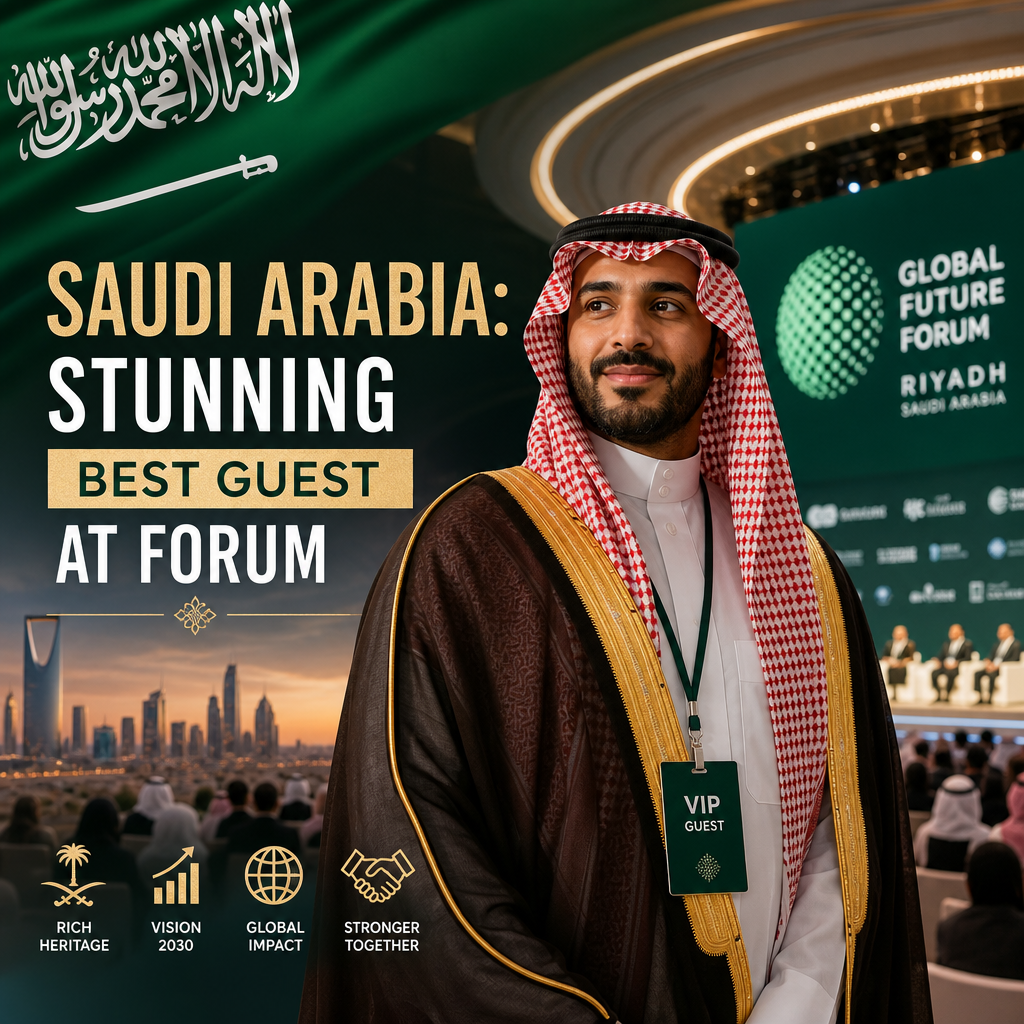
Saudi Arabia: Stunning Best Guest at Forum


Saudi Arabia is stepping into the spotlight as a guest of honour at Russia’s St Petersburg International Economic Forum, and the symbolism matters almost as much as the business on the table.
At a time when global alliances are being tested by war, sanctions, oil politics and shifting trade patterns, the presence of Saudi officials at a major Russian economic event says something important: neither side wants to be boxed into old assumptions. For Russia, the invitation helps project resilience and diplomatic reach. For Saudi Arabia, it reinforces a foreign policy built on flexibility, pragmatism and the careful balancing of competing powers.



The headline may sound ceremonial, but the context is far from routine. Reports from Russian, Qatari and British outlets all point to the same underlying story: Riyadh is now a central player in a world where economic partnerships are increasingly political, and political relationships are increasingly economic.
Saudi Arabia at the forum and what it signals
Russia has been eager to frame the forum as more than a trade show. In Moscow’s telling, Saudi Arabia’s elevated role reflects expanding cooperation in energy, investment and broader economic ties. That message aligns with the Kremlin’s wider effort to show that, despite Western sanctions and diplomatic isolation over Ukraine, Russia still has influential partners willing to engage.




Saudi Arabia, however, is not simply endorsing Russia’s position. Instead, its participation appears consistent with the kingdom’s wider strategy: keep channels open with major powers, diversify economic relationships and avoid becoming dependent on any single bloc. That approach has become a hallmark of Saudi diplomacy under Crown Prince Mohammed bin Salman. The country wants to attract capital, technology and strategic partnerships while preserving room to maneuver between Washington, Moscow, Beijing and regional rivals.
From the Russian perspective, Saudi participation is a win because it helps legitimise the forum and underscores that the global economy has not fractured along perfectly neat lines. From the Saudi perspective, the event is an opportunity to discuss investment, energy coordination and commercial cooperation without surrendering its carefully calibrated neutrality.
Why the Saudi Arabia guest role matters now
The timing is especially significant because energy markets remain one of the most sensitive areas of Russia-Saudi cooperation. Both countries are major oil producers, and both have a strong interest in keeping prices from collapsing. Their relationship through OPEC+ has often been described as pragmatic rather than warm, but pragmatism can still have enormous geopolitical impact.
That is where the more skeptical coverage becomes important. Western reporting has often highlighted the tension between Saudi Arabia’s economic diplomacy and its security ties with the United States. The kingdom still relies heavily on Washington for defence cooperation, yet it has steadily widened its foreign-policy options. That does not amount to a break with the U.S., but it does suggest that Saudi leaders are less interested than before in acting as a predictable American partner.
Al Jazeera’s coverage of the broader regional and economic landscape often places this kind of move within a pattern of multipolar diplomacy. In that view, Saudi Arabia is not pivoting toward Russia so much as pursuing a world in which power is distributed across several centres. That is a useful lens here: Riyadh’s choices are better understood as hedging than aligning.
Sky News, meanwhile, tends to emphasize the friction points that still surround any high-profile Saudi international engagement: human rights concerns, oil policy controversies and questions over how far the kingdom’s modernisation drive can coexist with its political system. Those issues do not disappear because Saudi Arabia is welcomed at a forum. If anything, the optics of the event make the contrast sharper. Saudi Arabia is presenting itself as an indispensable global business partner, while critics continue to question the ethical trade-offs that come with deepening economic ties.
The business case and the political reality
There is a genuine business logic behind the relationship. Saudi Arabia wants foreign investment for its vast transformation agenda, including infrastructure, tourism, manufacturing and technology. Russia, for its part, is looking for partners that can help cushion the impact of sanctions and provide routes for commercial exchange outside the West.
Potential areas of cooperation include:
– energy and oil-market coordination
– investment in transport and logistics
– industrial and technology partnerships
– joint discussion of food security and supply chains
– tourism and cultural exchange
Still, it would be a mistake to treat the forum appearance as evidence of a deep strategic alliance. The relationship is constrained by differences in interests, external pressure and the simple fact that both countries are careful about overcommitting. Saudi Arabia is unlikely to jeopardise key Western relationships. Russia is unlikely to become a straightforward economic partner in the traditional sense while sanctions remain so extensive.
That tension is what makes the story more interesting than a photo opportunity. Saudi Arabia is not choosing sides in a clean geopolitical contest. Instead, it is showing that it can engage with rivals, extract benefits and maintain leverage. In today’s international environment, that may be the most powerful position of all.
A sign of a changing global order
The bigger takeaway is that Saudi Arabia’s role at the forum reflects a shifting global order in which symbolism, trade and diplomacy are tightly interwoven. Russia wants proof it is not isolated. Saudi Arabia wants proof it can operate as a global power without being tied to one camp. Other countries are watching to see whether that model succeeds.
There is no simple conclusion here. The forum does not prove a new alliance, and it certainly does not erase the tensions that define both countries’ relationships with the West. But it does show how much international politics has changed. States that once would have been forced into rigid alignments are now trying to maximize options, manage contradictions and turn ambiguity into advantage.
Saudi Arabia’s guest role is, in that sense, more than a diplomatic courtesy. It is a signal that the future of global influence may belong less to loyal blocs and more to countries skilled at staying in the room with everyone.