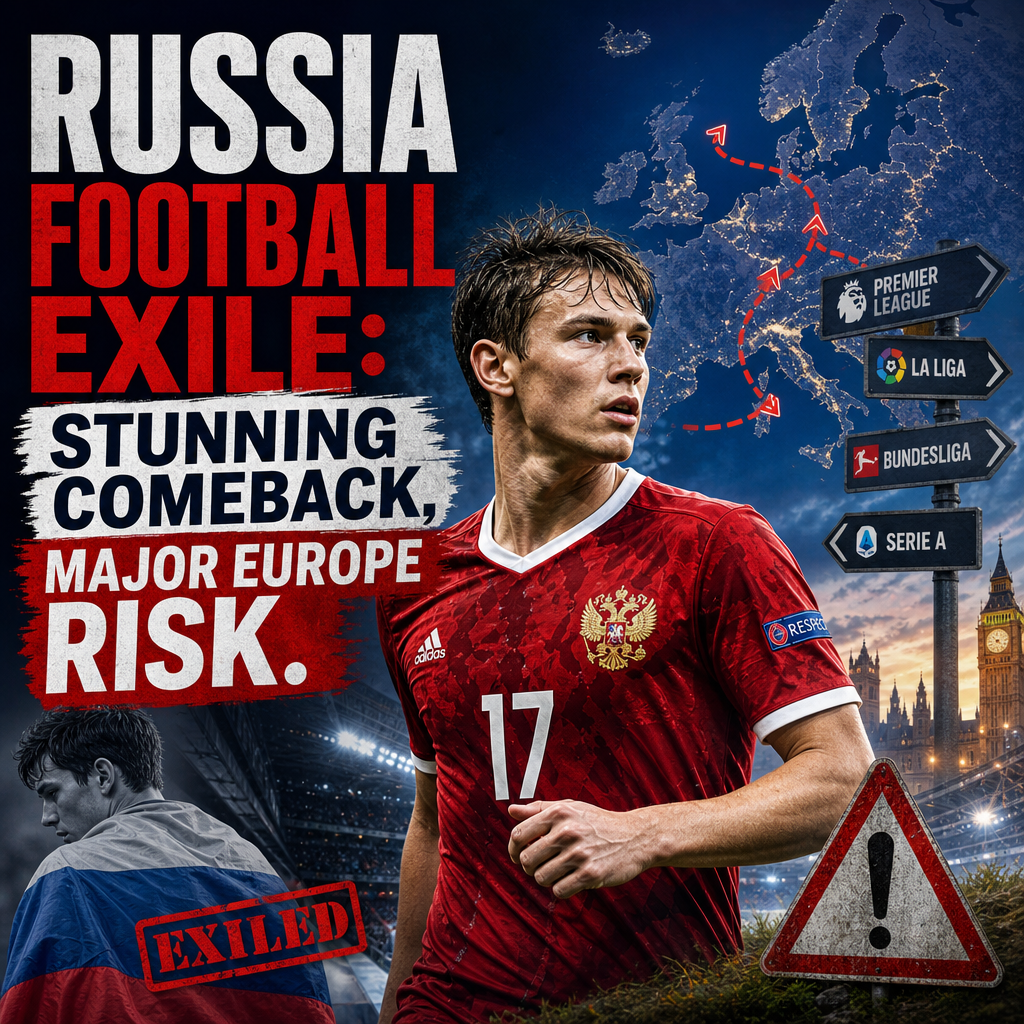
Russia Football Exile: Stunning Comeback, Major Europe Risk


Russia Football Exile is entering a new and politically fraught phase, with fresh discussion about whether Russian teams could eventually return to European competition — but the path back is anything but straightforward.
For more than two years, Russian clubs and national teams have been shut out of UEFA and FIFA competitions after the full-scale invasion of Ukraine. That punishment was initially framed as a temporary emergency measure, yet the longer the war has continued, the more the football ban has become a symbol of Europe’s broader isolation of Moscow. Now, with renewed chatter about a possible thaw, the debate is no longer just about sport. It is about legitimacy, security, public opinion, and whether football can truly separate itself from geopolitics.



Why Russia Football Exile Is Becoming a Bigger Debate
From the Russian perspective, the exile has always looked like collective punishment. Pro-Kremlin outlets have long argued that athletes and fans are being penalized for decisions made by political leaders, not sporting bodies. That argument resonates with some football traditionalists who believe competition should be kept apart from international conflict whenever possible.
But the counterargument from most European and global institutions remains equally strong: football does not exist in a vacuum. When a country is in the middle of a war that has destabilized Europe, banning its teams is seen by many officials and supporters as a necessary statement, not a symbolic overreach. In that view, restoring normal sporting ties too quickly risks sending the message that the crisis can be brushed aside without meaningful change.




The current conversation appears to reflect these two incompatible instincts. One side sees football as a bridge that should remain open even in hard times. The other sees it as one of the few public arenas where pressure can be maintained.
The sporting case for a return
Supporters of re-entry point to several practical arguments:
– Russian football has been disconnected from top-level European play for too long, weakening player development and international competitiveness.
– A prolonged ban can hurt domestic leagues, youth systems, and neutral fans who have little say in geopolitical decisions.
– History shows that sporting reintegration is often part of wider normalization, not something that must wait until every diplomatic issue is solved.
These points are not trivial. Football bans can create unintended consequences, especially when they last years rather than months. Players lose exposure, clubs lose revenue, and the wider sport becomes less competitive. For those reasons, some observers argue that any eventual return would need to be managed gradually and transparently rather than treated as a sudden political concession.
Why Europe Still Sees Major Risk
Yet the risks for Europe are just as real, and perhaps larger.
Sky News’ coverage of broader international tensions underscores a key problem: European policymakers remain wary of any step that could be interpreted as softening pressure on Moscow while the conflict continues. That matters because sport is highly visible. A decision to readmit Russia would not be a niche administrative change; it would be a headline across the continent and beyond.
Al Jazeera’s reporting on the wider war context also helps explain why this issue remains so sensitive. The war has not faded into the background. Civilian casualties, sanctions, military escalation, and diplomatic breakdowns continue to shape public attitudes. In that climate, football authorities face a difficult question: can they justify a return without appearing to normalize a still-active conflict?
There is also a reputational risk for governing bodies. UEFA and FIFA are often accused of acting inconsistently — hardline in some cases, cautious in others. Readmitting Russian teams prematurely could fuel criticism that football’s institutions bend under political pressure. On the other hand, keeping the ban in place indefinitely could be seen as selective moral judgment if other states with contested records are treated differently in future.
The main sources of uncertainty
At this stage, several unresolved issues make any comeback highly uncertain:
– Security concerns: Hosting Russian teams could trigger protests, boycotts, or logistical risks at venues.
– Political timing: Any change in the war’s trajectory could alter the appetite for reintegration.
– Institutional credibility: UEFA and FIFA need a process that looks principled, not improvised.
– Public reaction: Fans across Europe may reject a return even if administrators become more open to it.
This is why the debate feels so volatile. A sporting decision here is never just sporting.
The Fair Middle Ground: Re-entry Only With Conditions
If there is a realistic path forward, it is likely to be cautious and conditional. A full and immediate restoration of Russian participation would be hard to defend while the conflict remains unresolved. But an open-ended exile also raises fairness concerns, especially for athletes who have no role in state policy.
A more defensible approach would involve clear benchmarks and a staged process. That could mean partial lifting of restrictions only if there is evidence of de-escalation, international monitoring, or broader diplomatic movement. Even then, reintegration would probably begin with smaller steps before any full return to elite competition.
That kind of compromise would not satisfy everyone. Russian officials and supporters may argue it still treats their teams as political hostages. Critics in Europe may say even limited readmission rewards aggression. But in a situation this charged, a perfect solution may not exist. The most credible policy may simply be the one that acknowledges both the humanity of athletes and the reality of the conflict.
What This Means for European Football
The broader lesson is that modern football cannot avoid geopolitics, no matter how often it tries. Russia Football Exile has become a case study in the limits of sporting neutrality. It shows how quickly competition rules can turn into moral statements, and how hard it is to reverse them once a war, sanctions, and public outrage become part of the picture.
For now, the idea of a stunning comeback remains just that — an idea. But even the discussion matters. It forces football’s governing bodies to confront a hard truth: the longer a ban lasts, the more it becomes not only a disciplinary measure, but a political position.
Whether that position can be softened will depend less on football itself than on events far beyond the pitch.