
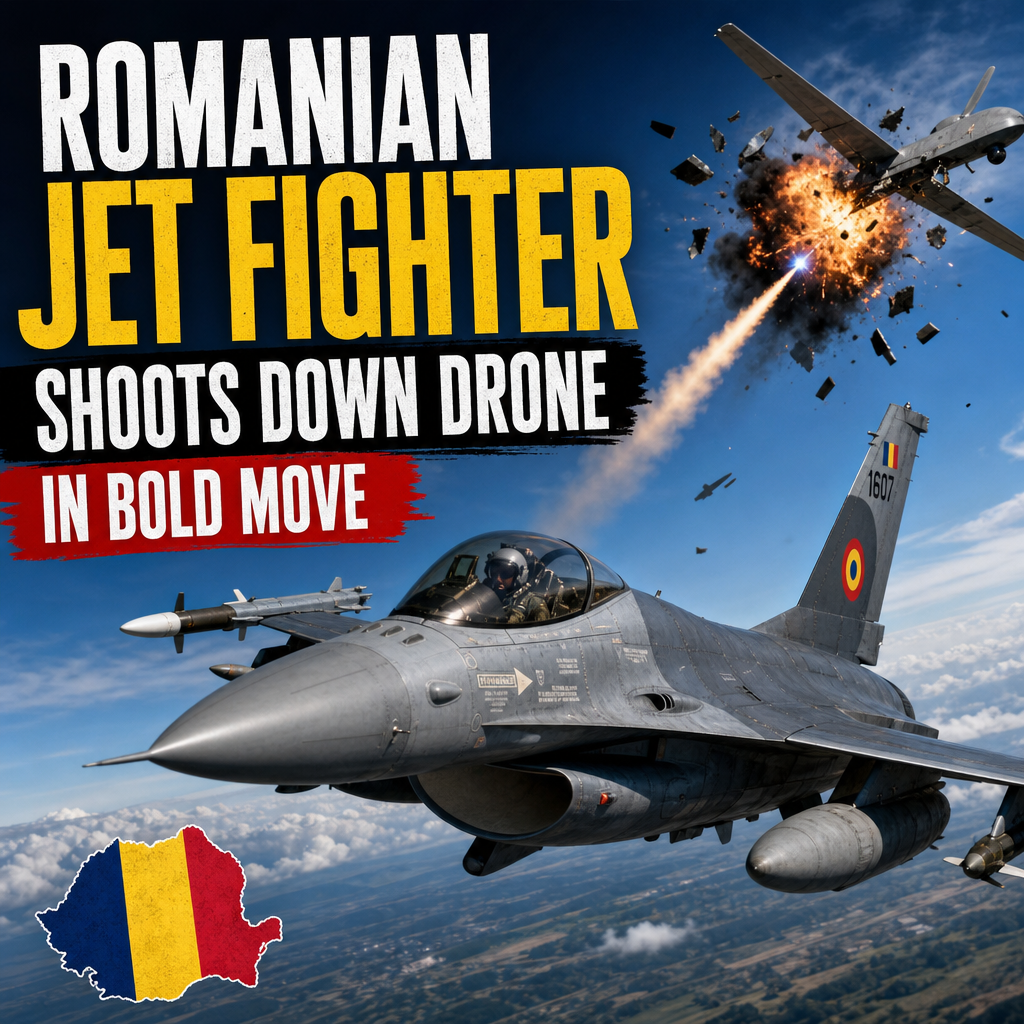
Romanian Jet Fighter Shoots Down Drone in Bold Move


Romanian jet fighter shoots down drone after a tense border incident, underscoring how quickly the war in Ukraine can spill into NATO airspace.
The move, reported by international outlets including Al Jazeera and Sky News, came after Romanian authorities said a drone entered the country’s airspace during a period of heightened Russian attacks across the Danube from southern Ukraine. It was a rare and assertive response from a NATO member state, and it immediately raised two questions: was this an isolated breach, or a sign that the conflict is widening in more dangerous ways? And equally important, how should allies respond when drones cross into their territory without warning?



What happened, and why it matters
According to the reports, Romanian forces scrambled aircraft after detecting a drone near the border area. A fighter jet then shot it down, marking a significant escalation in how NATO states are handling these incidents. Romania, which shares a border with Ukraine and has repeatedly found drone fragments on its territory during the war, has long warned that the spillover from the conflict is not hypothetical.
The immediate strategic significance is clear. A drone entering Romanian airspace is not just a technical breach; it is a test of NATO’s patience, readiness, and rules of engagement. If allied countries ignore repeated incursions, they risk normalizing violations. If they respond too aggressively, they risk widening the conflict.




That tension is why this incident drew attention well beyond Romania. For countries on NATO’s eastern flank, the message is simple: border security is no longer just about patrols and air defense planning on paper. It is about making split-second decisions in a live conflict environment.
Different readings of the incident
The reaction to the shootdown varies depending on the lens through which it is viewed.
A defensive necessity, or a risky escalation?
From Bucharest’s perspective, the decision appears rooted in caution and deterrence. If a drone is deemed a threat, taking it down can be seen as the most responsible option. It also sends a signal that airspace violations will not be tolerated indefinitely.
Sky News’ coverage emphasized the broader NATO concern: repeated drone incidents are forcing frontline allies to move from monitoring to action. That aligns with the view in many Western capitals that Russia’s war is increasingly creating “gray zone” pressure on neighboring states, even when Moscow does not explicitly target them.
But other interpretations are more skeptical about the implications. Russian state-aligned coverage, such as RT’s framing of similar cross-border incidents, often downplays responsibility and suggests that claims about Russian drones can be politically convenient for NATO governments. That does not prove the drone was anything other than what Romania said it was, but it does illustrate how quickly these events become part of a wider information war. In that environment, every incident is contested not only in the air but in the narrative space afterward.
A warning sign for NATO
What makes this episode especially sensitive is that it touches on NATO’s collective security credibility. The alliance has spent months trying to reassure members along its eastern edge that it can defend them without being drawn into direct war with Russia. Drone incursions complicate that balance.
If a member state is forced to shoot down an object over its own territory, the alliance must show that it has the political unity and military capacity to back such decisions. At the same time, it must avoid turning every border violation into a larger confrontation. That is a narrow and difficult path.
The incident also reflects a modern warfare reality: drones are cheap, hard to track, and often disposable. That makes them attractive tools for probing defenses, overwhelming radar, or applying pressure without the symbolism of manned aircraft. For frontline countries like Romania, this creates a persistent burden. They need to be ready all the time, while the attacker may only need to be lucky once.
The bigger picture: spillover risk is now part of the war
The strongest conclusion from the reporting is not that one drone has changed the war, but that the war has changed the security environment around it.
A few points stand out:
– Romania has become part of the conflict’s immediate security perimeter.
– NATO allies are under pressure to show quick, credible air defense responses.
– Drone incidents blur the line between accident, provocation, and deliberate escalation.
– Information warfare makes it harder to separate verified facts from strategic messaging.
This is where the contrast between sources matters. Western outlets tend to frame the shootdown as proof of escalating regional risk and a justified defense response. Russian-aligned coverage is more likely to stress uncertainty, deny hostile intent, or question whether the incident has been amplified for political effect. The truth may be less dramatic than the rhetoric on either side, but it is still serious: the border is now a live zone of military friction.
A cautious but firm response is still the best option
Romania’s decision to shoot down the drone may prove to be the right one, but it should not be treated as a standalone solution. The real challenge is to reduce the number of such incidents without stumbling into a broader clash.
That likely means three things. First, stronger air surveillance and rapid interception capabilities along NATO’s eastern border. Second, clearer communication channels so allied governments can share verified information quickly and avoid misinformation. Third, measured public messaging that avoids both panic and complacency.
The danger is not only that drones cross borders. It is that repeated crossings could gradually erode the sense that Europe’s frontiers are stable. That would be a strategic win for anyone seeking to unsettle the alliance, regardless of whether each individual incident was intended as a provocation.
For now, Romania’s response shows that NATO’s frontier states are becoming less willing to absorb violations silently. That may help deter future incursions. But it also reminds the rest of Europe that the war in Ukraine is not confined to one battlefield. It is reshaping the security map around it, one airspace breach at a time.


























