
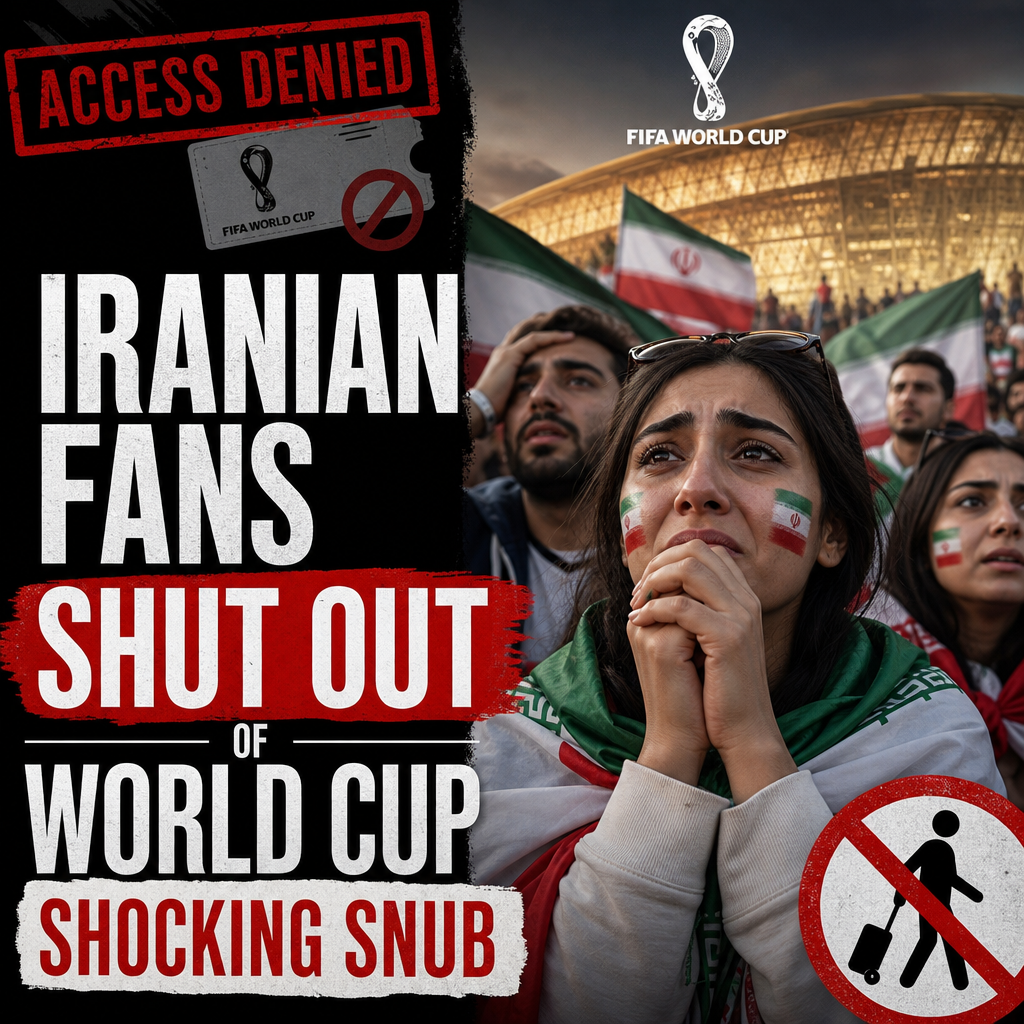
Iranian Fans Shut Out of World Cup: Shocking Snub


Iranian fans shut out of World Cup has become more than a football story; it is now a reminder of how geopolitics can spill into sport in ways that feel unfair to ordinary supporters.
Reports across multiple outlets suggest that Iranian fans have faced serious barriers to buying tickets and traveling to the tournament, with the issue quickly becoming a flashpoint about access, discrimination, and the extent to which international football can really claim to be politically neutral. While the details vary depending on the outlet, the common thread is clear: many Iranian supporters believe they are being excluded for reasons that have little to do with the game itself.



Why Iranian fans were shut out
The main complaint is not simply that tickets are scarce — that is true at most major tournaments — but that some Iranian fans say they were effectively blocked by systems and restrictions that should have been designed to welcome global participation.
RT’s coverage framed the situation as a “snub,” emphasizing the sense of humiliation among fans who expected the World Cup to be a rare chance to support their national team on the world stage. That perspective reflects a wider frustration: for many supporters, football is supposed to transcend political tensions, not become another place where those tensions are felt most sharply.




Al Jazeera’s broader reporting on Iran-related international issues offers important context here. In many of its stories, the network has highlighted how Iranian citizens often experience the consequences of sanctions, diplomatic isolation, and visa complications even when they are not directly involved in political disputes. In that light, the fan backlash is not surprising. When travel becomes difficult and ticketing systems appear opaque, supporters naturally read the situation as part of a bigger pattern of exclusion.
Sky News, meanwhile, tends to approach World Cup stories from a more institutional angle, focusing on the tournament’s organization, security, and logistical constraints. That perspective matters too. Tournament hosts and FIFA often argue that ticket distribution, visa policies, and security screening are based on practical concerns rather than nationality alone. But even if that is the official line, it does not fully resolve the perception problem. If large groups of fans from one country feel singled out, the damage to the tournament’s image is real.
The sporting issue is also a political one
At first glance, this might look like a straightforward administrative failure. But it has a deeper meaning. World Cup access is about more than seat allocation; it is about who gets to be seen, heard, and included in a global event.
For Iranian fans, being unable to attend can feel like a double loss:
– they miss the chance to support their team in person;
– their absence reinforces the idea that global sport is not equally open to everyone.
That is where the story becomes uncomfortable for FIFA and tournament organizers. The governing bodies often speak the language of unity, inclusion, and football without borders. Yet the fan experience frequently tells a different story. When policies, diplomatic relations, and security rules collide, the burden usually falls on ordinary people, not the officials making the decisions.
What the different reports agree on
Despite their different editorial angles, the sources point toward a few broad points of agreement.
First, there is a clear sense of frustration among Iranian supporters. Whether the blockage is described as bureaucratic, political, or technical, the emotional result is the same: fans feel excluded from one of football’s biggest stages.
Second, the controversy reveals how fragile the idea of “neutral” sports administration can be. Even when organizers insist that decisions are based on procedure, those procedures can still have unequal outcomes.
Third, there is no easy fix once public trust has been damaged. If fans believe they are being treated differently because of their nationality, even a later explanation may not be enough to restore confidence.
The missing piece: transparency
The most important unanswered question is whether the restrictions were truly unavoidable or whether better planning could have prevented the problem.
That distinction matters. If ticket allocation and travel access were constrained by genuine capacity and security requirements, organizers should be able to explain that clearly and consistently. If, however, the barriers were the result of political pressure, nationality-based screening, or poor coordination between sports bodies and host authorities, then the criticism becomes much stronger.
This is where the reporting leaves room for uncertainty. None of the coverage suggests a single, universally accepted explanation. Instead, it shows a familiar pattern in international sport: fans are left trying to decode decisions made far above their heads, while institutions speak in cautious language that avoids direct blame.
What this means for football’s image
The wider danger is not just bad publicity for one tournament. It is the erosion of faith in the idea that football belongs to everyone.
If supporters from Iran — or any country facing political tension — believe they can be shut out of the world’s premier sporting event, then the World Cup stops looking like a shared global festival and starts looking like a curated guest list. That is a serious problem for FIFA, which depends on the symbolism of universal participation as much as on the matches themselves.
Still, it would be too simple to turn this into a one-sided outrage story. Host nations do have legitimate security concerns, and international travel rules are rarely designed with football fans alone in mind. The challenge is making those rules transparent, proportional, and fair. When they are not, the result is predictable: anger, suspicion, and a sense that sport is being used to mirror political divisions instead of easing them.
The strongest conclusion, then, is not that one side is entirely right and the other entirely wrong. It is that the episode exposes a real weakness in the way global tournaments are managed. If the World Cup is meant to bring people together, then its organizers must do more than say so. They have to prove it in the way tickets are allocated, visas are handled, and fans are treated.
For Iranian supporters, that proof still appears to be missing.


























