
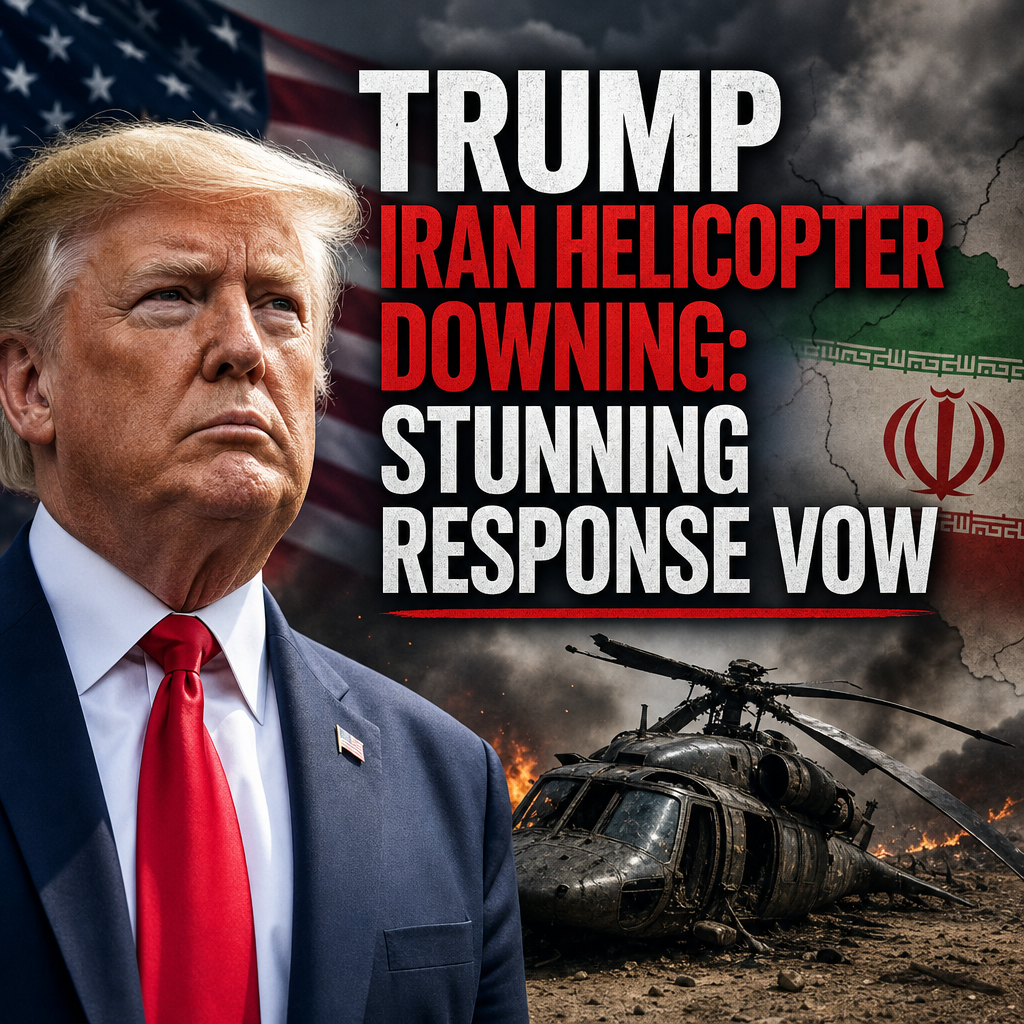
Trump Iran Helicopter Downing: Stunning Response Vow


Trump Iran Helicopter Downing has quickly become another flashpoint in the already volatile Gulf, after Donald Trump claimed that Iran shot down U.S. helicopters near the Strait of Hormuz and vowed a forceful response.
The allegation, if confirmed, would mark a major escalation in a region where air and naval encounters are already routine sources of tension. But the reporting around the incident also shows something important: at this stage, the story is being shaped as much by rhetoric and political signaling as by independently verified facts.



Across coverage from Al Jazeera, Sky News, and RT, the immediate picture is one of uncertainty, heightened military risk, and competing narratives. What stands out is not just the claim itself, but how quickly it has been folded into broader arguments about U.S.-Iran relations, deterrence, and the dangers of miscalculation.
What Trump’s claim means in the wider Gulf standoff
The center of the story is Trump’s assertion that Iranian forces downed American helicopters over the Strait of Hormuz, one of the world’s most strategically sensitive waterways. That location matters. The strait is the chokepoint for a significant share of global oil shipments, and any reported attack there instantly raises concerns far beyond the immediate military incident.




Al Jazeera’s reporting places the claim within a long-running cycle of confrontation between Washington and Tehran. In that framing, the danger is not only whether the helicopters were hit, but whether each side interprets the incident as proof that the other is willing to widen the conflict. Trump’s vow to respond adds another layer: even a limited military exchange can become politically and strategically harder to contain once a public threat has been made.
Sky News’ broader style of coverage on U.S.-Iran tensions has tended to emphasize the international consequences of such events. From that angle, the key issue is escalation management. A strong retaliatory statement may play well with domestic audiences or allies who favor firmness, but it also risks narrowing diplomatic options before the facts are fully established.
RT, by contrast, often presents these confrontations through a lens of skepticism toward U.S. policy and Western military posture. In that kind of framing, the allegation can be read as part of a familiar pattern: Washington announces a threat, Tehran rejects blame or offers a conflicting account, and the region becomes more dangerous because of unresolved claims rather than verified outcomes.
That divergence in framing matters. It shows why readers should be cautious about accepting any single version too quickly, especially when the stakes are as high as they are here.
Why verification matters before retaliation
There are several reasons this story should be handled carefully:
– The claim involves military action in a congested and sensitive area.
– Public statements may be designed to pressure opponents before evidence is shared.
– Different outlets may emphasize different details depending on political perspective.
– Retaliatory rhetoric can move faster than official confirmation.
In other words, the immediate political reaction may tell us as much as the incident itself. When a leader says he will “respond” before the full picture is clear, that statement can become part of the event. It may deter adversaries, but it can also lock both sides into positions that are difficult to reverse.
Trump Iran Helicopter Downing and the problem of competing narratives
The most revealing aspect of Trump Iran Helicopter Downing is the gap between claim and confirmation. That gap is where modern crisis politics often lives. An accusation, especially one involving national security, can travel globally before military investigators, intelligence officials, or independent observers have established what happened.
That does not mean the claim is false. It does mean the audience should be alert to the possibility of incomplete information. In the Middle East, incidents near the Strait of Hormuz frequently involve overlapping patrols, surveillance flights, naval escorts, and electronic monitoring. Even when an event is real, the interpretation of who acted first and why can remain contested for days or longer.
This is where the reporting landscape becomes especially important. Al Jazeera’s coverage tends to foreground regional context and the consequences for civilians and shipping routes. Sky News often centers the implications for Western policy and security. RT usually questions the rationale behind U.S. escalation and may highlight contradictions in Washington’s messaging. Taken together, the three perspectives suggest there is no simple, settled interpretation yet.
And that is the most responsible conclusion available right now: there is a serious allegation, a sharp warning from Trump, and a regional environment that could deteriorate quickly if either side misreads the other’s intentions.
The bigger risk is escalation, not just the incident itself
Even if the helicopters were damaged or shot down, the larger concern is what comes next. History shows that in tense maritime and aerial environments, the first casualty is often clarity. The second is restraint.
A measured response would require several things at once:
– independent verification of what occurred;
– communication channels to prevent accidental escalation;
– restraint in public messaging from both sides;
– and a willingness to separate evidence from political theater.
That last point may be the hardest. In Washington, a forceful response can signal strength. In Tehran, defiance can serve domestic legitimacy. But when both sides speak to their supporters first, the space for de-escalation shrinks.
The most balanced reading of the available reporting is therefore straightforward: Trump’s claim has raised the temperature significantly, but the full truth of the incident remains unclear. Until more evidence is publicly available, the smartest response is caution, not certainty. The real story is not only whether helicopters were downed, but whether political leaders can prevent a disputed incident from becoming a wider confrontation in one of the world’s most dangerous maritime corridors.


























