
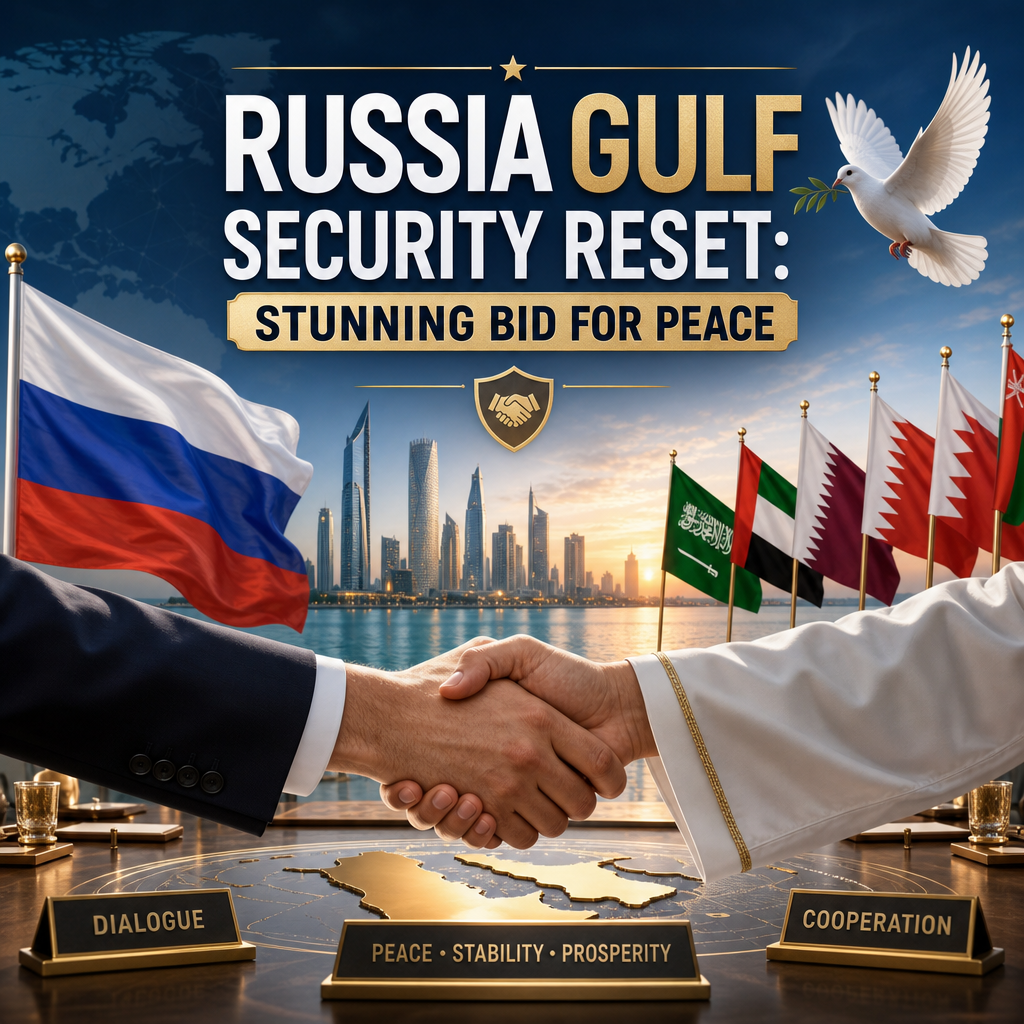
Russia Gulf Security Reset: Stunning Bid for Peace


Russia Gulf Security Reset is emerging as one of the more intriguing diplomatic ideas in a region that has spent years balancing rivalry, war, and uneasy coexistence. The concept, as presented in recent reporting and commentary across international outlets, suggests that Moscow is trying to position itself not just as a disruptor in Middle Eastern politics, but as a potential architect of a new security conversation involving Gulf states, Iran, and possibly wider regional actors. Whether that effort becomes a meaningful peace track or remains a symbolic gesture depends on who is willing to trust whom—and how much leverage Russia still has to offer.
Russia Gulf Security Reset and the Politics of Trust
At the center of the proposal is a simple but difficult question: can a new regional security structure be built in a place where most players still hedge against each other? Russia’s pitch appears to rest on the idea that the Gulf does not need another externally imposed framework, but rather a more inclusive architecture that reduces confrontation and gives regional states more say over their own security.



That argument will appeal to some governments. Gulf states have spent the past decade diversifying their foreign policy, strengthening ties with the U.S. while also engaging China, Russia, Iran, and regional rivals as part of a pragmatic “all options open” strategy. This is especially true after years of conflict spillover from Yemen, Syria, and tensions in the Strait of Hormuz. A diplomatic reset sounds attractive in that context, even if no one expects overnight breakthroughs.
But the proposal also runs into a credibility problem. Russia presents itself as a broker of stability, yet its own war in Ukraine has sharpened Western distrust and made many governments wary of Moscow’s motives. Even when Russia speaks the language of peace, critics see strategic messaging: a way to remind the world that it remains relevant in the Middle East and can still influence the agenda. Al Jazeera’s regional coverage often reflects this broader reality—that Gulf diplomacy is driven less by ideology than by survival, trade, and strategic flexibility. In that sense, Russia’s outreach fits the region’s habit of engagement without full alignment.




Why Gulf states may listen, even if they do not commit
The most important reason Gulf capitals may not dismiss the idea outright is that they are already living in a multipolar security environment. They know the old model—relying almost exclusively on U.S. protection—has become less predictable. U.S. policy shifts, domestic political pressure in Washington, and the lingering memory of regional interventions have all pushed Gulf leaders to widen their options.
A Russia-backed reset could therefore serve several practical purposes:
– It offers a platform for dialogue without forcing immediate alignment.
– It signals that regional security is not solely a Western-managed file.
– It may create room for de-escalation among rivals who rarely speak directly.
– It gives Gulf states more bargaining power with Washington and Tehran alike.
Still, listening is not the same as endorsing. Sky News reporting on Middle Eastern security trends has frequently shown that states in the region are careful not to overpromise on diplomacy when battlefield realities remain unstable. That caution matters here. Even if Gulf officials are willing to explore new channels, they are unlikely to embrace a plan that looks like a substitute for hard security guarantees, missile defense, or credible deterrence.
What the regional picture really suggests
The broader picture from diverse news sources points to a mixed reality. On one hand, there is a clear appetite for de-escalation. The wars in Gaza, Yemen’s long conflict, tensions involving Iran, and the risk of maritime disruption have all made regional governments more interested in practical stability than in abstract geopolitical posturing. On the other hand, the distrust between key players remains too deep for a quick reset to succeed.
That is why the phrase “stunning bid for peace” may be more dramatic than the situation itself. Russia may be floating an idea that has diplomatic value, but peace in the Gulf cannot be manufactured by announcement alone. A meaningful security reset would need:
1. Agreement on basic rules of conduct at sea and in airspace.
2. Channels for crisis communication between rivals.
3. Some mechanism for dealing with proxy conflicts.
4. A minimum level of confidence that commitments will be kept.
Right now, those conditions are only partly in place.
The limits of Moscow’s role
Russia’s biggest asset is not necessarily trust, but access. It can speak to actors who do not always speak to each other. That gives it diplomatic utility. Yet access has limits when the messenger is also seen as self-interested, especially after years of strained relations with the West and a global atmosphere in which every geopolitical move is interpreted through the lens of power competition.
That does not mean the initiative should be dismissed. In fact, the most realistic reading is that Russia is testing the boundaries of what kind of diplomacy the Gulf might tolerate in a fractured world. If the proposal helps stimulate dialogue, it could still matter. If it becomes a substitute for substantive regional negotiation, it will likely fade into the long list of ambitious but underdeveloped peace ideas.
The honest conclusion is that a Russia-backed Gulf security reset is neither a breakthrough nor a fantasy. It is a signal—one that reveals how hungry the region is for stability, and how hard it remains to build it. The Gulf may be open to new conversations, but it will judge them by results, not rhetoric.

























