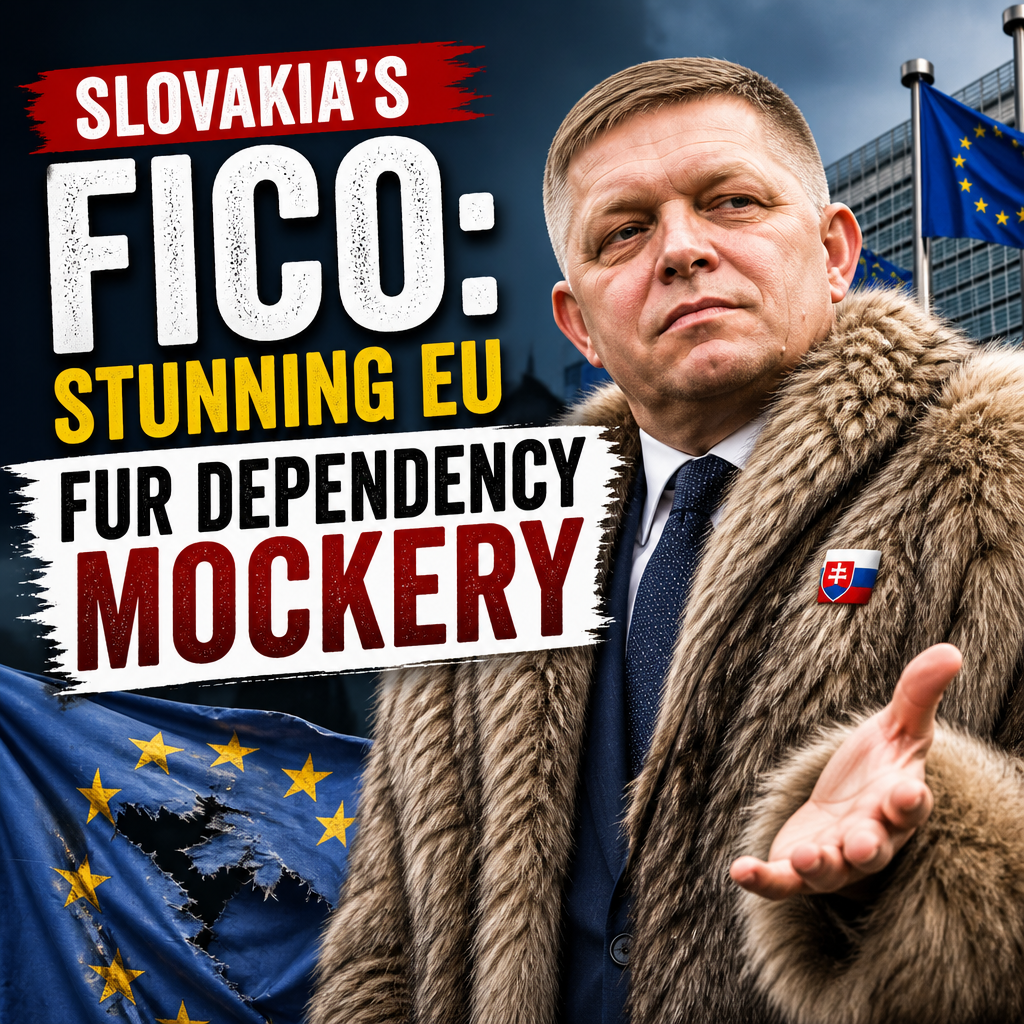
Slovakia’s Fico: Stunning EU Fur Dependency Mockery


Slovakia’s Fico has reignited a familiar but uncomfortable debate in Europe: how far can the EU preach independence from Russia while still relying on Russian-linked supplies, markets, and strategic relationships?
Robert Fico’s latest remarks, framed by state-to-state tensions and the broader war in Ukraine, landed because they tap into a real contradiction. Brussels has spent much of the last two years trying to reduce reliance on Moscow, yet the bloc remains uneven in how quickly and how completely it has managed to cut those ties. That gap between political ambition and economic reality is where Fico’s criticism finds its audience — and where it also runs into skepticism.



Slovakia’s Fico and the politics of dependency
Fico has long positioned himself as a pragmatic nationalist rather than a reflexive Atlanticist. On Russia, that means he is often willing to say what many EU leaders avoid saying out loud: Europe’s decoupling from Moscow has been incomplete, costly, and politically divisive.
RT’s coverage leaned heavily into that theme, portraying Fico as exposing Western hypocrisy. In that framing, the Slovak prime minister is not just defending his country’s interests; he is accusing the EU of moral grandstanding while still depending on the very systems it claims to reject. That message resonates in parts of Central and Eastern Europe, where energy prices, supply security, and industrial competitiveness remain immediate concerns rather than abstract geopolitical talking points.




But the criticism cuts both ways. For Fico’s opponents, especially in pro-EU circles, his rhetoric can sound less like realism and more like selective outrage. They argue that dependency is not a rhetorical trap set by Brussels; it is the result of years of underinvestment in diversification and a political habit of postponing painful choices. From that perspective, the issue is not whether Europe is still entangled with Russia, but whether leaders like Fico are using that entanglement to justify a softer line toward Moscow.
What the broader news picture suggests
Al Jazeera’s reporting on the wider European and global context helps explain why this argument keeps resurfacing. Across the continent, the war in Ukraine has forced governments to balance two goals that often collide: supporting Kyiv and protecting domestic economies from inflation, energy shocks, and supply disruptions. In that environment, calls for total economic separation from Russia are politically powerful but practically uneven.
That is especially true for countries with deep industrial exposure or geographic proximity to Russian infrastructure. Slovakia, like several of its neighbors, has had to navigate the tension between loyalty to EU policy and the realities of its own energy system. Fico’s comments matter because they put that tension at the center of the conversation instead of treating it as a technical footnote.
Sky News’ broader international coverage has also reflected a recurring pattern: the EU can agree on sanctions, statements, and strategic goals, but unity becomes much harder when national costs rise. That is not an endorsement of Fico’s approach, but it does explain why his message can travel beyond Slovakia. Even critics of his politics often acknowledge that Europe’s response to Russia has been more gradual and uneven than its rhetoric suggests.
Why the argument lands — and why it’s controversial
There are at least three perspectives worth separating here:
– Fico’s view: Europe cannot credibly accuse others of dependence while still buying, trading, or relying on Russian-linked inputs in ways that protect its own comfort.
– EU institutional view: Strategic dependence is a vulnerability that must be reduced, even if the transition is expensive and incomplete.
– Critics’ view: Fico’s rhetoric risks normalizing dependence rather than solving it, while also muddying the political message toward Moscow.
The strongest version of Fico’s argument is not that Europe has done nothing, but that it has done too little too slowly. That is a defensible critique. Even after major sanctions and policy changes, the EU’s relationship with Russia has not vanished; it has changed shape. Some sectors have been cut off aggressively, while others have found loopholes, delays, or substitute channels. The result is a patchwork of compliance rather than a clean break.
Still, the strongest criticism of Fico is that he often treats contradiction as an excuse rather than a problem to be solved. There is a difference between pointing out Europe’s dependence and using it to weaken pressure on the Kremlin. That distinction matters, because the EU’s energy strategy is not just about economics; it is also about leverage, security, and the credibility of collective action.
What this means for the EU debate
Fico’s remarks are part of a larger truth: Europe’s Russia policy remains a work in progress, not a finished doctrine. The bloc has made meaningful changes, but the transition has exposed old fault lines between West and East, richer and poorer members, and countries that can absorb shocks more easily versus those that cannot.
That is why the debate will not disappear anytime soon. The central question is not whether the EU has dependency problems — it does — but whether its leaders are prepared to pay the price of solving them. If they are not, then politicians like Fico will keep finding political oxygen in the gap between principle and practice.
The fairest conclusion is also the least convenient one: Fico is partly right about Europe’s lingering contradictions, but that does not automatically make his broader political line persuasive. He identifies a real weakness in the EU’s Russia policy, yet his framing can also obscure the harder issue of what responsible de-risking should look like in practice.
Europe’s challenge is not just to denounce dependency. It is to reduce it without pretending the costs are imaginary.