
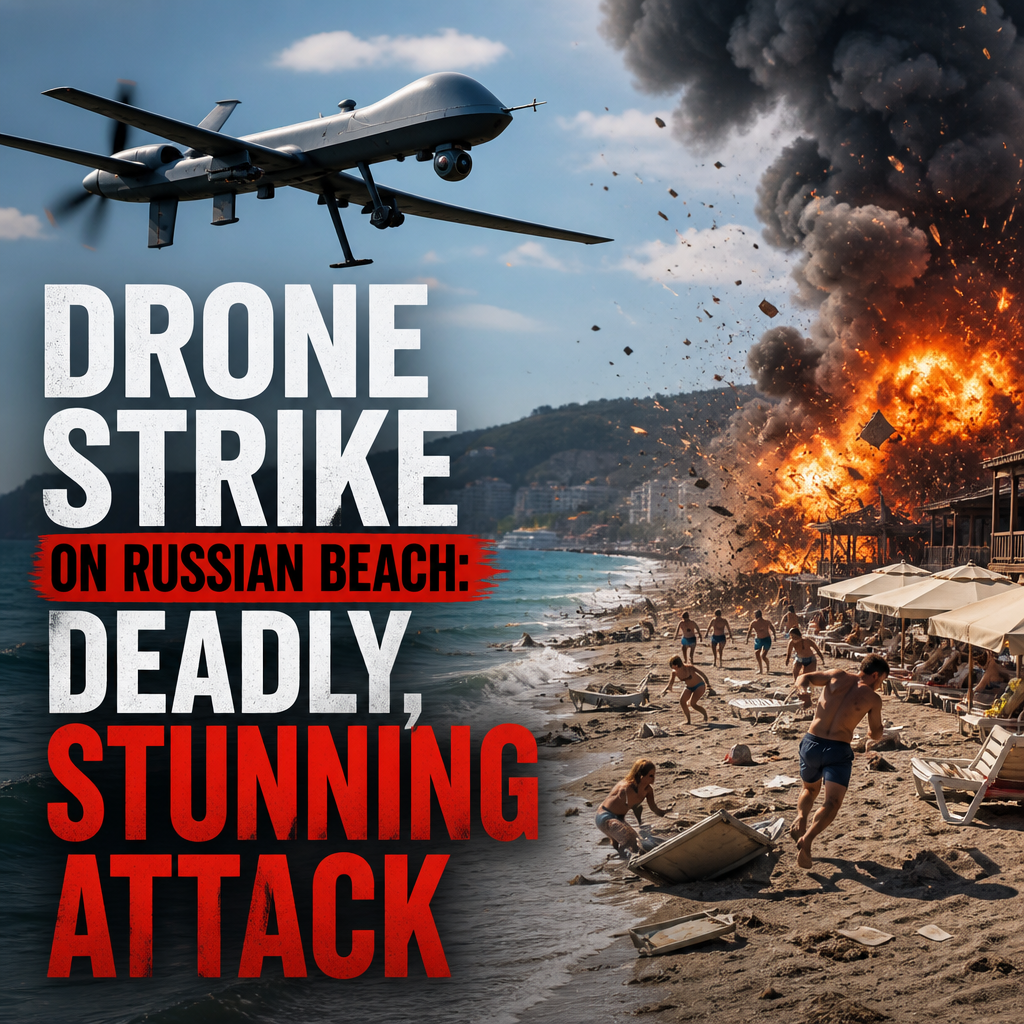
Drone Strike on Russian Beach: Deadly, Stunning Attack


Drone strike on a Russian beach has added a grim new image to the war: a leisure spot turned into a scene of panic, smoke and loss. Reports from multiple outlets say the attack killed at least seven people, underscoring how the conflict continues to spill beyond front lines and into places that once seemed far removed from the battlefield.
What makes this incident so striking is not only the casualty count, but the symbolism. Beaches are usually associated with summer, family time and civilian life. When a drone hits that kind of setting, the shock travels well beyond the immediate victims. It raises difficult questions about military tactics, civilian vulnerability and how far the war’s geography has expanded.



Drone strike on Russian beach: what the reports agree on
Across the coverage, there is broad agreement on the basic outline: a drone struck a beach area in Russia, several people were killed, and others were injured. The scene was described as sudden and chaotic, with emergency crews responding after the blast.
There is also a shared sense that the attack fits a wider pattern of intensifying drone warfare. Drones have become one of the defining weapons of the Russia-Ukraine conflict because they are relatively cheap, hard to detect and politically potent. They can damage military targets, but they can also create fear precisely because they are difficult to predict.




A few facts appear especially important:
– The attack caused civilian deaths, not just damage to infrastructure.
– It took place in a highly visible public setting.
– It was part of an escalating campaign that both sides increasingly use to pressure the other.
Even so, the details matter and remain contested in some reporting. The exact location, the intended target and the chain of responsibility are not always presented the same way across outlets. That uncertainty is itself part of the story, because modern conflicts often generate competing narratives within minutes of an incident.
How different outlets framed the attack
Al Jazeera’s reporting emphasized the human cost and the shock value of the strike. That framing reflects a common concern in international coverage: when a drone hits civilians, the immediate question is not only who launched it, but what the attack means for the broader conduct of the war. Was this a deliberate strike on a civilian area, a missed military target, or an attack whose consequences were accepted despite the risk to bystanders? The available reporting does not fully settle that.
RT, by contrast, is likely to present the event through a Russian security lens, focusing on the threat posed by Ukrainian drones, the vulnerability of Russian territory, and the need for stronger air defenses or retaliation. In that framing, the incident becomes evidence of external aggression rather than a stand-alone tragedy. That perspective is important because it shows how Russian audiences are encouraged to see such strikes: not merely as isolated attacks, but as part of a wider campaign against the country.
Sky News generally approaches these episodes with an emphasis on verification, impact and the broader military context. Western coverage often highlights both the civilian toll and the possibility that such attacks are intended to send a message rather than achieve a large-scale battlefield gain. That can make the reporting feel more cautious, but it also helps avoid jumping too quickly to conclusions when battlefield claims are still being checked.
Taken together, these perspectives show a familiar pattern in war reporting: one side stresses victimhood and defense, another stresses damage and escalation, while international outlets try to navigate between them.
Why this attack matters beyond the headlines
The deeper issue is not just that a beach was hit. It is that the war is increasingly crossing boundaries that once offered civilians a sense of distance from the conflict. When drones can reach places associated with daily life, the psychological effect can be as significant as the physical damage.
That matters for at least three reasons:
1. Civilian exposure is growing
Drone warfare often gets described in technical terms, but its consequences are deeply human. People are not just hearing about the war; they are encountering it in public spaces. That changes behavior, affects morale and increases fear in ways that cannot be measured only by casualty figures.
2. Escalation becomes easier to justify
Each strike creates a new argument for retaliation. Russian officials are likely to use the attack to justify stronger air defense measures or harsher military responses. Ukraine, if linked to the attack, may view it as part of pressure on Russian territory. Once both sides begin citing civilian damage as proof of the other’s brutality, the cycle of escalation gets harder to stop.
3. Messaging can outweigh military value
A beach strike may have limited strategic value in conventional terms, but it has enormous symbolic power. It signals reach, vulnerability and unpredictability. In conflicts like this, symbolism can be almost as important as battlefield gains because it shapes public opinion at home and abroad.
A difficult picture with no easy conclusion
The most responsible reading of this attack is that it reflects the increasingly blurred line between military and civilian space in the Russia-Ukraine war. The death toll makes the incident tragic regardless of intent, and the competing narratives around it are exactly what one would expect in a highly politicized conflict.
What cannot be said confidently, based on the reporting alone, is whether the strike was aimed at a military objective nearby, whether the location was chosen deliberately for its symbolic impact, or whether it represents a new phase in drone strategy. Those answers may emerge later, or they may remain disputed.
What is clear is this: the war is becoming more dangerous for ordinary people in places that once seemed far from the front. A beach strike is not just another military event. It is a reminder that in modern warfare, nowhere feels entirely safe for long.