Iran Uncertainty: Stunning Best Guide to Trump’s Shift


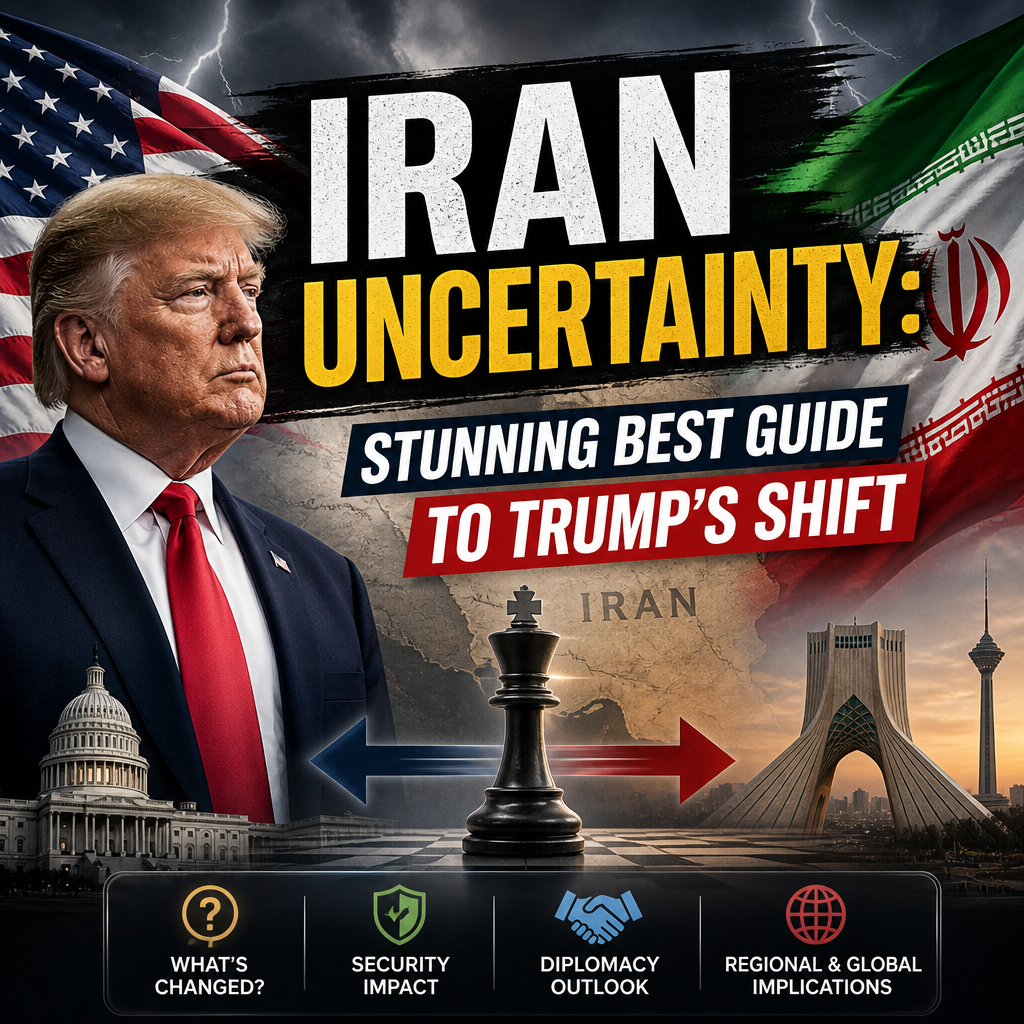
Iran uncertainty has become a defining feature of the latest political moment, as Donald Trump’s shifting language on war, diplomacy, and pressure on Tehran leaves observers trying to read signals that are anything but clear. Across international coverage, the same pattern keeps emerging: one day the rhetoric sounds like escalation, the next it sounds like room for a deal, and the result is a climate of hesitation that affects markets, regional leaders, and especially ordinary Iranians trying to understand what comes next.
At the center of the debate is a simple but consequential question: is Trump preparing to confront Iran more directly, or is he using the threat of force to extract concessions? The answer appears to depend on which statement, interview, or diplomatic whisper is being emphasized at a given moment. That inconsistency matters because policy ambiguity is not just a communications problem. In the Middle East, where miscalculation can move quickly from rhetoric to real-world consequences, uncertainty itself becomes a strategic force.



Iran uncertainty and Trump’s mixed signals
Trump’s approach to Iran has long blended pressure and unpredictability. Supporters of a tougher line see that as leverage. From their perspective, speaking forcefully while keeping military options on the table can push adversaries back to negotiations under less favorable terms. That logic has appealed to audiences that want deterrence without committing to a full-scale conflict.
But critics argue that constant fluctuation weakens the credibility of U.S. policy. If Tehran cannot tell whether Washington wants escalation or compromise, then neither side has a stable basis for negotiation. And if allies in the region cannot tell where the U.S. stands, they may hedge more aggressively on their own, which can deepen instability.




That tension is reflected in how different outlets frame the issue. Al Jazeera’s coverage tends to emphasize the human and regional uncertainty created by the back-and-forth. Sky News typically focuses more on the diplomatic and security implications, especially how Washington’s posture affects alliances and the risk of a wider conflict. RT, by contrast, often highlights the geopolitical rivalry angle, portraying U.S. policy as part of a broader contest in which sanctions, military signaling, and diplomacy are tools of influence rather than solutions in themselves. Taken together, these perspectives reveal a shared reality even when the framing differs: no one is entirely sure what the next move is.
Why the uncertainty matters on the ground
For Iranians, this is not an abstract debate about strategy. It affects expectations about sanctions, currency stability, travel, business planning, and security. When officials in Washington send mixed messages, people living under economic pressure tend to absorb that uncertainty first.
A few broad consequences stand out:
– Economic anxiety: Any hint of conflict can rattle already fragile markets and discourage investment.
– Diplomatic caution: Governments in the region may slow their own outreach until the U.S. position becomes clearer.
– Public fatigue: Years of confrontation have made many Iranians skeptical that sudden hardline rhetoric will lead to anything constructive.
– Risk of misreading: Ambiguous signals can be interpreted as weakness, bluff, or imminent action, depending on the audience.
This is why the issue cannot be reduced to whether Trump is “for” or “against” war. The more important question is whether his approach creates predictable incentives. A negotiation strategy works best when the other side can distinguish between a genuine opening and a tactical threat. If every statement seems reversible, then even serious diplomacy can look like theater.
What the major viewpoints agree on
Despite their differences, the sources broadly converge on one point: uncertainty is now part of the story itself. Whether the discussion is framed around diplomacy, deterrence, or regional power politics, the underlying problem is the same. No actor involved can confidently assume the next phase will follow a clear script.
There is also a shared recognition that the stakes are wider than U.S.-Iran relations alone. Gulf states, European governments, and non-state actors all watch Washington’s posture closely because it shapes everything from shipping security to nuclear diplomacy. A dramatic shift in tone from the White House can echo far beyond the bilateral file.
At the same time, it would be too neat to say the only issue is Trump’s inconsistency. Iran’s own calculations matter too. Tehran has its own reasons to project resilience, avoid appearing weak, and keep its options open. That means each side is reading the other through a prism of suspicion. In such an environment, even a small change in rhetoric can have outsized effects.
A fair reading of Trump’s shift
The most balanced interpretation is that Trump’s stance is intentionally flexible but not fully defined. That flexibility may be politically useful, especially in the short term. It allows him to appeal to hawks without closing the door to a negotiated outcome. It also gives him room to adjust to events without being boxed into a single public position.
But there is a cost. When the world sees a policy as oscillating between threats and talks, the credibility of both options can suffer. Diplomacy looks less reliable, and deterrence looks less certain. For Iran, that can encourage caution, nationalism, or defiance. For the U.S. and its allies, it can complicate long-term planning.
In practical terms, the smartest reading is neither panic nor reassurance. The situation suggests real danger, but not inevitability. It suggests pressure, but not a fixed endpoint. And it suggests that the most important thing to watch is not just what Trump says, but whether his administration’s words begin to form a consistent pattern.
For now, that pattern remains elusive. And as long as it does, Iran uncertainty will continue to shape how both sides think, talk, and prepare.