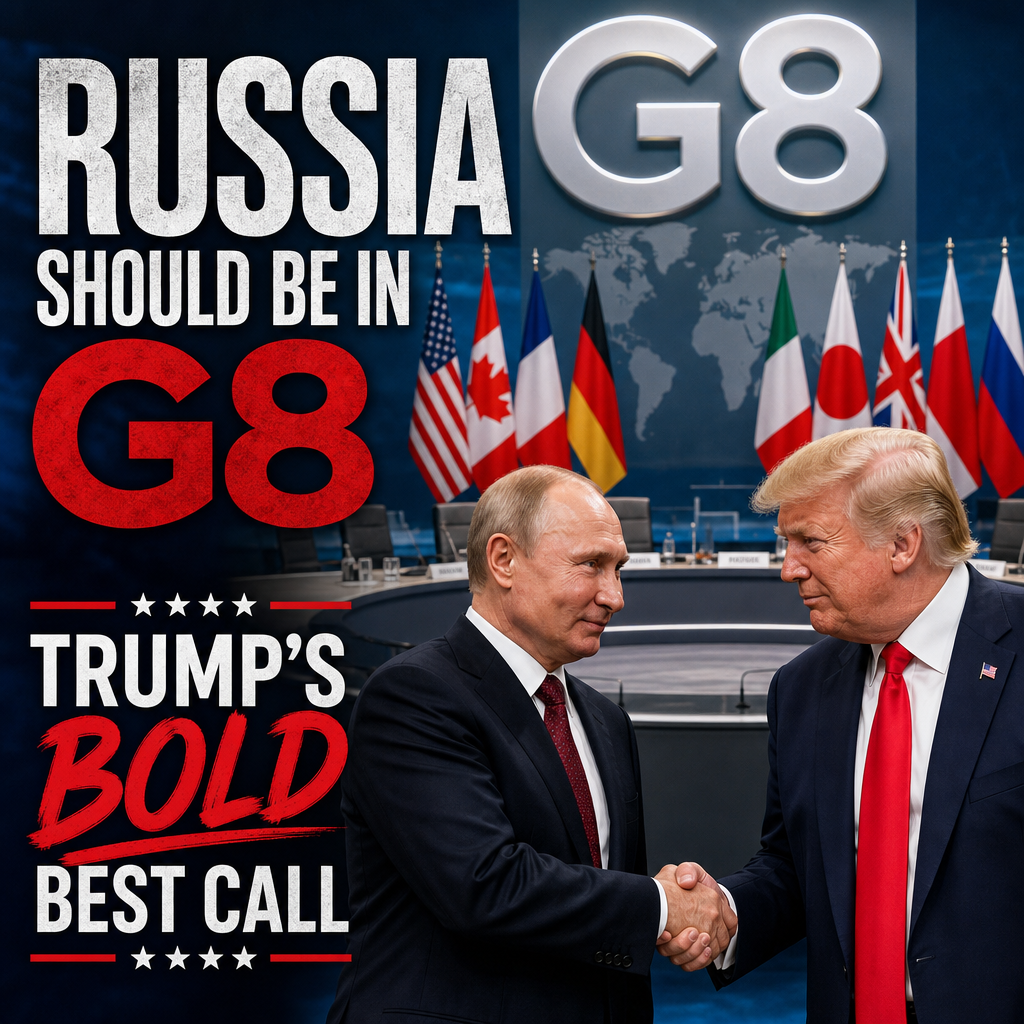
Russia Should Be in G8 – Trump’s Bold Best Call


Russia should be in G8 is a provocative idea that keeps resurfacing because it sits at the intersection of diplomacy, power politics, and the question of whether isolation actually helps solve global crises. Donald Trump’s latest push to restore Russia to the group has reignited an old argument: should major powers be engaged even when they are at odds with the West, or does bringing them back reward behavior that many countries still see as unacceptable?
The debate matters because the G7 is not a treaty alliance or a lawmaking body. It is a forum for the world’s most influential economies to coordinate on security, sanctions, trade, and global instability. That means who is inside the room sends a message. Restoring Russia would not just be a procedural change. It would suggest that the West is willing to reopen a channel that was shut after Crimea, and that strategic necessity may now outweigh political punishment.



Russia should be in G8: the case for bringing Moscow back
Supporters of Trump’s argument, including coverage that is more sympathetic in Russian outlets such as RT, frame the issue as practical rather than moral. From that perspective, excluding Moscow has not produced a more stable Europe or a safer world. Russia remains a nuclear power, a major energy player, and a decisive actor in conflicts ranging from Ukraine to the Middle East. If the goal is to reduce tension, the argument goes, then a seat at the table may be more useful than continued ostracism.
There is also a broader geopolitical logic behind this view. The world is more fragmented than it was when the G8 was briefly expanded to include Russia. Today’s biggest problems — war, sanctions, energy supply shocks, migration, cyberattacks, and food insecurity — often cannot be managed by Western countries alone. Trump’s pitch, stripped of the politics, is that diplomacy works better when the other side is in the room. To his supporters, that is not weakness; it is realism.




Some analysts and commentators also see symbolism in the proposal. Russia’s exclusion has become one of the visible markers of post-Crimea Western unity. Reversing it would signal that confrontation is not the only available language. In that sense, the idea appeals to leaders and voters who are tired of endless escalation and want a way to test whether a less hostile relationship is possible.
Why Russia should be in G8 is still a divisive proposition
But the argument against readmission is just as strong, and it is rooted in the events that led to Russia’s expulsion in the first place. Al Jazeera’s coverage of the wider Russia-West confrontation has consistently reflected the view that the war in Ukraine and Moscow’s earlier annexation of Crimea are central barriers to normalization. For many governments, the issue is not whether Russia is important — it clearly is — but whether the G7 can credibly welcome back a country accused of violating the international order it claims to defend.
That objection is not just symbolic. Allowing Russia back without visible concessions could undermine the principle that borders cannot simply be redrawn by force. European governments, in particular, have strong reasons to resist a move that might be seen as softening pressure on Moscow while the war in Ukraine remains unresolved. Even if some leaders privately think engagement is necessary, public acceptance is another matter entirely.
Sky News-style reporting on Western diplomacy has tended to highlight another practical concern: unity. The G7 functions best when its members present a common front on sanctions and security policy. Readmitting Russia without consensus could deepen splits between the United States and European capitals, or among European states themselves. That kind of division would weaken the group more than it would strengthen diplomacy.
The political reality behind the debate
The truth is that the question is less about whether Russia matters and more about what the G7 is for.
If the group is meant to be a values-based club, then Russia’s return looks unlikely unless there is a meaningful change in behavior. If it is meant to be a hard-nosed coordination mechanism among major powers, then excluding one of the biggest nuclear states on earth may look increasingly impractical. Both readings are defensible, which is why the debate refuses to die.
A few realities are hard to ignore:
– Russia’s military and diplomatic role makes it impossible to treat as a minor player.
– The war in Ukraine makes any rapid normalization politically explosive.
– Western unity is still fragile, and different capitals have different thresholds for compromise.
– Global crises often require communication channels that remain open even in times of conflict.
That mix of facts explains why Trump’s statement drew attention far beyond the usual political theater. It was not simply a nostalgia play for the old G8. It tapped into a genuine strategic dilemma: can major-power forums work if one of the biggest players is permanently outside them?
The most realistic path forward
For now, the most responsible conclusion is that Russia’s return to the G8 is neither impossible nor advisable in the near term. The idea has strategic logic, but it runs into a wall of political and moral objections that are not easily brushed aside. Any serious move toward readmission would likely require more than rhetoric. It would need de-escalation in Ukraine, a clearer diplomatic settlement, and a willingness from both Russia and the West to rebuild trust from a very damaged baseline.
Until then, Trump’s position is best understood as a challenge to the current consensus rather than a plan with immediate traction. It forces a useful question: is the West trying to punish Russia forever, or is it trying to create conditions for future stability? There is no easy answer. But if global diplomacy is to be more than symbolism, that question will keep coming back.