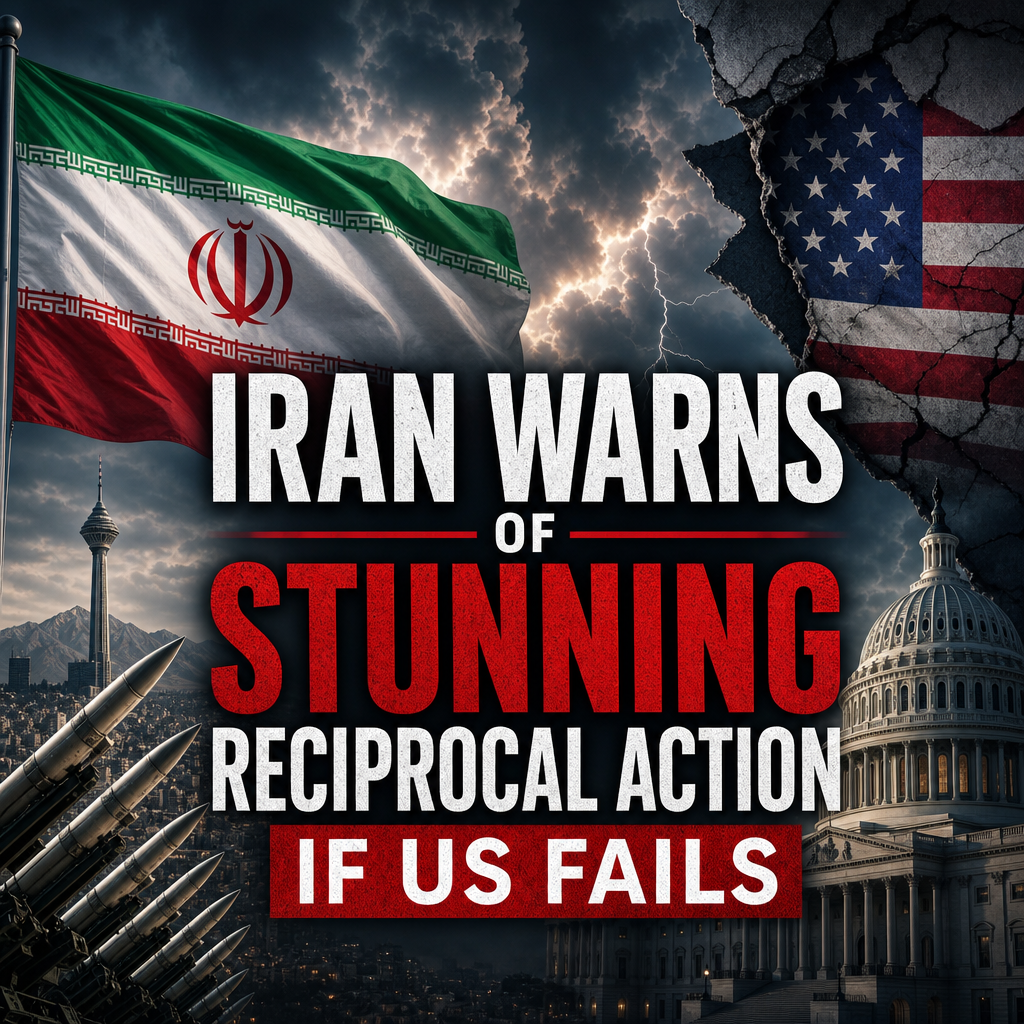
Iran Warns of Stunning Reciprocal Action if US Fails


Iran warns of reciprocal action at a moment when tensions between Tehran and Washington are already running high, and the warning lands as much as a political message as a diplomatic one. The core of the dispute is familiar: Iran says the United States must honor its commitments, while Western coverage frames the issue through the lens of escalation risk, credibility, and the broader instability that could follow if talks or understandings break down.
Iran warns of reciprocal action: what the warning is really signaling
In reporting from international outlets, the language coming out of Tehran suggests a two-track strategy. On one hand, Iranian officials are signaling that they still expect commitments made in any memorandum of understanding or related arrangement to be respected. On the other, they are warning that if those commitments are not met, Iran says it will respond in kind.



That kind of language matters because it is intentionally ambiguous. “Reciprocal action” can mean different things depending on the audience: diplomatic pressure, a reduction in cooperation, or a more assertive move in regional politics. The lack of detail is itself part of the message. Iran is not only complaining about non-compliance; it is also preserving room to act without telegraphing the exact response.
Across the coverage available from Al Jazeera, Sky News, and RT, one clear point emerges: everyone agrees the situation is fragile. Where they differ is in emphasis.




– Al Jazeera’s framing tends to place the warning within the wider context of Iranian frustration over agreements that are seen as unevenly honored.
– Sky News typically highlights the potential security implications for the region and the diplomatic pressure on Washington and its allies.
– RT often presents such developments as evidence of U.S. unreliability or Western double standards, reinforcing a narrative that American commitments are politically conditional.
Taken together, these viewpoints suggest that the dispute is not only about one document or one commitment. It is about trust, and trust is scarce.
Why the warning matters beyond the headline
What makes this episode significant is not just the possibility of retaliation, but the broader signal it sends to other actors in the region. Iran’s allies and adversaries alike are watching to see whether Tehran is preparing a symbolic protest or a more substantive response. Even a limited move could affect negotiations, shipping routes, regional calculations, or the already tense balance between deterrence and provocation.
Western governments are likely to see the warning through a risk-management lens. If Iran believes the U.S. has failed to uphold its side of an agreement, American officials will face pressure to show that the relationship still has guardrails. That could mean direct diplomacy, public reassurances, or quiet mediation through intermediaries.
Iran, however, may view escalation as leverage rather than a goal. In that reading, the warning is meant to force attention. Tehran is essentially saying that non-compliance has consequences, and that those consequences will not be one-sided.
The political logic on both sides
There is a reason these standoffs keep recurring. Each side believes it is reacting defensively.
For Iran:
– Pressure is often interpreted as proof that agreements are reversible.
– Public warnings help project strength domestically.
– Reciprocity can be used to deter future violations.
For the United States:
– Any concession can be seen as rewarding coercive behavior.
– Officials must balance diplomacy with domestic political scrutiny.
– Hard language may be intended to discourage further brinkmanship.
That dynamic creates a familiar trap. The more each side talks in terms of principle and obligation, the harder it becomes to step back without appearing weak.
The bigger challenge: credibility in a crisis-prone relationship
If there is one lesson from the current moment, it is that the U.S.-Iran relationship remains highly vulnerable to mistrust. Agreements, memoranda, and understandings can exist on paper, but their value depends on how both sides interpret compliance. Once one side believes the other is acting in bad faith, even partial cooperation becomes difficult.
That is why the absence of clear public details should not be dismissed as unimportant. Ambiguity can be strategic, but it also increases the risk of miscalculation. If Iran’s warning is more than rhetorical, the region could see a chain reaction: an initial response, a counter-response, and then a scramble by third parties to stop the situation from spiraling.
At the same time, it would be premature to assume inevitable escalation. These warnings often serve as bargaining tools. They can be designed to push the other side back toward engagement rather than away from it.
What to watch next
The next few signals will matter more than the warning itself:
– Whether Iranian officials specify what “reciprocal action” would look like
– Whether U.S. officials publicly reject the premise or try to cool the situation
– Whether intermediaries step in to prevent the dispute from widening
– Whether any practical cooperation continues behind the scenes despite the rhetoric
The most responsible reading is neither alarmist nor dismissive. Iran’s warning is serious because it reflects a real grievance and a willingness to act if it feels cornered. But it is also part of a long-running pattern in which both Tehran and Washington use pressure as a negotiating tool.
For now, the main takeaway is that the dispute is still open-ended. There is no clear evidence yet of an immediate break, but there is also no sign that the underlying distrust has been resolved. In that sense, the warning is less a final move than a reminder: in this relationship, the space between diplomacy and confrontation is often uncomfortably thin.