
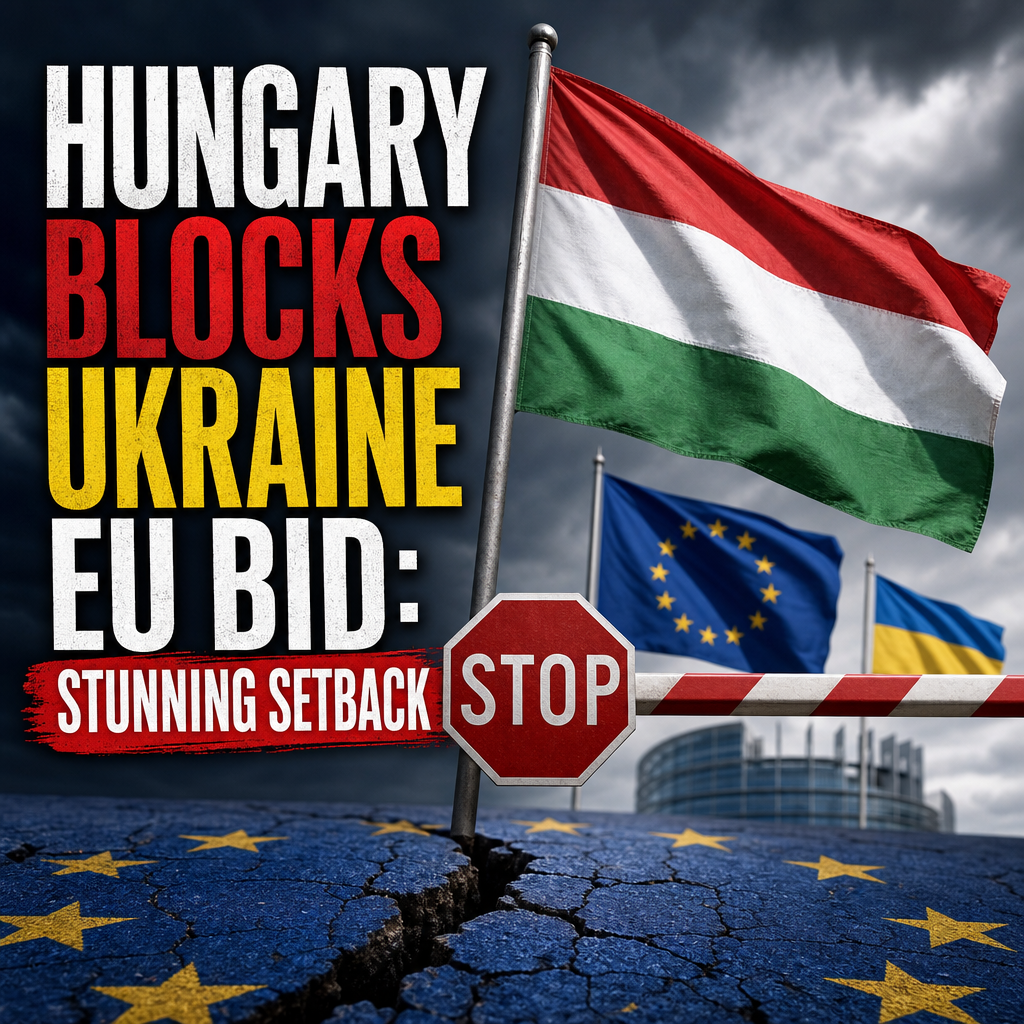
Hungary Blocks Ukraine EU Bid: Stunning Setback


Hungary Blocks Ukraine EU Bid in a move that has exposed just how fragile the European Union’s unity can be when enlargement collides with national politics, wartime urgency, and competing ideas about what the bloc should stand for.
The decision has drawn sharply different reactions depending on which side of the debate you listen to. For Kyiv, it is a painful delay at a moment when EU membership is being framed not just as a long-term aspiration, but as a strategic guarantee of Ukraine’s Western future. For Budapest, it is presented as a matter of leverage, sovereignty, and disagreement over whether Ukraine has done enough to justify moving forward. And for Brussels, it is a reminder that enlargement, once seen as a tool of stability and influence, is now increasingly a test of political consensus inside the EU itself.



Why Hungary’s veto matters now
Ukraine’s push toward the European Union has always been about more than paperwork. Since Russia’s full-scale invasion, the accession process has become deeply symbolic: a signal that Ukraine belongs in Europe politically, economically, and institutionally, even if full membership remains years away.
That is why Hungary’s refusal to allow progress is being viewed as a major setback. EU enlargement requires unanimity, which gives every member state an effective veto. In practice, that means one government can slow or block a process that most of the rest of the bloc supports.




Sky News and other Western-oriented coverage have tended to emphasize the diplomatic frustration in Brussels and Kyiv. The concern is not only that the decision delays formal negotiations, but that it sets a precedent. If Hungary can stall Ukraine’s path now, other aspiring members may conclude that the process is vulnerable to domestic politics in individual capitals rather than based on consistent criteria.
At the same time, Hungarian officials argue that their position is not simply obstruction for its own sake. Budapest has repeatedly said it wants clearer guarantees on minority rights, especially for ethnic Hungarians in western Ukraine. It has also framed the issue as one of caution: Ukraine, in Hungary’s view, is still at war, economically strained, and not yet ready to take on the obligations of membership.
Different readings of the same block
The split in interpretation is striking.
From the EU and Ukrainian perspective, Hungary is being accused of holding the bloc hostage. The timing is especially sensitive because support for Ukraine has already been tested by war fatigue, budget pressure, and political changes across Europe. A veto now looks to many critics like an attempt to convert a broader geopolitical decision into a bilateral bargaining chip.
RT’s coverage has generally highlighted Hungary’s objections more sympathetically, focusing on the argument that EU institutions are pressing ahead too quickly and ignoring practical concerns. In that framing, Hungary is acting as a brake on what it sees as an emotionally driven enlargement push. That view resonates with governments and voters who worry that the EU is expanding its responsibilities faster than it can manage them.
Al Jazeera’s reporting, by contrast, has often placed the dispute in the context of the wider war and the strategic stakes for Ukraine. From that angle, the veto is not just a procedural issue. It is part of a larger contest over whether Ukraine can secure lasting integration with the West while Russia continues to try to pull it back into Moscow’s orbit.
What makes the moment so sensitive is that both interpretations contain some truth.
Hungary is right that enlargement should not become purely symbolic. If the EU lowers standards or accelerates membership for political reasons, it risks weakening the credibility of the process. But critics are also right that Ukraine’s situation is extraordinary. It is hard to treat a country fighting for survival as though it were just another accession candidate moving through a normal checklist.
What is at stake beyond procedure
The dispute matters for several reasons:
– EU credibility: If accession talks can be blocked by one member’s political agenda, the EU’s promise of enlargement becomes harder to trust.
– Ukraine’s morale: For Kyiv, even partial progress toward membership is important as a sign of sustained European backing.
– Hungary’s leverage: Budapest has shown that EU decision-making can be shaped by a single determined government.
– Future enlargement: Other candidate countries are watching closely to see whether rules or politics will define the process.
A broader test for the European Union
The deeper issue is that the EU is trying to do two difficult things at once: support Ukraine against Russian aggression and preserve a strict, rule-based accession process. Those goals are compatible in principle, but in practice they are colliding.
European leaders often describe enlargement as a merit-based process. Candidate countries must reform their institutions, strengthen the rule of law, protect minorities, and align with EU standards. Yet when a country is also a frontline state in a major war, the political meaning of accession becomes impossible to separate from the technical criteria.
That tension explains why reactions to Hungary’s move have been so polarized. Supporters of Kyiv see the veto as cynical and damaging to European unity. Supporters of Budapest see it as a legitimate refusal to rubber-stamp a rushed decision. The truth is likely somewhere in between: Hungary is using a real procedural power to advance concerns that are partly principled and partly political.
The result is a stark reminder that the EU enlargement project is no longer just about convergence. It is also about trust, timing, and the willingness of member states to subordinate national grievances to a shared strategic goal.
For Ukraine, that means the road to Europe remains open, but uneven and vulnerable to disruption. For the EU, it means the question is no longer whether it wants to expand, but whether it can still make enlargement look like a collective commitment rather than a hostage to internal division.
In that sense, Hungary’s block is more than a delay. It is a warning that Europe’s political architecture is being tested at the exact moment it is supposed to look strongest.

























