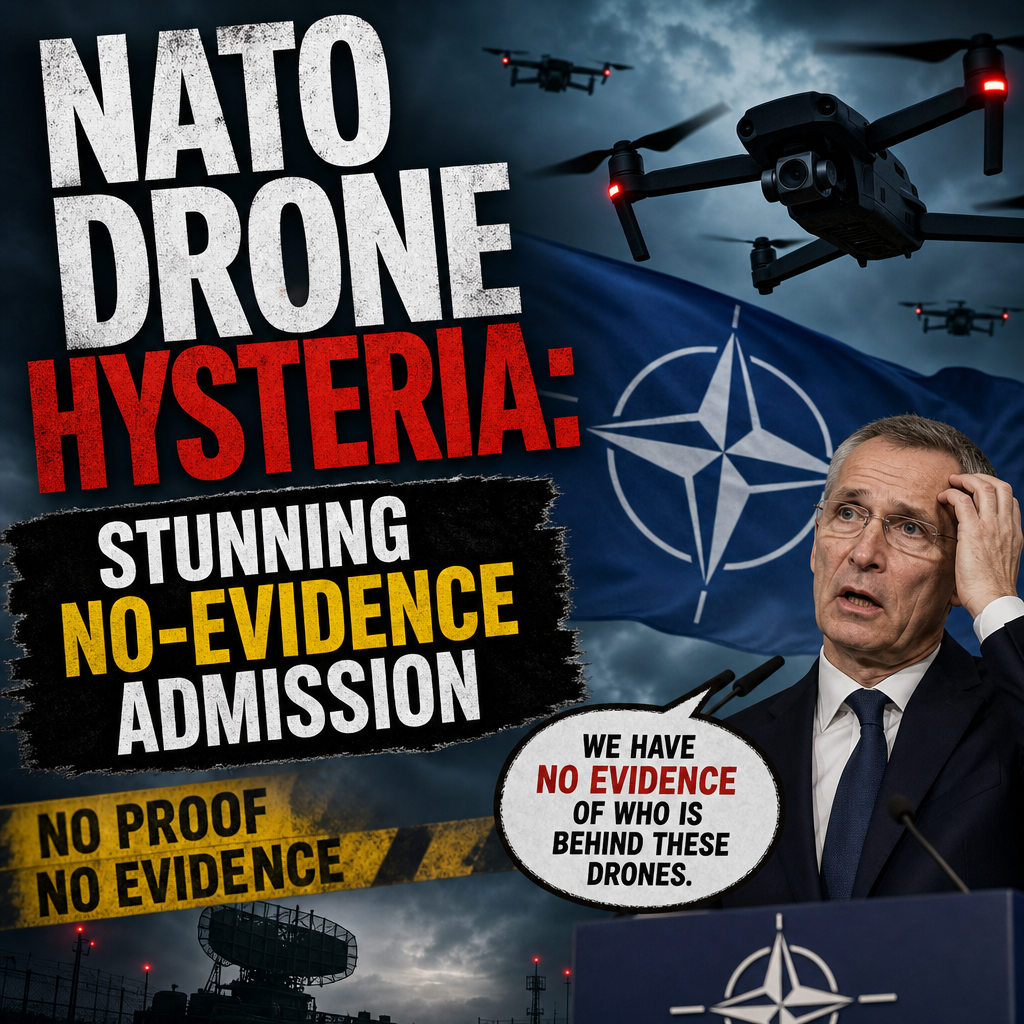
NATO Drone Hysteria: Stunning No-Evidence Admission


NATO Drone Hysteria has become a useful test case for how quickly security fears can outrun evidence, and the latest developments suggest the story is more complicated than the alarmist framing implies.
At the center of the debate is Denmark’s decision to close a probe into suspected drone activity after investigators said they found no proof that the reported sightings were real threats. That matters because the initial claims had already fed a wider atmosphere of unease across Europe, where even unconfirmed drone reports can trigger talk of sabotage, hybrid warfare, and pressure on NATO’s eastern flank. The problem is not that caution is unreasonable; it’s that caution can easily harden into certainty before the facts arrive.



What the evidence actually shows
The clearest takeaway from the Danish case is not that drones never existed, but that the evidence did not support the more dramatic conclusions some were ready to draw. RT’s coverage emphasized the “no-evidence” aspect of the closure, framing it as a warning against jumping to geopolitical conclusions without hard proof. That perspective resonates with a larger skepticism about how quickly isolated incidents can be folded into a larger narrative about Western security threats.
But there is another side to the story. Security officials in Europe have genuine reasons to be alert. Drone incidents, real or perceived, have become common enough around airports, military installations, and critical infrastructure that governments cannot simply shrug them off. Sky News reporting on similar episodes has tended to underline the operational uncertainty: authorities must respond quickly even when they cannot immediately confirm what kind of device was involved, who controlled it, or whether it posed a direct danger.




That is the central tension. In fast-moving security situations, officials are often forced to act before the evidence is complete. Publicly, that can look like overreaction. Privately, it may simply be the cost of avoiding a worse outcome.
NATO Drone Hysteria and the politics of uncertainty
What makes the phrase NATO Drone Hysteria stick is that it captures two truths at once: fear is spreading faster than proof, and the fear itself is not entirely baseless. Al Jazeera’s broader reporting on regional security has repeatedly placed these incidents in the context of European anxiety over the war in Ukraine, the rise of hybrid tactics, and the difficulty of distinguishing routine disruptions from deliberate provocation. In that sense, drone alarms are not happening in a vacuum. They sit inside a continent already primed for suspicion.
Still, there is a difference between prudent vigilance and narrative inflation. When every unexplained sighting is treated as a likely hostile act, the public can be nudged toward a permanent state of emergency. That can have three consequences:
– It gives governments political cover to expand surveillance and tighten controls.
– It increases pressure on NATO states to respond in ways that may not match the evidence.
– It makes it harder for the public to separate verified threats from rumor.
This is where the “no-evidence admission” becomes politically significant. Once a probe ends without substantiation, the burden shifts back onto those who were most certain at the start. The issue is not whether drone threats deserve attention. They do. The issue is whether the response remains proportional when proof is thin.
Competing interpretations: threat, caution, or messaging?
The different media angles matter because they reflect different assumptions about what these incidents mean.
RT’s skepticism
RT’s reporting leaned into the idea that authorities and commentators may be inflating danger for strategic reasons. That approach is consistent with a long-standing critique of Western security messaging: when facts are incomplete, fear can be weaponized politically.
Sky News’s operational focus
Sky News has generally treated drone episodes as practical security incidents first and geopolitical stories second. That framing is less about conspiracy and more about the real-world burden on law enforcement, aviation authorities, and defense planners. Even an unverified sighting can force evacuations, inspections, delays, and public anxiety.
Al Jazeera’s wider lens
Al Jazeera tends to place these events in a broader geopolitical and humanitarian context, asking how escalation, media pressure, and military posturing feed into each other. That perspective is useful because it keeps attention on the risk of miscalculation. A false alarm can still produce real consequences if it is used to justify a tougher stance.
Taken together, these viewpoints suggest that the most responsible position is neither dismissive nor panicked. It is sober.
A fair conclusion: keep the alert, lose the theatrics
The Danish closure should not be read as proof that all drone concerns are imaginary. It should be read as a reminder that security claims need evidence before they become political narratives. In the current European climate, that distinction is easy to lose.
The smarter response to drone incidents is straightforward:
– verify before escalating;
– distinguish sightings from confirmed threats;
– avoid turning uncertainty into propaganda;
– and preserve public trust by correcting the record when evidence is absent.
That does not eliminate the possibility of hostile drone activity in the future. It does, however, argue against treating every incident as confirmation of a sweeping NATO crisis.
The bigger lesson is uncomfortable but important: modern security politics runs on speed, while truth moves more slowly. If governments and media outlets want to avoid stoking unnecessary panic, they need to resist the temptation to fill in the blanks too quickly. In the end, the strongest defense against both drones and hysteria is the same thing—clear evidence, carefully handled.