Iran Military Capabilities: Stunning, Powerful Overview


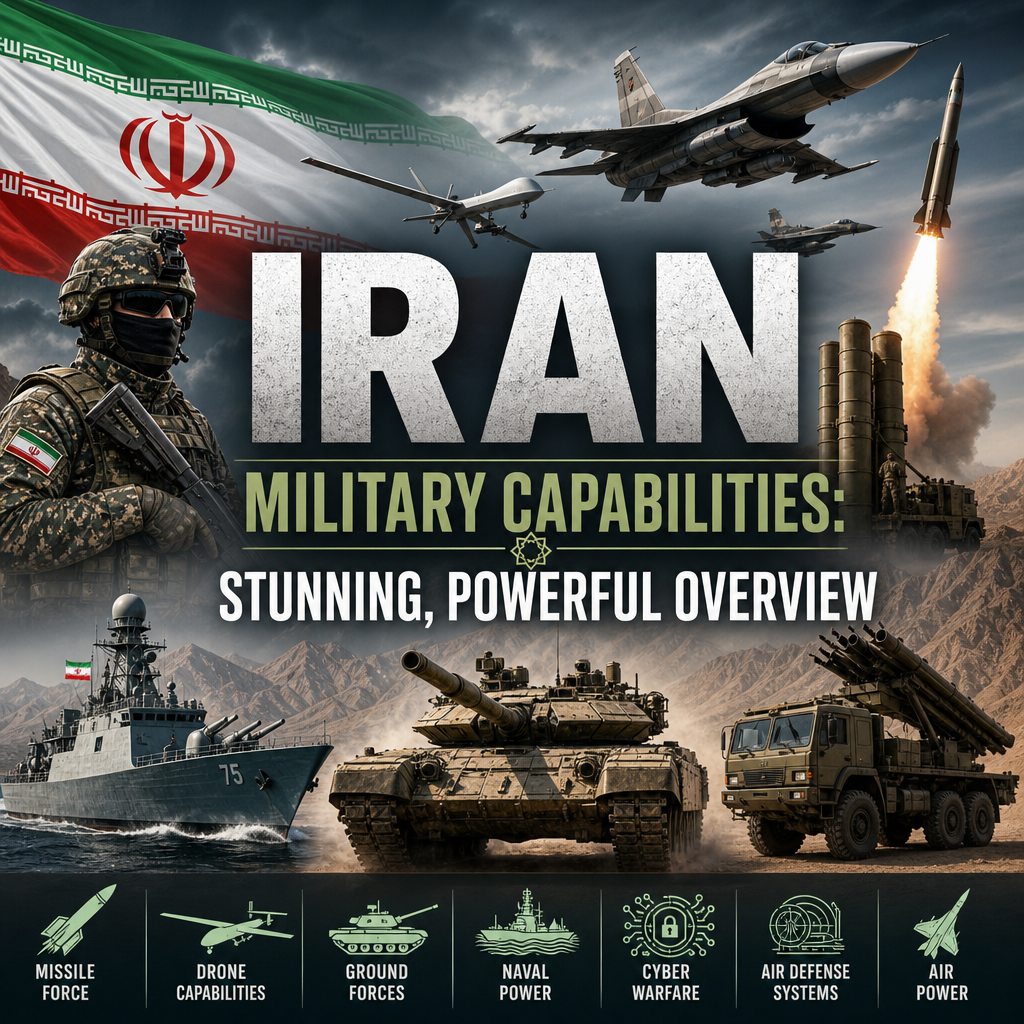
Iran military capabilities are often discussed in dramatic terms, but the reality is more layered: Tehran’s strength comes less from a single “super weapon” and more from a mix of missiles, drones, regional proxies, air defenses, naval harassment tools, and hardened political resolve. That combination makes Iran a serious regional military actor even though it does not match the conventional airpower or high-tech command systems of the United States, Israel, or other major militaries.
Iran military capabilities in context
A fair assessment starts with the basics. Iran’s armed forces are split between the regular military and the Islamic Revolutionary Guard Corps, and that structure matters. The IRGC, especially its aerospace and naval branches, is central to Iran’s deterrence strategy. Rather than trying to outspend or outmatch adversaries plane for plane, Tehran has invested in asymmetric warfare: systems that are cheaper, harder to defend against, and designed to complicate enemy planning.



That approach helps explain why different news outlets frame Iran’s capabilities differently. Some coverage emphasizes the scale of Iran’s missile arsenal and drone production, arguing that the country can strike far beyond its borders and threaten shipping lanes, bases, and regional infrastructure. Other reporting is more cautious, pointing out that many of Iran’s systems are untested against sustained peer-level warfare and that Israeli and U.S. defenses have repeatedly shown they can intercept a significant share of incoming threats. Both views can be true at once.
Missiles and drones: Iran’s most visible edge
If there is one area where Iran has clearly built strategic weight, it is missiles. Short- and medium-range ballistic missiles give Iran the ability to hit targets across the Middle East. Cruise missiles and guided rockets add flexibility. In recent years, drones have become an even more important part of the picture, especially loitering munitions and one-way attack drones that are relatively low cost but useful for saturation attacks.




This matters because war is not only about accuracy; it is also about volume, survivability, and pressure. Iran can force opponents to spend expensive interceptor missiles to stop comparatively cheap projectiles. That exchange ratio is one reason analysts say Iran’s arsenal has deterrent value even if its systems are not always the most advanced on paper.
Iran’s drone program has also gained attention because it is exportable. Drones sold or shared with partners have extended Tehran’s influence beyond its own territory, making Iran not just a local military concern but a supplier in wider conflicts. That broader network can magnify its leverage even when its own forces are constrained.
How strong is Iran’s conventional military?
Conventional comparisons are where the picture gets more complicated. Iran’s air force is dated by global standards, with many aircraft inherited from earlier eras and limited access to modern Western spare parts. Its navy is not built for blue-water dominance against a major power. In a direct, sustained conventional war with the U.S. or Israel, Iran would likely face severe limits in air superiority, logistics, and battlefield communications.
Still, dismissing Iran as weak would be a mistake. It has adapted to scarcity. It has built missile bases, underground facilities, and command nodes designed to survive strikes. It has practiced dispersal, deception, and rapid retaliation. And while many of its platforms are older, its doctrine is optimized for endurance and punishment rather than symmetry.
Air defenses, cyber tools, and hardened infrastructure
Iran’s air-defense network has been a focal point of debate. Officials in Tehran have long sought to make the country more resistant to air attack, and public messaging often stresses indigenous systems and layered defenses. The practical question is not whether those systems are flawless — they are not — but whether they can raise the cost and complexity of an attack enough to matter. In that sense, even partial defenses can influence an adversary’s planning.
Cyber capabilities also belong in any serious assessment. Cyber operations are difficult to verify publicly, which is part of the point. Iran has repeatedly been linked to cyber campaigns against regional rivals and critical infrastructure. Cyber tools do not replace missiles or aircraft, but they add another layer to a strategy built around disruption.
Regional power, proxy networks, and the deterrence question
Perhaps Iran’s most consequential military asset is not a weapon at all, but its network of regional partners and aligned groups. Support for militias and armed movements in Iraq, Syria, Lebanon, Yemen, and elsewhere extends Iran’s reach and creates strategic ambiguity for opponents. This is why analysts often describe Iran as a “networked” power: it can shape conflict without always fighting with its own uniformed forces in the open.
That creates a dilemma for outside powers. If they strike Iranian assets directly, they risk escalation. If they hold back, Iran’s influence can grow through pressure, attrition, and local allies. The result is a pattern of limited conflict, signaling, and mutual deterrence rather than all-out war.
The strongest argument in Tehran’s favor is that this model has worked for a long time. Iran has survived sanctions, isolation, covert action, and periodic strikes while still preserving enough capability to threaten retaliation. The strongest argument against overestimating it is that deterrence is not the same as invulnerability. Iran’s economy, industrial base, and airpower remain vulnerable to sustained pressure.
A balanced view: powerful, but not all-powerful
The most accurate conclusion is that Iran is militarily powerful in some domains and constrained in others. It can project risk, complicate enemy planning, and absorb pressure better than many countries its size. But it does not possess the kind of comprehensive conventional superiority that would let it dominate a major regional war.
What makes Iran dangerous is the combination:
– missiles that can reach strategic targets;
– drones that are cheap, flexible, and scalable;
– proxies that extend its reach;
– defensive preparations that complicate retaliation;
– and a leadership willing to use all of these tools together.
So the picture is neither cartoonishly unstoppable nor easily dismissed. Iran’s military capabilities are best understood as a carefully built deterrent machine: uneven, adaptive, and often underestimated. That is precisely why it remains central to every serious negotiation, crisis, and security calculation in the Middle East.