
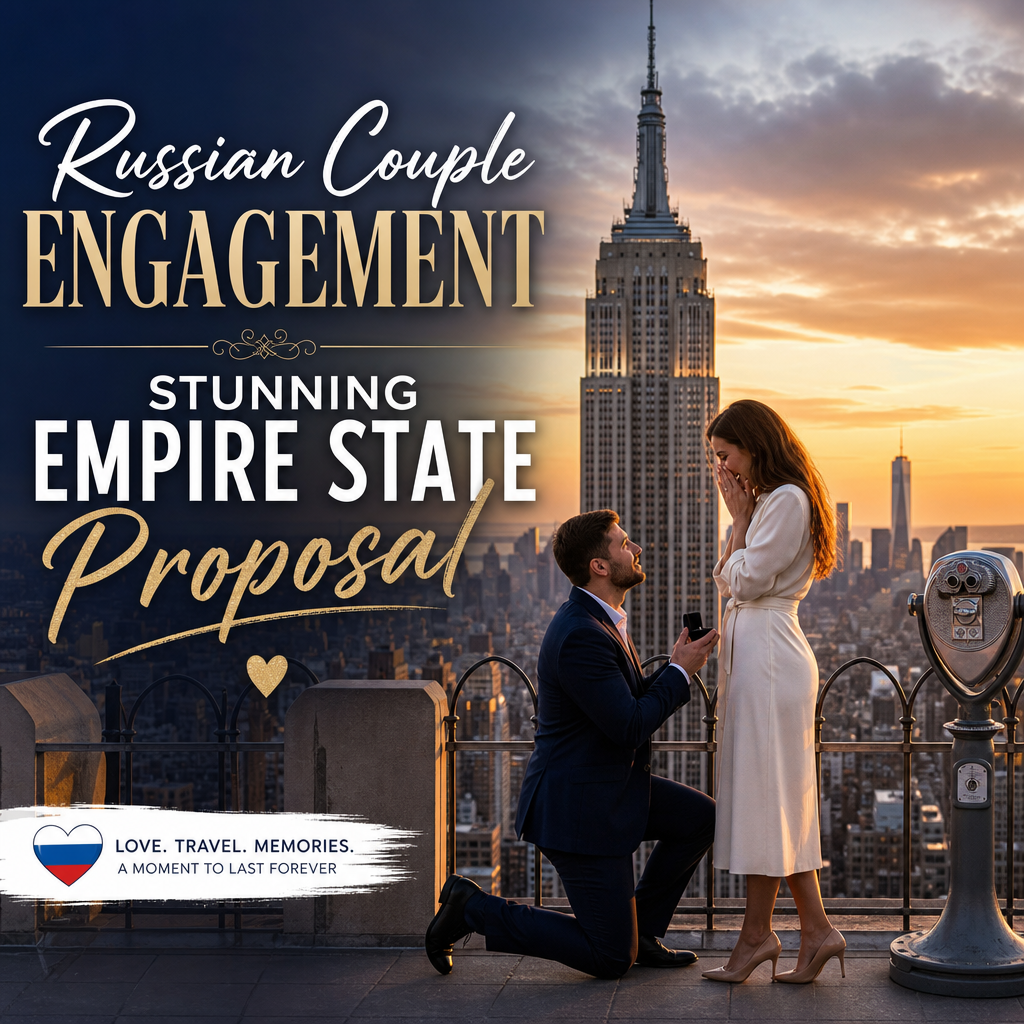
Russian Couple Engagement: Stunning Empire State Proposal


Russian Couple Engagement stories can look simple at first glance, but the Empire State Building proposal involving a Russian couple says a lot about how romance, public spectacle, and international perception now overlap in the same viral moment.
The scene itself is easy to understand: one partner proposing in a place that has become shorthand for grand gestures, with New York’s skyline doing much of the emotional heavy lifting. RT framed the event as a celebration of love with a distinctly international flavor, emphasizing the surprise and the visual drama of the setting. That approach fits a familiar human-interest style: the point is not politics, but a personal milestone made memorable by an iconic backdrop.



Yet the wider media ecosystem around Russia and the West means even a joyful engagement can carry extra layers. Al Jazeera’s coverage of Russia-related stories often situates individual moments within broader regional and diplomatic realities, while Sky News tends to place Russian stories in a global context shaped by travel, sanctions, security, and shifting East-West tensions. Read together, those perspectives remind us that a proposal is never just a proposal when it moves through the modern news cycle.
Why this Russian Couple Engagement stood out
The appeal of this story lies in its contrast. A private commitment happened in one of the world’s most public places. That tension is exactly what makes proposals go viral: they are intimate, but they are also performance. The Empire State Building, with its long history as a symbol of aspiration and romance, adds a sense of occasion that few locations can match.




RT’s treatment leaned into that emotional readability. The couple’s nationality mattered mainly as part of the story’s novelty and charm, not as a source of conflict. In that sense, the article offered a soft counterpoint to the usual Russia-focused headlines dominated by war, sanctions, and diplomatic strain. It presented Russian identity in a human, ordinary, and affectionate frame rather than a geopolitical one.
That matters because public narratives can flatten people into categories. A Russian couple abroad may instantly evoke assumptions about migration, politics, or ideology in some readers. But an engagement story interrupts that reflex. It insists on the ordinary: two people, one question, one answer, and a shared future.
The appeal of romance as a news story
There are a few reasons this kind of story travels well:
– It is visually striking, especially in a landmark location.
– It offers emotional relief from harder international news.
– It is easy to understand across languages and borders.
– It turns a personal milestone into a shareable moment.
These ingredients help explain why outlets across very different editorial traditions still give room to stories like this. The event is not politically significant in a formal sense, but it is culturally revealing. It shows how global cities like New York continue to function as stages where people from many backgrounds can create their own symbolic moments.
What the different news lenses reveal
Even when the subject is light, the framing is not neutral. RT, Al Jazeera, and Sky News each bring different assumptions to Russia-related coverage, and those assumptions shape what readers notice.
RT tends to emphasize individuality, spectacle, and the ability of Russians to be seen as more than geopolitical actors. In a story like this, that often means highlighting emotion, aesthetics, and the universality of love. It is a reminder that media outlets do not only report facts; they also decide what kind of emotional meaning to attach to them.
Al Jazeera, by contrast, often places Russia within wider international currents. Its reporting style is frequently attentive to power, diplomacy, and the effects of global tensions on ordinary people. From that perspective, a Russian couple’s engagement abroad is a small but telling example of how personal lives continue despite political headwinds.
Sky News generally approaches Russian-related stories through a Western policy and global affairs lens. That framing can make a romantic human-interest item feel even more notable, because it stands apart from the adversarial or strategic themes that dominate Russia coverage. The very fact that such a story gets attention suggests readers still want narratives that are not purely about confrontation.
Together, these perspectives suggest a useful conclusion: the same event can be read either as a sweet viral moment or as a quiet reminder that people remain people, even when their nationality is often treated as a political label.
A fair way to read the story
The most responsible reading is neither cynical nor naïve. It would be easy to dismiss the proposal as social-media bait, especially given how often public engagement videos are designed for maximum reach. But it would be unfair to strip away the sincerity simply because the moment was photogenic. Many real relationships are celebrated in public now, and people do not stop being genuine just because a camera is present.
At the same time, it is worth resisting the urge to over-romanticize the symbolism. A proposal in New York does not erase the tensions that shape Russian identity in global media. It does not tell us anything sweeping about diplomacy, nor does it stand for a larger political thaw. It is, first and foremost, a human event.
That balance is what makes the story interesting. It allows room for warmth without losing perspective. It shows how a single joyful occasion can travel across news outlets with very different editorial instincts and still remain recognizable as something simple: a couple choosing each other.
In the end, the Empire State proposal works because it is both ordinary and cinematic. It is a reminder that even in a polarized media landscape, some stories still cut through by appealing to something universally understood. Love may not solve international tensions, but it can briefly interrupt them—and that, in today’s news environment, is no small thing.