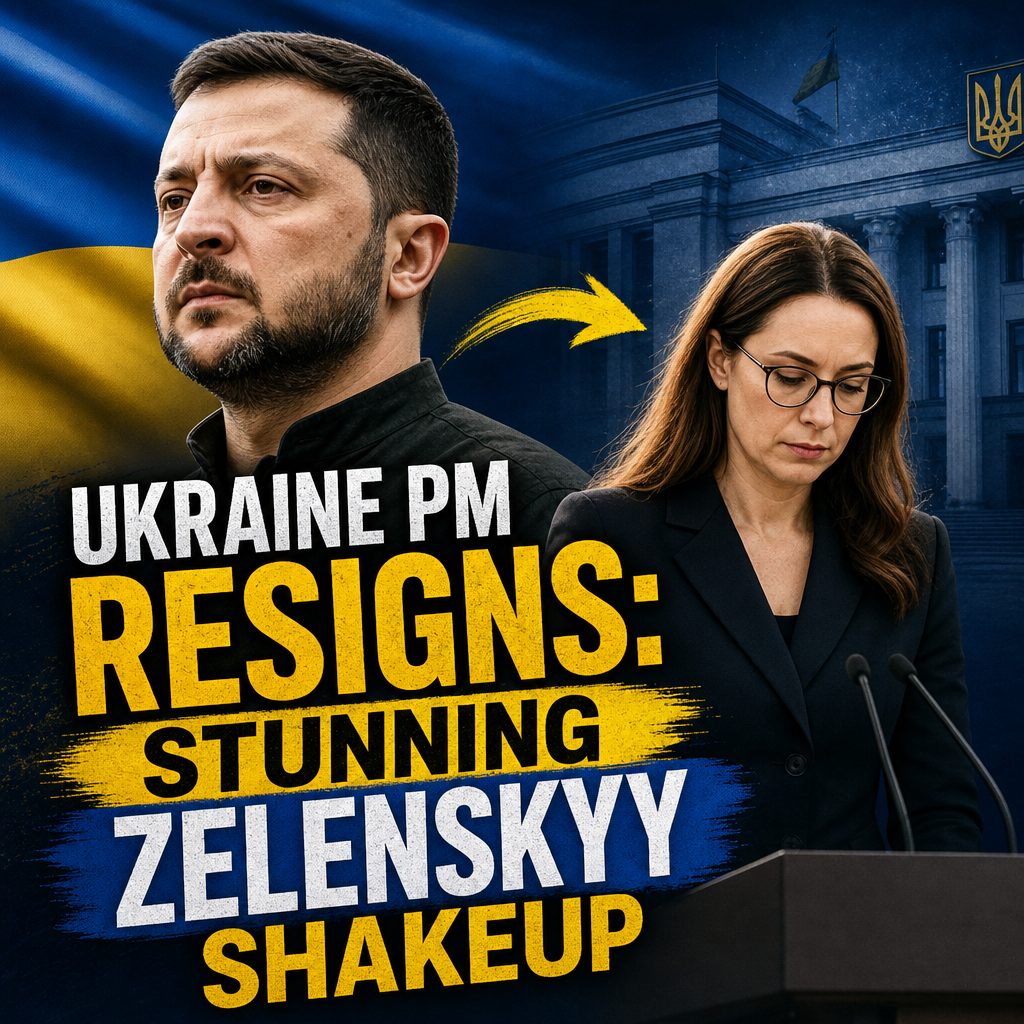
Ukraine PM Resigns: Stunning Zelenskyy Shakeup


Ukraine PM resigns in a move that has instantly raised questions about stability, strategy, and power inside President Volodymyr Zelenskyy’s wartime government. Depending on which source you read, the shake-up looks like either a necessary reset for a country under extraordinary pressure or a sign of deeper political strain at a critical moment in the war.
What is clear is that the resignation comes during a period when Ukraine can least afford confusion. The country is still balancing battlefield demands, damaged infrastructure, international aid dependence, and the constant need to reassure both citizens and allies that the government remains in control. A change at the top of the cabinet is therefore more than a routine personnel shift; it can affect how Ukraine is viewed abroad and how confidently it is governed at home.



A reshuffle under wartime pressure
Sky News framed the move as a major reshuffle within Zelenskyy’s circle, highlighting how unusual it is for such a high-level departure to come amid an active war. That angle matters because Ukraine’s leadership has largely emphasized continuity since Russia’s full-scale invasion. In wartime, even a political reset can be read as a message: the president wants a more responsive team, or perhaps one better aligned with changing battlefield and diplomatic realities.
Al Jazeera’s broader regional coverage tends to place such developments in the context of the war’s long duration and the strain it places on institutions. That perspective suggests the resignation should not be seen in isolation. Ukraine has spent more than two years operating under emergency conditions, with leaders expected to manage military mobilization, reconstruction, corruption concerns, and relations with Western backers all at once. In that environment, cabinet turnover may be less surprising than it would be in peacetime.




RT, by contrast, typically approaches Ukrainian political changes through a more skeptical and adversarial lens. Its coverage often emphasizes instability, internal rivalry, or the idea that Kyiv is under mounting pressure. That perspective should be read carefully, but it does reflect a broader truth: Russia’s information environment is eager to portray Ukrainian leadership as fractured. Even so, the existence of political change itself gives that messaging something to work with.
Ukraine PM resigns: what the move could mean
The resignation may have several possible explanations, and not all of them are mutually exclusive:
– A strategic reset: Zelenskyy may be trying to refresh the government and improve coordination at a time when the country needs faster execution.
– A response to fatigue: After years of war, pressure can build inside any cabinet, especially when policy decisions become increasingly difficult and politically costly.
– A signal to allies: A reshuffle can be used to show that the government is adapting rather than drifting.
– A power consolidation move: Critics may see the change as Zelenskyy tightening control over the executive branch.
The difficulty is that wartime politics rarely offer a single neat explanation. Leaders often combine practical and political motives. A resignation can be both a real administrative adjustment and a symbolic message to domestic audiences.
That ambiguity is important, because the consequences depend on what follows next. If the replacement is widely seen as competent, reform-minded, and capable of keeping ministries aligned, the transition may end up strengthening Zelenskyy. If it creates delays, confusion, or new factional tensions, then the move could feed doubts at exactly the wrong time.
Why the timing matters
The timing of the resignation is as significant as the resignation itself. Ukraine remains heavily reliant on foreign military and financial support, and allies are watching for signs that the government can continue to function coherently. A leadership shuffle can either reassure donors that Kyiv is serious about efficiency or worry them that internal politics are becoming a distraction.
It also matters for the Ukrainian public. Citizens have endured mobilization, economic strain, and repeated security threats. Many are likely to judge the move less by political symbolism and more by practical results: will services improve, will corruption be tackled more effectively, and will the cabinet be better at responding to wartime needs?
There is also the question of morale. In a conflict where resilience is itself a strategic asset, the government must project steadiness. That does not mean avoiding change. It means explaining change clearly and making sure it looks purposeful rather than chaotic.
The bigger picture
The resignation should not automatically be read as collapse, nor should it be dismissed as routine. The more balanced interpretation is that it reflects the extreme pressure under which Ukraine’s leadership has been operating. Wartime governments often become both more centralized and more vulnerable to turnover, because every decision carries larger consequences.
At the same time, the Kremlin and its media allies will almost certainly seize on the move as evidence of weakness. That is why the next steps matter so much. If Zelenskyy can quickly present a credible successor and a coherent rationale, he may turn the shake-up into a demonstration of control. If not, the resignation could deepen questions about whether the cabinet is being reshaped for performance or for politics.
For now, the safest conclusion is that this is a significant but not yet fully explained development. The facts point to change at the top; the meaning of that change will depend on what comes next, how openly Kyiv communicates it, and whether the new setup produces results in a country that continues to fight for survival.