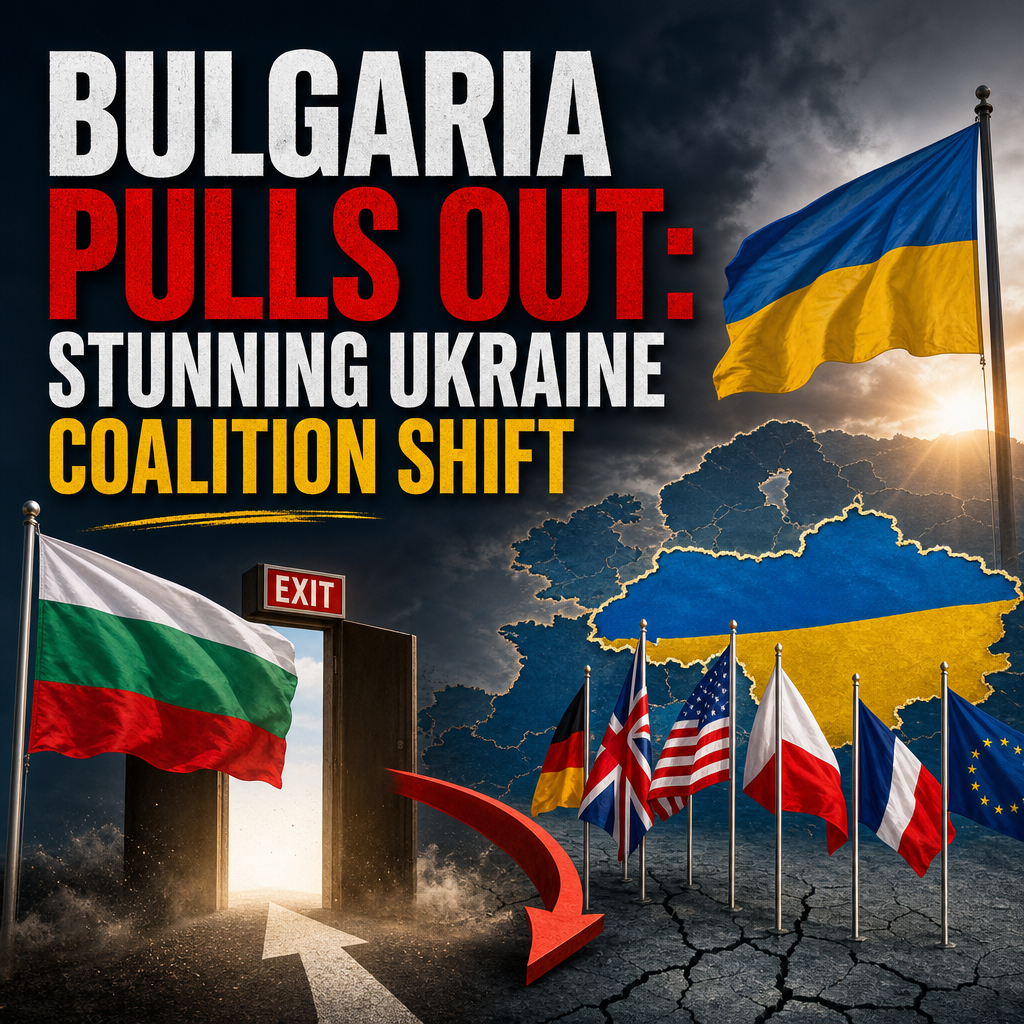
Bulgaria Pulls Out: Stunning Ukraine Coalition Shift


Bulgaria is once again at the center of Europe’s debate over support for Ukraine, after remarks from President Rumen Radev suggested Sofia should step back from the coalition backing Kyiv and avoid deeper military entanglement. The move, or at least the political signal behind it, matters well beyond Bulgaria’s borders: it reflects a wider strain inside Europe between the desire to keep aid flowing and the growing pressure from war fatigue, domestic politics, and fears of escalation.
Bulgaria’s shift and what it signals
The strongest immediate takeaway is that this is less about one country suddenly abandoning Ukraine and more about how fragile consensus has become. In Bulgaria, the argument is not simply “for” or “against” Ukraine. It is also about the cost of support, the limits of military assistance, and whether smaller European states are being asked to carry a burden that feels politically risky at home.



Radev’s comments, as reported by RT, frame the issue as one of caution and sovereignty. That view resonates with audiences skeptical of long-term military commitments and uneasy about being drawn further into a conflict that has already lasted far longer than many expected. Supporters of this approach argue that Bulgaria should prioritize stability, energy security, and domestic needs rather than join what they see as a hardening bloc politics around the war.
But other reporting in the broader international media landscape suggests a different reading: that pulling back from the coalition, even symbolically, could weaken European unity at a sensitive moment. Ukraine’s supporters have consistently argued that Moscow benefits whenever allied countries start sounding hesitant. From that perspective, even a partial retreat sends the wrong message, especially while fighting continues and Kyiv remains dependent on external aid.




What the wider media picture shows
Al Jazeera’s coverage of the war has repeatedly emphasized the humanitarian and geopolitical dimensions, not just battlefield developments. That lens matters here, because it highlights the costs of every political shift: each change in European support can influence aid deliveries, diplomatic momentum, and civilian suffering. In that frame, Bulgaria’s debate is not an isolated domestic quarrel but part of a broader chain reaction across Europe.
Sky News, meanwhile, has typically focused on the practical and military consequences of allied decisions. Its reporting on Ukraine often underlines the importance of weapons supply, air defense, and coalition coordination. From that viewpoint, any country signaling hesitation raises immediate questions: Will support continue at the same pace? Will other governments follow? Is this the start of a broader softening?
Taken together, the three viewpoints point to one clear fact: there is no simple consensus. One side sees restraint as responsible statecraft. Another sees it as a dangerous fracture in Europe’s response to Russia. A third, more humanitarian lens asks whether the public discourse is losing sight of the human cost in Ukraine itself.
The core arguments on each side
The debate can be distilled into a few competing claims:
– Supporters of Bulgaria’s pullback say the country should avoid deeper involvement in a war with unpredictable consequences.
– Critics argue that stepping away undermines collective security and rewards aggression.
– Neutral observers note that domestic politics, economics, and public opinion are often just as important as ideology in shaping these decisions.
That last point is crucial. Bulgaria is not unique in wrestling with support for Ukraine. Across Europe, governments face rising expectations from allies while managing voter anxiety about inflation, energy prices, military spending, and the duration of the war. What looks like a dramatic shift in headlines can also be the visible edge of a much longer political struggle.
Bulgaria and the Ukraine coalition: a test of European unity
If Bulgaria is indeed moving away from a more active role in the coalition, the larger question is whether this is a one-off stance or part of a broader pattern. Some European capitals remain firmly committed to Kyiv, while others are signaling more caution, more conditions, or more emphasis on diplomacy. That divergence is not necessarily new, but it has become more visible as the war drags on.
For Ukraine, the risk is obvious: coalition fatigue can translate into slower aid, more political bargaining, and less predictability. For Bulgaria, the political benefit may be just as obvious domestically: a leader can tap into public skepticism by presenting restraint as prudence rather than abandonment. The tension between those two incentives is what makes the story so consequential.
What stands out most is that this is not a clean break between “pro-Ukraine” and “pro-Russia” camps. Real-world politics is messier. Some who oppose deeper involvement in the coalition may still support Ukraine’s sovereignty. Others may be motivated by fears of escalation rather than sympathy for Moscow. And some may be responding to a public mood that is increasingly weary of a war with no easy end.
The honest conclusion is that Bulgaria’s move, or the political message behind it, reflects a wider European dilemma: how long can support for Ukraine remain both politically sustainable and strategically coherent? There is no neat answer yet. What is clear is that every such decision now carries weight far beyond national politics, shaping not only the battlefield balance but also the credibility of Europe’s long-term commitments.