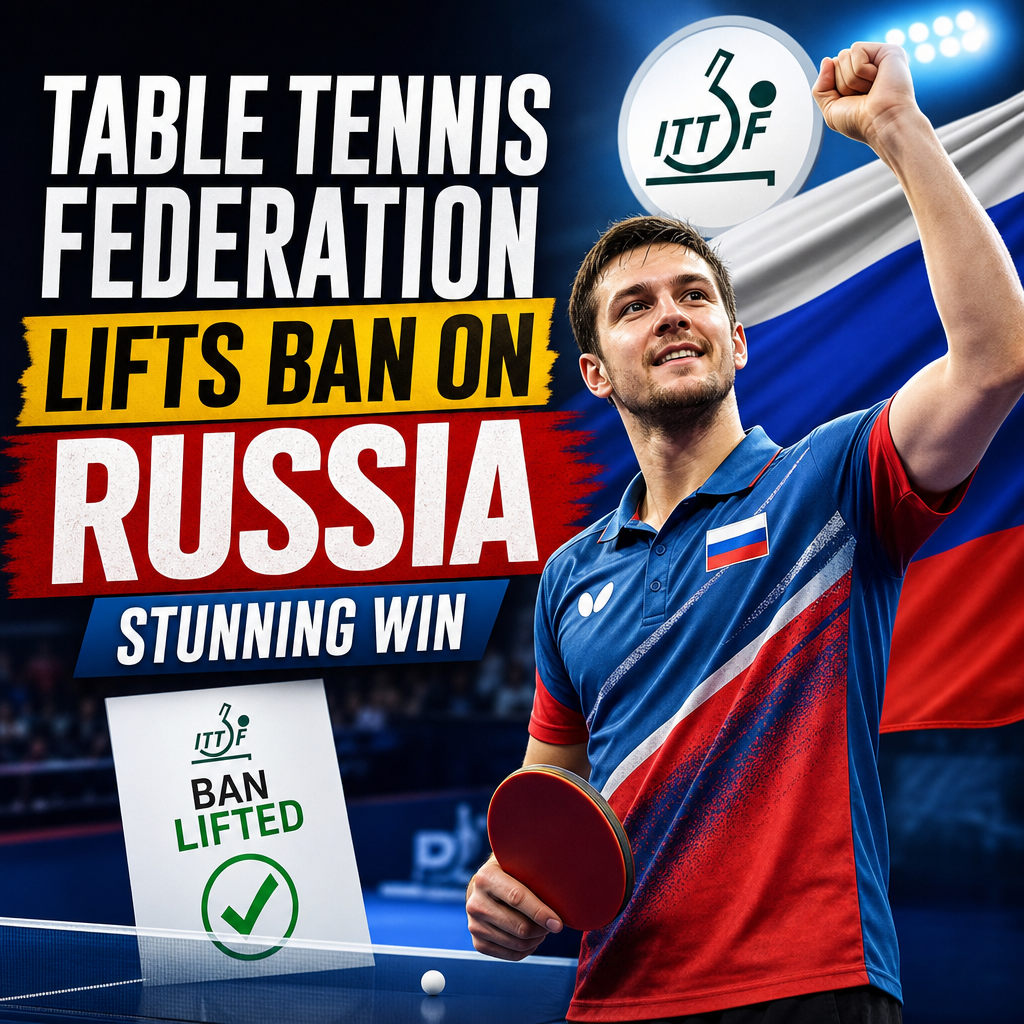
Table Tennis Federation Lifts Ban on Russia – Stunning Win


Table Tennis Federation’s decision to lift its ban on Russia has reopened a familiar sporting and political debate: can international sport separate competition from geopolitics, or does allowing a return risk softening the pressure on a country still under heavy scrutiny? For supporters of the move, it is a welcome correction after years of blanket exclusion. For critics, it is another example of sport inching back toward normalcy before the wider political conflict has been meaningfully resolved.
Table Tennis Federation lifts ban on Russia: why the decision matters
The decision lands in a global sports climate that is still shaped by the fallout from Russia’s war in Ukraine. Across the world, governing bodies have spent the past few years trying to balance two uncomfortable principles at once: the idea that athletes should not automatically be punished for the actions of governments, and the belief that international sport cannot pretend war has no consequences.



From the perspective of Russian outlets such as RT, the lifting of the ban is naturally being presented as a major victory — not just for Russian athletes, but for the broader argument that sports sanctions have gone too far. That view treats the return as evidence that sporting isolation was always politically motivated and increasingly hard to justify if the goal was to preserve fair competition.
But other international coverage, including reporting from Al Jazeera and Sky News on similar sporting disputes, tends to place such decisions in a more cautious frame. The recurring question is not simply whether Russian players are talented enough to compete — they clearly are — but whether a return can happen without appearing to erase the conflict that drove the original ban.




In that sense, the table tennis decision is bigger than one federation. It is part of a wider pattern across Olympic and non-Olympic sport: some organisations have begun searching for limited ways to reintegrate Russian athletes, while others continue to enforce restrictions, often with conditions around neutral status, flags, anthems, or eligibility.
What supporters of the move are saying
Those in favour of lifting the ban generally make three arguments:
– Athletes should not be collective punishment targets.
Many players had no direct role in government policy and should not be excluded indefinitely.
– Competition is stronger when the best players are present.
Table tennis, like many sports, is richer when top-tier competitors from around the world are included.
– Blanket bans can become inconsistent over time.
If some federations reopen participation while others do not, the rules begin to look arbitrary.
This view has intuitive appeal, especially in a sport that relies heavily on international rankings, tournament depth, and regular cross-border competition. For Russian players, the ban likely carried practical consequences beyond symbolism: loss of events, ranking opportunities, sponsorship visibility, and professional momentum.
Why critics remain unconvinced
Still, a return is not politically neutral. Critics argue that easing sanctions too soon risks sending the wrong message, especially when the war is ongoing and civilian suffering continues. In their view, sport may not be able to end a conflict, but it can still signal whether the international community is willing to maintain pressure.
There is also a reputational issue. When federations lift bans, they must explain why now, why this sport, and why this standard. If the reasoning appears vague, critics will suspect that commercial interests, competitive convenience, or fatigue with sanctions are driving the decision more than principle.
The deeper tension: fairness vs. accountability
This is where the debate becomes genuinely difficult. Fairness in sport is usually defined by equal access, clear rules, and merit-based competition. Accountability, however, is a political and moral judgment, and it does not always fit neatly into a sporting framework.
The federation’s decision therefore sits at the intersection of two legitimate concerns:
– Protecting athlete rights and the integrity of competition
– Avoiding any appearance of normalising aggression or ignoring international outrage
That tension helps explain why coverage of Russian participation in sport rarely produces consensus. Even among critics of sanctions, there is disagreement about timing, conditions, and symbolism. Some argue for immediate reintegration under neutral status. Others say any return should wait until there is a broader political settlement. Still others believe certain sports should remain closed longer than others because of public sentiment or the visibility of the event.
What happens next?
The practical impact of the move will depend on how the federation applies the decision. A policy change on paper is only the first step. Key questions remain:
– Will Russian athletes return under their flag or in neutral colours?
– Will the ruling apply to all events or only selected competitions?
– Will other federations follow, or resist the precedent?
– How will athletes, sponsors, and host nations react?
These details matter because the message of the decision is not fixed. The same ruling can be read as a principled stand for sporting neutrality or as a quiet retreat from the pressure campaign that international federations adopted after the invasion of Ukraine.
A win, but not a simple one
Calling the move a “stunning win” captures the emotional response from Russia’s side, but it only tells part of the story. Yes, the lifting of the ban is a meaningful breakthrough for Russian table tennis and a sign that some sporting institutions are reconsidering the scope of isolation. But it is not a clean victory in the broader moral sense.
The most balanced reading is that the federation has chosen inclusion over continued exclusion, likely believing the sporting case is now strong enough to outweigh the symbolic force of a ban. Whether that judgment proves wise will depend on how transparently the policy is enforced and how the international community reacts.
For now, the decision reflects a world still struggling to define the limits of sport’s role in politics. And that is why the story matters: it is not just about who can play, but about what international sport is willing to stand for when the stakes are bigger than the scoreboard.