
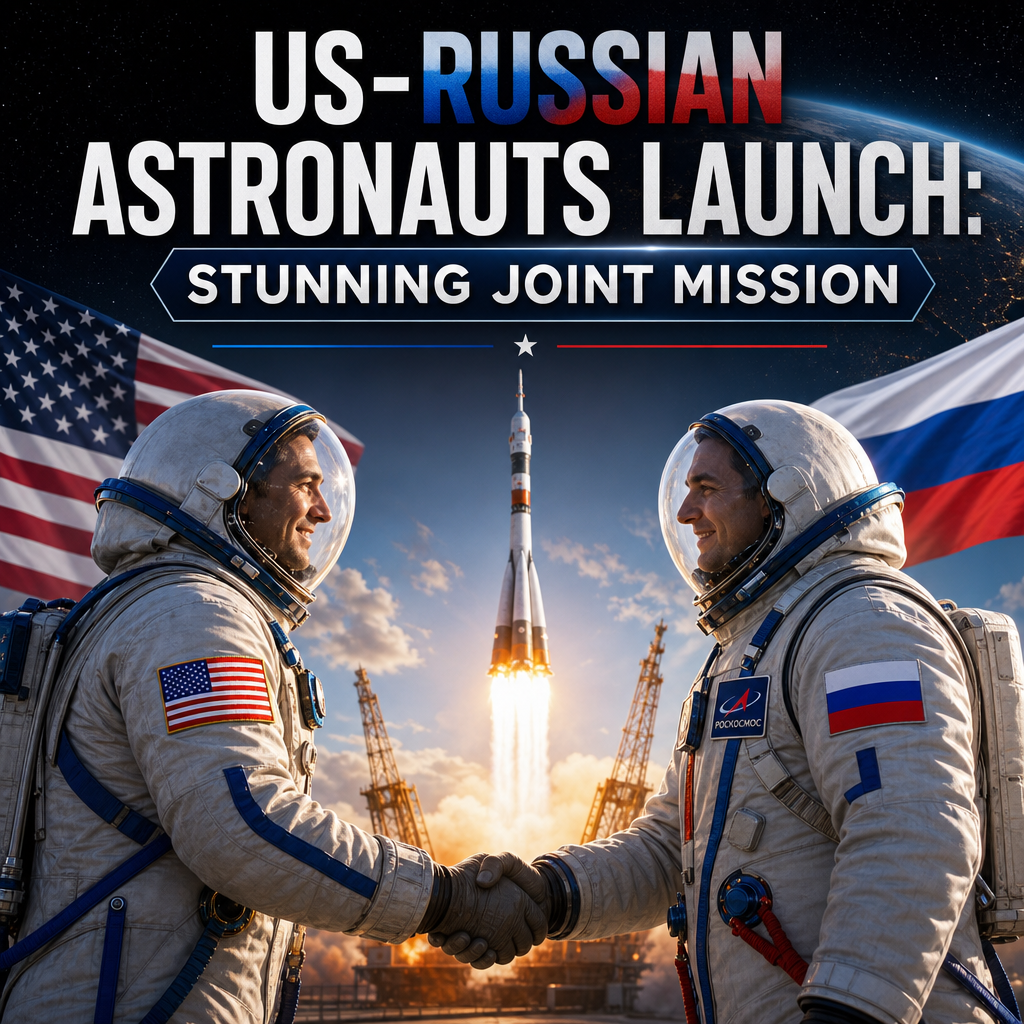
US-Russian Astronauts Launch: Stunning Joint Mission


US-Russian astronauts launch marks a rare moment of cooperation in a period otherwise defined by geopolitical strain, and that contrast is exactly what makes the mission worth paying attention to.
For all the noise surrounding tensions between Washington and Moscow, the launch shows that space still has a way of forcing practical collaboration. Reports from Al Jazeera, Sky News, and RT all point to the same basic fact: despite a fractured political relationship, the two countries continue to work together in orbit. What differs is the framing. Some coverage emphasizes the symbolic value of the mission, some focuses on the technical and human side of the launch, and some treats it as evidence that strategic cooperation can survive even when diplomacy is under pressure.



What the joint launch says about space cooperation
The most immediate takeaway is simple: this mission is happening because both sides still need each other. That may sound unremarkable, but in the current climate it is not. Space travel remains one of the few fields where scientific necessity and operational pragmatism often outweigh political rhetoric. Crew transport, station maintenance, and orbital safety are not the kind of tasks countries can easily do alone.
Al Jazeera’s reporting tends to place the launch in the broader context of international relations, highlighting how unusual it is to see Americans and Russians sharing a mission when relations on Earth are so tense. That perspective gives the event a diplomatic dimension. The launch is not just a trip to orbit; it is a reminder that cooperation can still exist even when formal trust is limited.




RT, meanwhile, typically frames such missions as proof that Russian and American space professionals can still collaborate effectively despite political confrontation. That angle is important because it shifts attention away from state-level conflict and toward operational competence. In that reading, the story is less about symbolism and more about endurance: the idea that space institutions are resilient enough to keep functioning regardless of headlines.
Sky News usually brings a more mainstream international audience to the story, often balancing the spectacle of the launch with the practical significance of the mission. That approach helps ground the event. A joint crew launch is exciting, yes, but it is also a routine part of how orbital programs survive. Behind the cameras and the countdowns are years of engineering, training, and coordination.
Why this mission matters beyond the launchpad
There are at least three reasons this story matters.
– It shows that cooperation can continue even when governments are locked in rivalry.
– It reinforces the reality that human spaceflight still depends on shared logistics and trust.
– It offers a rare image of joint purpose at a time when public discourse is dominated by division.
That combination makes the launch more than a feel-good headline. It is a case study in how strategic interdependence works. Even countries with deep disagreements may still find it useful, or necessary, to cooperate in highly specialized arenas.
US-Russian astronauts launch and the politics of symbolism
The symbolism here is hard to ignore. A joint mission between American and Russian astronauts inevitably invites comparisons with earlier eras of space cooperation, especially the long-running partnerships built around the International Space Station. In a world where sanctions, military posturing, and diplomatic suspicion often dominate U.S.-Russia coverage, a crew launch is a visible reminder that some bridges remain standing.
Still, it would be too easy to turn this into a simplistic story about peace through science. The reality is more complicated. Space cooperation does not erase geopolitical conflict; it exists alongside it. That tension is what gives the mission its complexity. The same governments that may clash over security, trade, or regional conflicts can still coordinate on launch schedules, orbital operations, and astronaut safety. That is not hypocrisy so much as practical necessity.
There is also a human element that gets lost if the story is treated only as diplomacy. Astronauts and cosmonauts train for years to trust one another in environments where mistakes can be fatal. Shared missions require communication, discipline, and mutual reliance. In that sense, the crew itself becomes a small-scale model of cooperation under pressure. The public may see national flags; the people inside the spacecraft see teammates.
A cautious reading of what comes next
Even so, it would be premature to claim that the launch signals a broader thaw in U.S.-Russian relations. One successful mission does not resolve deeper disputes. At best, it shows that channels of coordination remain open in a narrow but highly meaningful field. At worst, it may be treated by political leaders as proof of goodwill without any corresponding change in policy.
That uncertainty matters. The launch is evidence of cooperation, but not necessarily of reconciliation. It tells us that technical partnerships can survive when broader diplomacy struggles, which is encouraging in its own way. It also reminds us that space remains one of the few arenas where results, not rhetoric, still carry the most weight.
What makes the mission compelling is not that it solves anything, but that it demonstrates how much can still be achieved when specialists keep working across national lines. In a period of confrontation, that is no small thing. The image of American and Russian astronauts heading into orbit together may not rewrite geopolitics, but it does offer a rare and useful correction to the idea that all cooperation has collapsed.
The launch is stunning not because it is romantic, but because it is practical. It shows two rivals choosing coordination where it matters most: in the unforgiving environment of space. And in a news cycle often dominated by conflict, that alone makes the story stand out.