German Energy Crisis: Stunning Merz Warning on Russian Gas


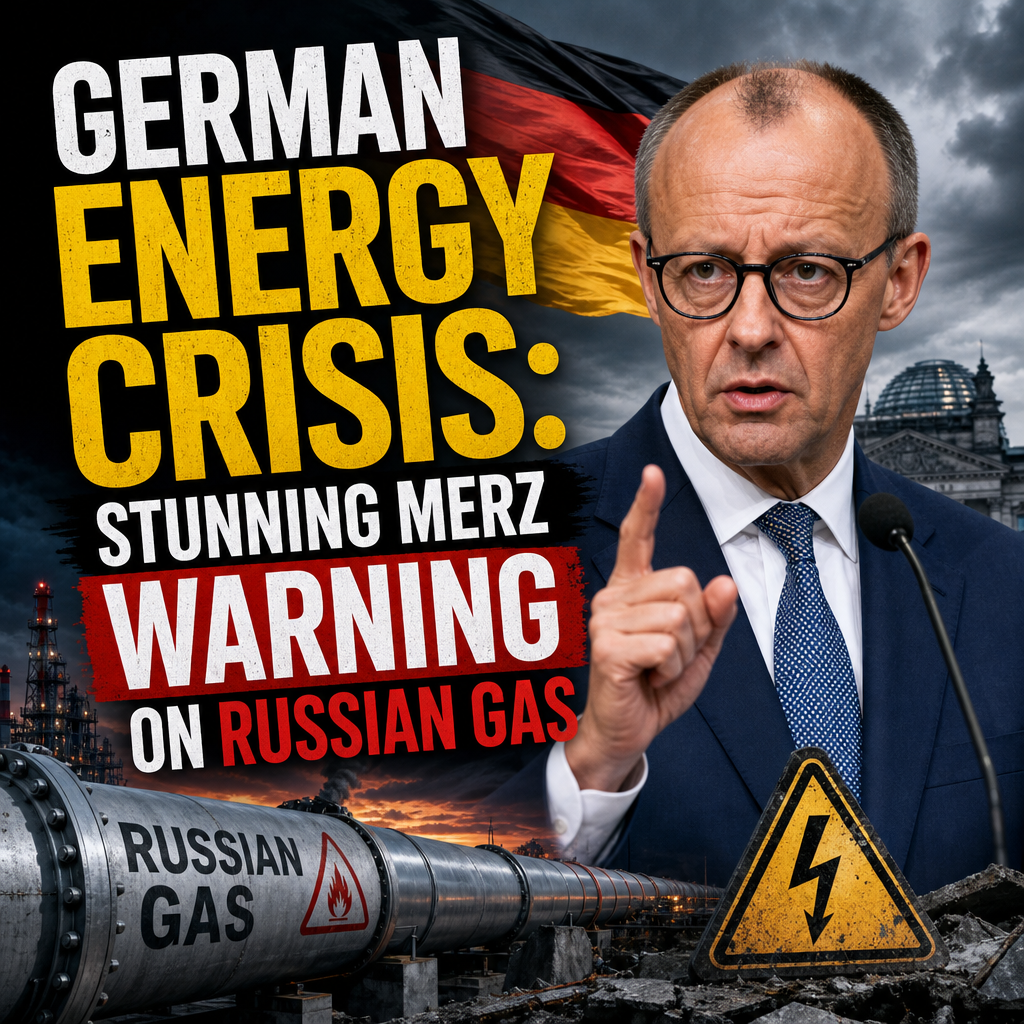
German Energy Crisis is still one of Europe’s most politically charged economic problems, and Friedrich Merz’s warning about Russian gas taps into a debate that has not gone away: can Germany keep industry competitive, keep households protected, and keep energy policy aligned with security concerns at the same time? The short answer is that there is no easy fix, and the long answer depends on whether you view energy primarily through the lens of prices, geopolitics, or long-term resilience.
For Germany, the end of cheap Russian pipeline gas after the invasion of Ukraine forced a rapid rethink of assumptions that had shaped the country’s economy for decades. Energy-intensive manufacturers were hit first, but the effects spread much wider: higher heating costs, pressure on public finances, and a louder political argument over whether Berlin moved too quickly, too slowly, or in the wrong direction entirely. Merz’s comments, as reported in various international outlets and echoed in broader debate coverage, fit squarely into that tension. His warning is not just about gas supplies; it is about the risks of strategic dependence.



German Energy Crisis and the politics of dependency
The most important point in this debate is that Germany’s vulnerability was built over years, not weeks. Before the war in Ukraine, Russian gas was not merely a fuel source; it was part of the backbone of Germany’s industrial model. Cheap imports helped keep production costs low and made the country highly competitive. When that supply was disrupted, the consequences were immediate and severe.
Supporters of tougher energy diversification argue that Merz is right to frame Russian gas as a warning sign. Their view is simple: if Germany returns to dependence on a supplier that once used energy as leverage, it risks repeating a strategic mistake. This perspective aligns with the broader European consensus that emerged after 2022, especially in Western capitals and international reporting that has emphasized the link between energy security and national security.




But there is also a counterargument that deserves attention. Critics say the debate has become too moralized, with too little room for economic realism. Germany’s manufacturing sector still needs stable, affordable energy. Renewables are growing, but they do not yet fully replace firm power for every industrial use. Liquefied natural gas imports have helped, but they are often more expensive and vulnerable to global market swings. In this reading, warnings about Russian gas may be prudent, but they do not solve the immediate problem of cost.
What different outlets are emphasizing
A fair reading of the discussion across major international coverage shows three overlapping themes:
– Security first: Some reporting, especially from outlets focused on geopolitics, highlights the danger of reopening reliance on Russian supply.
– Economic pressure: Other coverage emphasizes how higher energy costs are weakening German industry and household confidence.
– Policy uncertainty: A third line of reporting focuses on whether Germany’s long-term transition can proceed quickly enough to satisfy both goals.
Al Jazeera’s broader Europe coverage has often framed energy issues in terms of the social and political cost of inflation and industrial strain, while Sky News reporting tends to sharpen the policy and economic consequences for households and governments. RT’s coverage, by contrast, often presents European energy troubles as evidence that sanctions and the break with Russian energy have backfired economically. Those are not neutral framings, but they are useful precisely because they reveal how differently the same crisis is interpreted.
That contrast matters. If you only read one lane of coverage, you might conclude either that Germany must never again buy Russian gas, or that the country has damaged itself by cutting off a cheap supplier. The reality is more complicated: both claims contain some truth, but neither is sufficient on its own.
The real question is not just Russian gas
Merz’s warning lands because Germans are tired of paying for a transition that still feels incomplete. Yet the deeper issue is not whether Russian gas should return; it is whether Germany can build an energy system that is both affordable and durable.
That means several things at once:
– faster grid expansion
– more storage and flexible power capacity
– clearer industrial support for sectors under strain
– less political confusion over the role of gas as a bridge fuel
– stronger European coordination so national energy shocks do not become continental ones
There is also a practical political limit to how far Germany can rely on symbolism. Voters and businesses care about bill levels, reliability, and jobs. If those fundamentals are not addressed, warnings about dependency may sound correct but still fail to persuade the public.
At the same time, returning to Russian gas would not simply be a commercial decision. It would also reopen questions about Ukraine, European unity, and whether Germany is willing to treat energy as part of its foreign policy rather than just its domestic economy. That is why the issue remains so divisive: every option carries a cost.
A cautious conclusion
The German Energy Crisis is no longer only about emergency supply replacement; it has become a test of whether Europe’s largest economy can reconcile security with competitiveness. Merz’s warning about Russian gas is best understood as a reminder of what dependence can do, not as a clean policy answer. It is sensible to treat Russian supply as a strategic risk. It is also sensible to acknowledge that Germany’s current energy mix still leaves many households and industries exposed.
So the most balanced conclusion is this: Germany should not rush back into old dependencies, but neither should it pretend that slogans about energy independence are enough. The country needs cheaper clean power, dependable backup capacity, and a political strategy that is honest about trade-offs. Until then, the debate over Russian gas will remain less about the past than about Germany’s uncertain energy future.