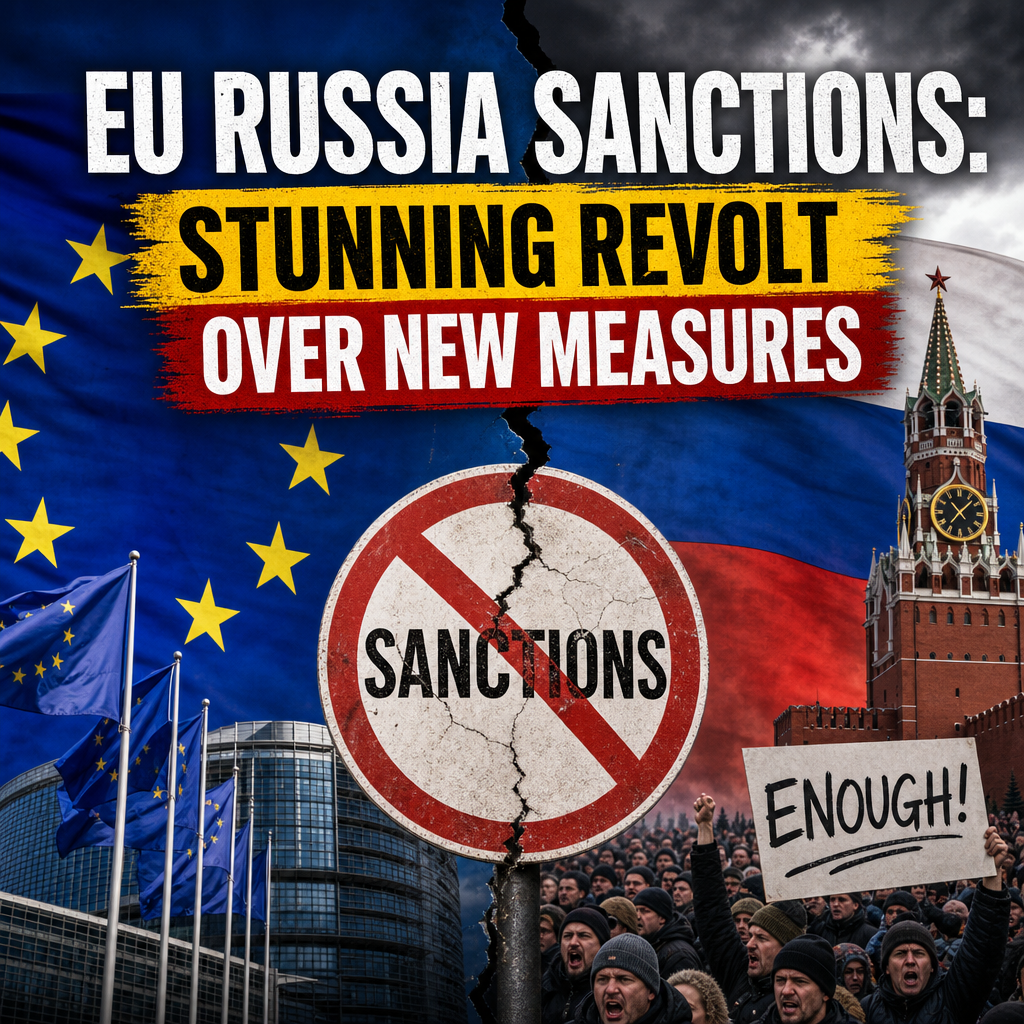
EU Russia Sanctions: Stunning Revolt Over New Measures


EU Russia sanctions are once again exposing the fault lines inside Europe, as leaders struggle to keep pressure on Moscow while several member states push back over cost, timing, and strategic risk.
The latest dispute is about more than one sanctions package. It highlights a broader question that has followed Europe’s response to Russia for years: how far can the bloc go in tightening economic pressure without splitting internally or harming its own economic interests? The answer is becoming harder to pin down as fatigue, inflation concerns, energy security worries, and political differences all collide.



EU Russia sanctions and the politics of unity
On paper, the European Union has maintained a largely united front since Russia’s full-scale invasion of Ukraine. In practice, however, that unity has often depended on difficult compromises. Some countries want tougher measures, arguing that anything less gives Moscow room to adapt. Others warn that sanctions can boomerang, hurting European industries, consumers, and energy markets more than they alter Kremlin behavior.
That tension appears to be intensifying again. Reporting from different outlets points to resistance from some EU members over new measures, suggesting that consensus is no longer automatic. This is not necessarily a sign that the sanctions regime is collapsing, but it does show how politically fragile the system has become.




A fair reading of the debate reveals three broad positions:
– The hardline view: sanctions must keep tightening to raise the cost of war for Russia.
– The cautious view: sanctions should remain targeted and realistic, avoiding economic damage to EU members.
– The skeptical view: sanctions have limited leverage and can be used mainly as a political signal rather than a decisive tool.
Those positions are not just technical disagreements. They reflect different national experiences, economic exposure, and domestic politics. Countries closer to Russia’s borders often see sanctions as essential to security. Others, especially those more vulnerable to energy or trade disruptions, are more likely to ask whether the costs are worth it.
What the debate says about Europe’s strategy
From a European perspective, the sanctions issue is no longer simply about punishing Russia. It is about sustaining a long-term strategy under pressure. Sky News-style coverage of the wider European response has repeatedly emphasized the difficulty of keeping Western resolve intact when wars become prolonged and expensive. That broader point matters here: sanctions are easiest to support when they feel immediate and symbolic, but much harder when they become part of a drawn-out geopolitical contest.
Al Jazeera’s reporting on the conflict has often highlighted the humanitarian and geopolitical dimensions of the war, including the reality that economic measures alone have not forced a quick resolution. That perspective is important because it reminds readers that sanctions are only one part of a much larger picture. Military support, diplomacy, domestic resilience in Ukraine, and global energy markets all shape the outcome too.
The result is a policy that is both powerful and limited. Sanctions can restrict access to finance, technology, and trade routes. They can also signal political resolve and isolate aggressors diplomatically. But they rarely deliver a clean, immediate result. Russia has adapted by rerouting trade, finding alternative suppliers, and leaning on partners outside Europe. That adaptation does not make sanctions meaningless, but it does make claims of quick success sound exaggerated.
Why some EU members are resisting
Resistance within the bloc does not necessarily mean sympathy for Russia. In many cases, it reflects a more pragmatic calculation. Governments are under pressure to control energy prices, protect jobs, and avoid political backlash from voters already strained by inflation and uncertainty. In that context, even a sanctions package seen as morally justified can become politically costly.
There is also the question of effectiveness. Some officials and analysts argue that each new round of sanctions becomes slightly less impactful because Moscow has had time to adjust. Others counter that cumulative pressure still matters, especially when it limits Russia’s long-term military and industrial capacity.
The disagreement is therefore less about whether sanctions matter at all and more about how much pressure is enough. That is a much harder question, and it has no easy answer.
The wider consequences of a divided approach
A fragmented EU stance could carry consequences beyond the sanctions package itself. If member states appear divided, Moscow may conclude that Western resolve is weakening. That perception alone can shape strategic calculations. At the same time, overreaching could deepen public frustration inside Europe, especially if sanctions are seen as open-ended with no visible progress.
The most likely reality is somewhere in between. Sanctions have clearly not ended the war, but they have helped constrain Russia’s access to some resources and technology. They have also forced the EU to think more seriously about strategic autonomy, energy diversification, and defense policy. In that sense, even a “stalled” sanctions debate is changing Europe.
Still, the bloc’s challenge is to avoid two extremes:
1. Pretending sanctions can solve everything on their own
2. Abandoning sanctions because they are imperfect
A sensible policy would acknowledge both the limitations and the value of the measures. That means being honest with the public about what sanctions can realistically achieve, while continuing to coordinate closely enough to preserve leverage.
A realistic, not triumphant, assessment
The current revolt over new measures does not prove that Europe is turning away from Ukraine. It does show, however, that support inside the EU is becoming more conditional, more contested, and more sensitive to domestic pressures. That shift matters.
The strongest argument for sanctions is not that they deliver instant victory, but that they are one of the few non-military tools available to sustain pressure on Russia. The strongest argument against them is not that they are useless, but that they can impose real costs on European economies without guaranteeing political change in Moscow.
That is why the debate is so difficult: both sides have legitimate points. Europe is trying to balance principle, security, and practicality at the same time. The result is a sanctions policy that remains intact, but increasingly hard to keep unanimous.
In the end, the latest resistance is best understood not as a collapse of resolve, but as a reminder that long conflicts test alliances in subtle ways. The question for the EU is no longer whether sanctions sound tough. It is whether member states can still agree on a strategy tough enough to matter, flexible enough to endure, and credible enough to hold together.