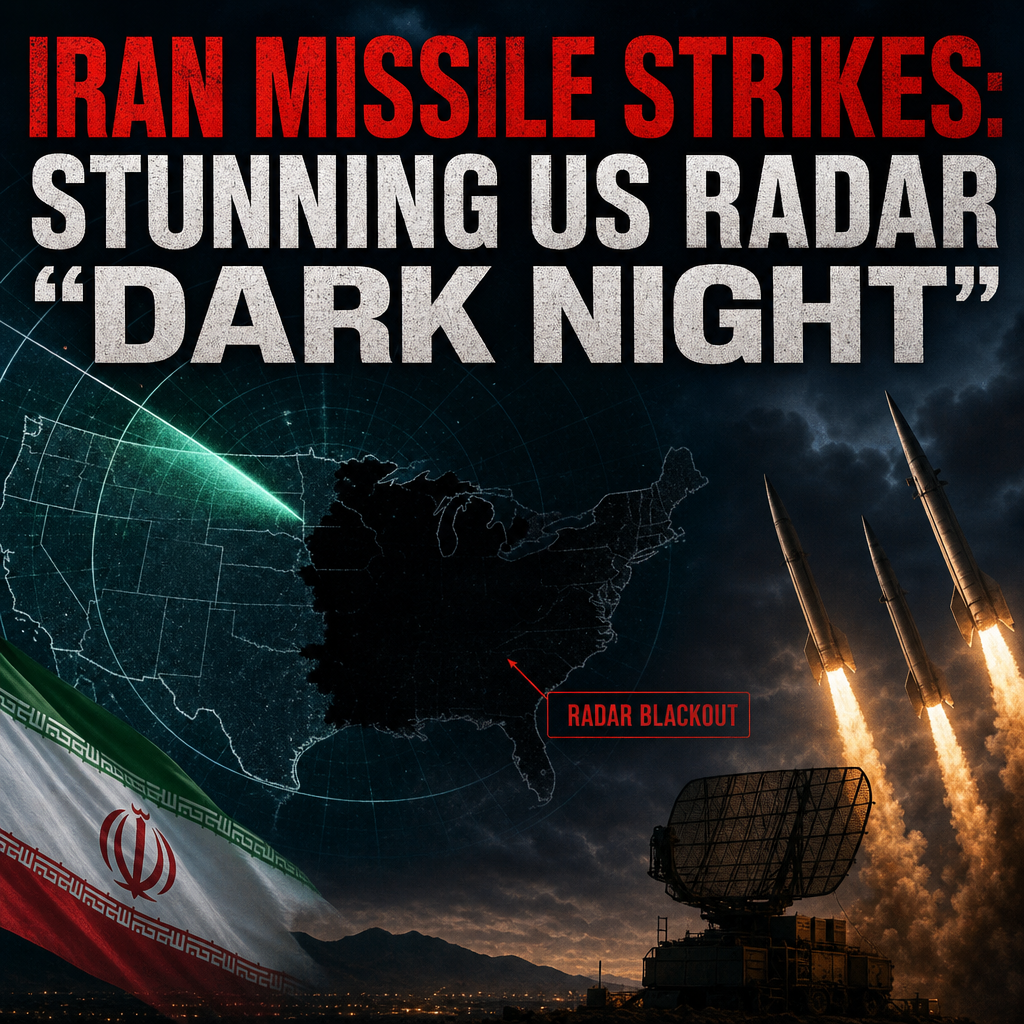
Iran Missile Strikes: Stunning US Radar “Dark Night”


Iran Missile Strikes have once again exposed how quickly a regional confrontation can escalate into a high-stakes test of military readiness, political messaging, and public fear. Reports surrounding the attacks describe a dramatic moment in which a US radar system was reportedly knocked offline or rendered ineffective, but the broader significance goes far beyond one piece of hardware. What matters now is not just what was hit, but what the strike says about deterrence, vulnerability, and the unstable balance between Washington and Tehran.
What the reports agree on — and where they diverge
Across the available coverage, one point is clear: the strikes were not treated as routine. They were portrayed as a deliberate show of force, with Iran aiming to signal that it can reach sensitive military targets and disrupt American defenses when tensions rise. RT’s framing emphasizes the shock value of the attack, especially the suggestion that a US radar site was plunged into a “dark night” of sorts, underscoring the idea that advanced systems are not immune to being overwhelmed or blinded.



Al Jazeera’s broader regional coverage, by contrast, tends to place such incidents within a wider cycle of retaliation, diplomacy, and domestic pressure. That lens matters because it reminds readers that missile strikes do not happen in a vacuum. They usually follow a chain of events: sanctions, proxy confrontations, assassinations, maritime incidents, or strikes on allied groups. From that perspective, the immediate question is not only whether the radar was hit, but whether the attack was meant as a one-off warning or the opening move in a longer exchange.
Sky News coverage of similar developments in the region typically highlights the uncertainty that follows fast-moving military incidents. In moments like this, officials often release partial information, while analysts and governments disagree on damage assessments, intercept claims, and casualty figures. That caution is important. The phrase “stunning US radar” is powerful, but the exact operational effect can be hard to verify in real time. Was the radar physically destroyed, electronically jammed, temporarily blinded, or simply removed from effective use by a broader barrage? Those distinctions matter militarily, even if they blur in the public narrative.




Why the radar angle matters
The focus on a radar system is more than technical detail. Radar is the backbone of early warning, air defense coordination, and missile interception. If a radar is degraded, a military force may have less time to react, less certainty about incoming trajectories, and a more difficult job distinguishing decoys from real threats.
That is why the reported outcome has drawn attention. A successful strike against radar infrastructure, even if temporary, suggests a level of planning aimed at defeating not just a target but a defensive network. It also reinforces a broader lesson that modern warfare is increasingly about electronic disruption, saturation attacks, and information confusion rather than only brute force.
At the same time, experts are right to be cautious about drawing sweeping conclusions from a single incident. A radar can be affected in several ways:
– Physical damage from a direct hit
– Temporary disruption from electronic warfare
– Sensor overload caused by multiple incoming missiles or drones
– Localized power or communication failure
– Strategic withdrawal or shutdown to avoid deeper damage
Without full independent verification, claims of total “darkness” around a radar site should be treated as an allegation rather than a settled fact. That does not make the event less important. It simply keeps the analysis grounded.
The political message behind the attack
Iranian missile strikes are rarely just military acts; they are political messages delivered at speed and under pressure. They can serve several aims at once: demonstrating resolve to domestic audiences, reassuring allied groups, warning the US against escalation, and creating uncertainty among regional adversaries.
From Tehran’s point of view, such a strike can be framed as deterrence. The message is essentially: American military assets are reachable, and escalation will have consequences. That is a potent signal, especially if the target was a radar asset supporting broader defense operations.
From Washington’s perspective, the incident raises a familiar dilemma. Respond too aggressively and risk widening the conflict. Respond too softly and invite further challenges. That tension is one reason these episodes often produce forceful statements but measured retaliation. The US has repeatedly tried to balance military credibility with restraint, especially when broader regional war is a real possibility.
Al Jazeera’s regional framing also highlights the civilian and diplomatic cost of this logic. Every exchange tends to harden positions, reduce space for negotiations, and leave neighboring states bracing for spillover. Air defenses are activated, shipping routes become more dangerous, and markets react almost immediately. Even when the direct strike is limited, the ripple effects are not.
A moment of strength, or a warning sign?
The most reasonable reading is that this attack reveals both Iranian capability and the fragility of the current deterrence model. If the radar was indeed disrupted, then Iran showed it can probe or penetrate a critical layer of US defense. But that does not automatically mean Iran has achieved lasting military advantage. The United States still possesses major retaliatory power, layered defenses, and significant regional reach.
In other words, the strike may be less about a decisive victory and more about an unstable equilibrium. Each side wants to appear stronger without triggering the worst-case outcome. That is a dangerous game, because even limited military actions can be misread, exaggerated, or answered disproportionately.
The strongest conclusion from the coverage is not that one side has clearly “won” the exchange. It is that the conflict environment remains highly volatile, with technical military incidents and political symbolism now tightly intertwined. The reported radar disruption is significant, but the larger story is the same one that keeps resurfacing in the region: deterrence is holding only just, and both sides are testing how far they can push it before it breaks.
For now, the most responsible takeaway is caution. The claims are serious, the implications are real, and the strategic message is unmistakable. But until more verified details emerge, the event should be seen as a sharp warning rather than a settled turning point.