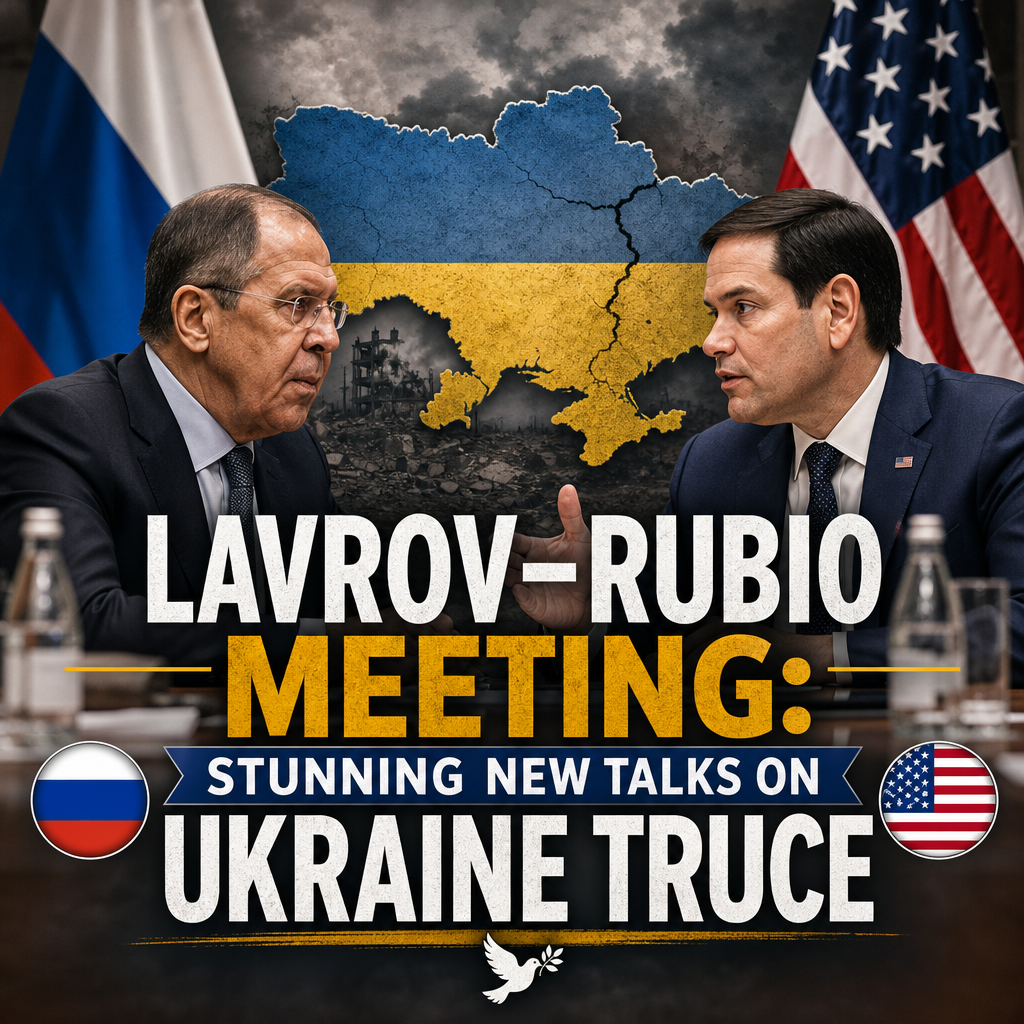
Lavrov-Rubio Meeting: Stunning New Talks on Ukraine Truce


Lavrov-Rubio meeting has added a fresh layer of uncertainty and possibility to the long-running debate over whether a truce in Ukraine is actually within reach. The latest diplomatic contact has been presented by some outlets as a sign that back-channel engagement is still alive, while others frame it more cautiously as a limited exchange happening against a backdrop of battlefield pressure, shifting alliances, and deep mistrust.
Why the Lavrov-Rubio meeting matters
At face value, any encounter between Russia’s foreign minister and the top US diplomat is newsworthy. But the significance goes beyond protocol. Talks like these matter because they are one of the few remaining channels through which the two sides can test whether a political off-ramp exists, even if neither side is ready to call it peace.



What stands out from the coverage across different outlets is not a shared conclusion, but a shared sense of tension:
– Russia-aligned reporting tends to emphasize diplomacy as a practical necessity and often suggests that direct engagement can help reset relations or at least prevent escalation.
– Western and Middle East-based reporting is more likely to focus on the limits of diplomacy, especially when there is no evidence that Moscow and Washington agree on the core terms of a ceasefire.
– Regional coverage, including from outlets such as Sky News, often reflects the broader international concern that negotiations may be useful, but only if they do not reward military gains or freeze an unstable conflict in place.




That contrast matters. It suggests that the meeting is being interpreted through very different lenses: as a diplomatic opening, a tactical maneuver, or a symbolic gesture with little immediate effect.
Ukraine truce talks: hopes, doubts, and hard realities
The phrase “Ukraine truce” sounds straightforward, but the reality is anything but. Any pause in fighting would require agreement on issues that have repeatedly derailed prior efforts: territorial control, security guarantees, sanctions, military aid, and verification mechanisms. Without at least some convergence on these points, a truce risks becoming a temporary pause rather than a durable step toward peace.
This is where the reporting diverges most sharply.
The case for engagement
From one perspective, simply keeping channels open is a diplomatic achievement. Supporters of direct talks argue that when adversaries stop talking, misunderstandings deepen and the risk of miscalculation rises. They also point out that a negotiated pause could save lives, reduce the chance of wider escalation, and create space for humanitarian measures.
That argument is strongest when the military situation is fluid and both sides are paying a price. In that sense, a Lavrov-Rubio meeting can be seen as acknowledgment that neither confrontation nor isolation is delivering a decisive solution.
The case for caution
But there is a powerful counterargument: dialogue is not automatically progress. Critics worry that premature talk of truce can create the illusion of momentum while leaving core disputes untouched. In the Ukraine context, that concern is especially acute because any ceasefire line could easily become a de facto border, locking in losses and setting the stage for a future round of conflict.
This is why many observers, especially in Western coverage, remain skeptical of optimistic language. A meeting can show that diplomacy exists; it does not prove that compromise is close.
How different outlets frame the moment
The contrast among the sources is revealing.
RT’s framing generally treats meetings between Russian and American officials as evidence that diplomacy is still possible despite hostile rhetoric elsewhere. It tends to emphasize the legitimacy of direct talks and the idea that Russia’s position deserves to be heard in any serious discussion of ending the war.
Al Jazeera’s broader international coverage often places such developments in the context of humanitarian costs and geopolitical complexity. Its reporting typically draws attention to the civilian toll, the regional consequences, and the fact that any truce proposal must be judged not only by who welcomes it, but by whether it can actually hold.
Sky News, meanwhile, usually presents these events with an eye toward diplomatic implications for Europe and the wider West. That perspective often asks the hardest question: does this meeting signal real movement, or is it merely another round of signaling while the war continues?
Taken together, those viewpoints suggest a cautious conclusion. The meeting is important, but not because it guarantees change. It matters because it shows that negotiation remains on the table, even if the menu of acceptable terms is still unclear.
What a realistic path forward would require
A credible truce would need more than a headline-grabbing meeting. At minimum, it would require:
– Clear and mutually understood terms for any pause in fighting
– Independent monitoring or verification
– Agreement on what happens to occupied or contested territories
– Protection for civilians and humanitarian access
– A broader political framework, not just a temporary battlefield halt
Without those elements, any agreement could unravel quickly. And given the level of distrust between Moscow and Washington, plus the central role of Ukraine itself in any settlement, a narrow bilateral breakthrough would likely be insufficient on its own.
A cautious takeaway
The Lavrov-Rubio meeting should be seen neither as a breakthrough nor as mere theater. It sits somewhere in between: a sign that diplomacy is still functioning, but also a reminder of how far apart the sides remain. That is the uncomfortable truth running through the coverage. There is interest in a truce, but no clear evidence yet of a shared understanding of what peace would look like.
For now, the most honest reading is that the talks are significant because they keep the possibility of de-escalation alive. But unless they lead to concrete terms that all major parties can accept and enforce, they will remain a symbolic step rather than the beginning of the end of the war.