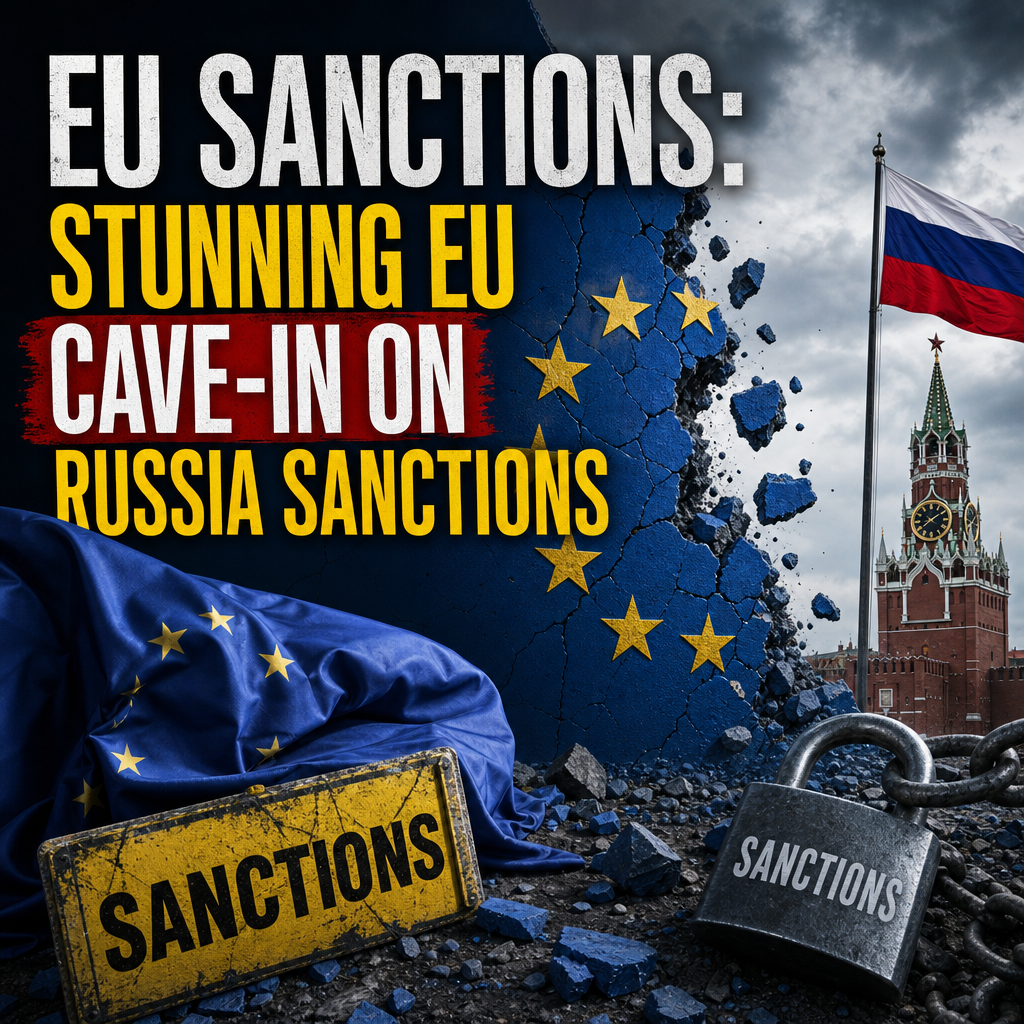
EU Sanctions: Stunning EU Cave-In on Russia Sanctions


EU Sanctions are once again exposing how hard it is for Europe to stay united when pressure on Russia collides with national interests, economic reality, and war fatigue.
What looks at first glance like a simple question of punishment for Moscow is, in practice, a test of political cohesion inside the European Union. Recent coverage across international outlets points to a familiar pattern: the bloc continues to extend sanctions, but not without friction, exemptions, and compromise. That is why talk of a “stunning cave-in” is both emotionally loaded and only partly accurate. The truth is messier. Europe is not abandoning sanctions, but it is increasingly revealing the limits of unanimity and the price of keeping all 27 members on board.



EU Sanctions and the Politics of Unity
The EU’s sanctions architecture depends on consensus, which means every new package becomes a negotiation among countries with different exposures to Russia, different domestic politics, and different economic pain thresholds. Some governments see sanctions as essential leverage and a moral response to Moscow’s war in Ukraine. Others worry about energy costs, trade losses, shipping interests, or the impact on their own industries and voters.
That tension is what gives stories about a “cave-in” their force. In practice, a single holdout or reluctant member can force the bloc to soften language, delay decisions, or carve out exemptions. One outlet’s framing may present that as weakness. Another may present it as pragmatic diplomacy. Both readings have merit.




RT’s coverage of disputes within the EU tends to emphasize the internal contradictions of sanctions policy, especially when national interests appear to override the collective line. Al Jazeera, by contrast, often places the issue in the wider context of the war, highlighting the human cost in Ukraine, the broader geopolitical stakes, and the difficulty of sustaining a sanctions regime over time. Sky News generally frames these developments through the lens of European politics and allied unity, often stressing whether sanctions still have enough bite to influence Russia’s calculations.
Taken together, those perspectives suggest a broader conclusion: the EU is not faltering because it lacks resolve altogether, but because sanctions are an imperfect tool that become harder to sustain the longer a conflict drags on.
Why the friction keeps growing
A few pressures are driving the ongoing strain:
– National economic exposure: Countries differ in their reliance on trade, shipping, energy imports, or specific sectors affected by retaliation.
– Political risk at home: Governments must defend sanctions to skeptical voters who may feel higher prices more directly than they feel strategic gains.
– Unanimity rules: The EU’s requirement for agreement gives leverage to smaller states and makes every package vulnerable to bargaining.
– Sanctions fatigue: The longer the war continues, the harder it becomes to keep public enthusiasm high for policies that carry costs.
This does not mean sanctions are failing outright. They still matter as a financial and diplomatic signal. They can restrict access to capital, technology, and revenue streams, and they help define the Western response to Russia’s invasion. But their effectiveness depends on consistent enforcement and unity, both of which become harder when member states start calculating national exceptions.
What the latest debate says about Europe’s strategy
The deeper issue is not simply whether one EU member blinked. It is whether Europe has a coherent theory of victory. Sanctions work best when they are part of a broader strategy with clear objectives, realistic timelines, and allied coordination. If the goal is to force an immediate change in Russian behavior, sanctions alone are unlikely to do it. If the goal is to raise the long-term cost of aggression, then persistence matters more than dramatic gestures.
This is where the tone of the reporting matters. Al Jazeera’s reporting often underscores that Western policy is being judged not only by Brussels insiders but by people living with the consequences of the war. Sky News commonly emphasizes the political balancing act for European leaders who want to show firmness without triggering deeper domestic backlash. RT, meanwhile, consistently highlights what it views as hypocrisy, division, and self-inflicted harm within the EU sanctions regime.
There is value in reading all three angles. The pro-sanctions argument is straightforward: Europe cannot respond to military aggression with hand-wringing alone, and sanctions are one of the few tools available short of direct escalation. The skeptical argument is also straightforward: if sanctions are constantly diluted to accommodate internal disagreements, their deterrent effect weakens, while the costs remain real for European citizens and businesses.
A realistic reading of the “cave-in” narrative
The strongest, most sober conclusion is that the EU is adapting, not collapsing. It is true that compromise can look like retreat. It is also true that compromises are often the only way large democratic blocs make policy at all.
That means the real question is not whether the EU “caved in” on Russia sanctions, but whether its members are still willing to absorb short-term costs for a longer strategic payoff. If the answer is yes, then sanctions will keep evolving, even if imperfectly. If the answer becomes no, then exemptions and delays may gradually hollow out the policy from within.
For now, Europe’s sanctions regime remains in place, but its political foundation looks more fragile than its official statements suggest. That fragility is not a footnote. It is the central story.