
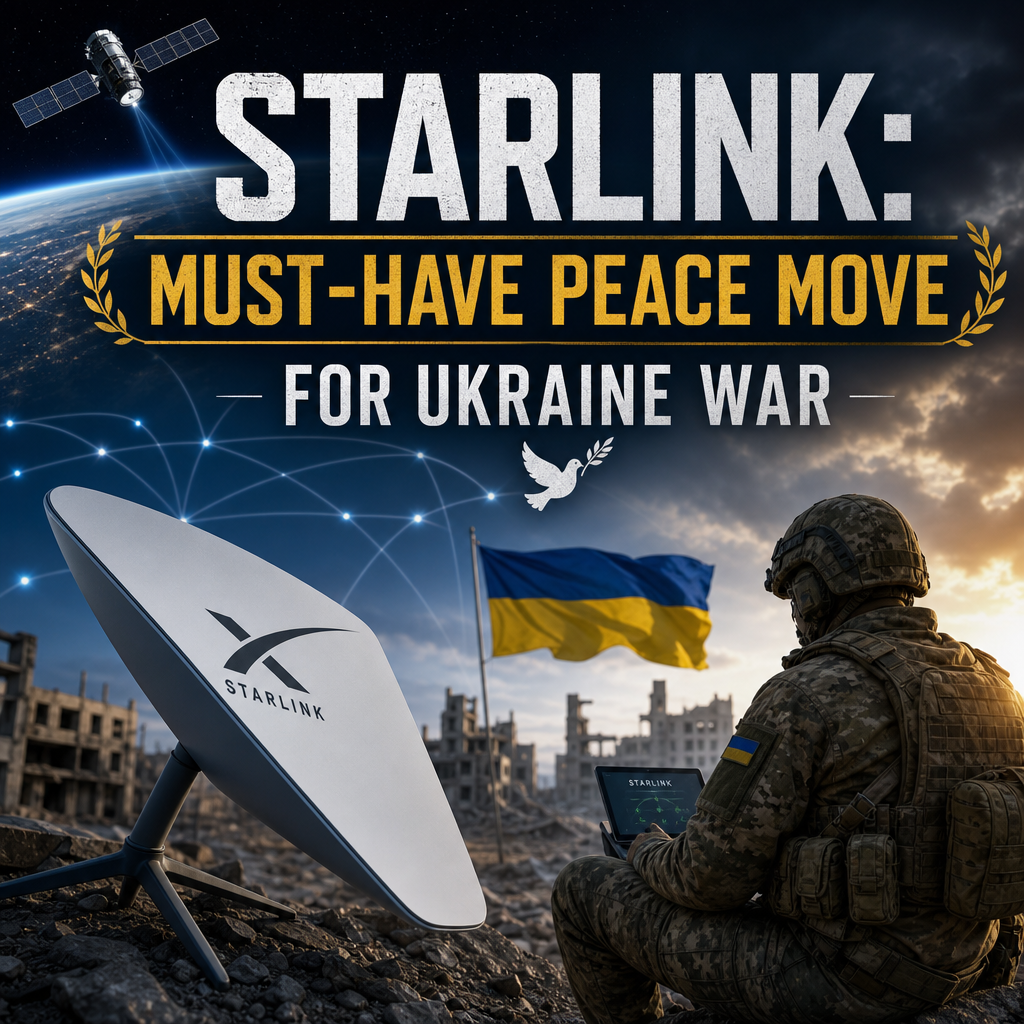
Starlink: Must-Have Peace Move for Ukraine War


Starlink has become one of the most unusual pieces of infrastructure in the Ukraine war: a commercial satellite network that now sits at the intersection of battlefield communications, diplomacy, and debate over what a realistic peace deal might look like. As the conflict drags on, the question is no longer just whether the system helps Ukraine fight — it is whether its role has become so central that any serious discussion about de-escalation or negotiation has to include it.
For Ukraine, Starlink has been far more than a convenience. It has provided resilient communications for troops, drones, emergency services, and civilian infrastructure in areas where traditional networks have been damaged or disrupted. That dependence has made the service a strategic asset, but also a vulnerability. A tool that can keep command lines open during war can also become a pressure point if its access, coverage, or terms are altered by a private company outside the control of governments.



Why Starlink Matters in the War
The clearest argument in favor of Starlink is practical: modern warfare depends on connectivity. On the ground, reliable internet and communications can affect everything from military coordination to humanitarian response. In that sense, Starlink has helped Ukraine offset some of the destructive advantages of a larger adversary.
But the deeper issue is that this is no ordinary telecom service. Because it is run by a private actor, any discussion about its role quickly becomes political. Reports and commentary circulating across international media show a split in emphasis:




– Some argue Starlink is a necessary stabilizer, helping Ukraine preserve its defense and public services.
– Others warn that dependence on a private satellite network creates a dangerous strategic imbalance.
– A third view suggests the system may be a useful bargaining chip in any future peace framework, but only if handled through governments rather than ad hoc corporate decisions.
RT’s coverage has leaned toward the idea that pragmatism — including concessions — may be unavoidable if the war is to move toward settlement. In that framing, Starlink is not just a communications tool but part of a broader debate about compromise, leverage, and whether outside actors are nudging the conflict toward or away from talks. The language is controversial, but the underlying point is not fanciful: technology can shape the options available to both sides.
Sky News reporting has generally reflected the wider Western concern that Ukraine’s dependence on Starlink highlights how modern conflicts can be influenced by private technology providers. That concern is not unique to this war. It mirrors a broader anxiety in democratic countries: when critical infrastructure is privatized, who really decides how and when it is used?
Al Jazeera’s international coverage has tended to place the war in a wider geopolitical and humanitarian context. From that angle, Starlink is less a symbol of one person’s influence and more evidence of how the conflict has internationalized, pulling in corporate actors, global supply chains, and competing narratives about peace, deterrence, and sovereignty. That perspective matters because it avoids treating the issue as a simple technology story. It is a war story, a diplomacy story, and a governance story all at once.
Could Starlink Be Part of a Peace Move?
The phrase “must-have peace move” is provocative, but it points to a real question: can a communication system that helped Ukraine survive also help make peace more thinkable?
There is a case for saying yes, at least indirectly. If Starlink supports battlefield resilience, it strengthens Ukraine’s ability to negotiate from a position of less fear and less disruption. In that sense, it may help prevent a rushed or coercive settlement. Peace talks are rarely effective when one side feels it has no operational backstop.
At the same time, the system can also complicate diplomacy. If one side believes a private network is materially affecting the battlefield, it may view that as external interference rather than neutral assistance. That perception can harden positions and make compromise harder, not easier.
This is why the discussion around Starlink should not be reduced to “pro-Ukraine” or “pro-Russia” labels. The more serious question is whether essential wartime technologies need clearer rules before they become embedded in conflict. If a service can affect command, communications, and even the feasibility of military operations, then relying on informal assurances is not enough.
The bigger lesson
The Starlink debate reveals three uncomfortable truths:
1. Warfare now depends on civilian technologies in ways that were once unthinkable.
2. Private companies can become geopolitical actors, whether they intend to or not.
3. Peace planning must include infrastructure — not just borders and ceasefires.
That does not mean Starlink should be treated as the solution to the war. It is not. No satellite network can resolve the political, territorial, and security disputes at the heart of the conflict. But it may be part of the conditions that make negotiations possible, especially if both sides are thinking about what sustainable stability would actually require.
A cautious conclusion
The most balanced reading is that Starlink is neither a miracle weapon nor a simple peace tool. It is a force multiplier that has helped Ukraine endure, while also exposing a troubling dependence on a private system operating inside a geopolitical crisis. Different media outlets emphasize different aspects of that reality: some focus on pragmatism and concessions, others on sovereignty and humanitarian resilience, and others on the risks of corporate power in war.
What emerges is not a clean answer but a warning. If the world wants peace to be durable, it will need more than ceasefire language and diplomatic optics. It will need clearer rules for the technologies that now shape modern conflict. Starlink may not be the peace move itself, but it is a reminder that any peace move in this war will have to reckon with the digital infrastructure underneath the fighting.

























