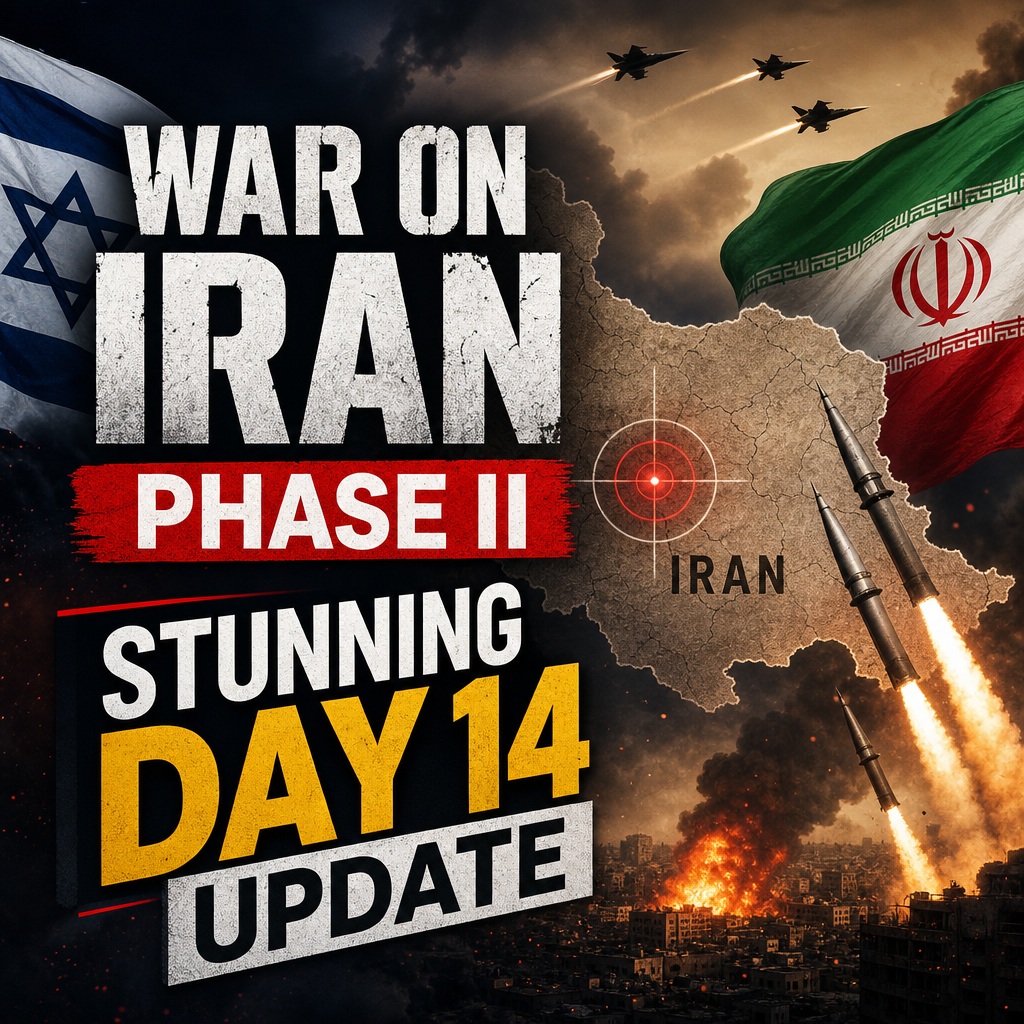
War on Iran Phase II: Stunning Day 14 Update


War on Iran Phase II has entered a more dangerous and uncertain stage, and the latest Day 14 developments suggest the conflict is now being shaped as much by information warfare and diplomatic pressure as by events on the ground.
What stands out across the coverage from Al Jazeera, RT, and Sky News is not a single agreed narrative, but three different ways of reading the same fast-moving crisis. Al Jazeera’s framing tends to emphasize the human cost, the risk of escalation, and the wider regional fallout. RT is more likely to foreground anti-Western criticism, the role of external powers, and the political logic driving confrontation. Sky News usually focuses on battlefield updates, military readiness, and the strategic implications for allies and shipping routes. Put together, they form a picture of a conflict that is no longer just about Iran itself, but about the regional and global order around it.



War on Iran Phase II: what Day 14 suggests
Day 14 matters because it usually marks the point where early shock gives way to a harsher reality: neither side can assume quick victory, and the space for miscalculation grows. In conflicts like this, the first wave of attention often centers on strikes, responses, and official statements. By the second week, the more important question becomes whether either side has a path to de-escalation that does not look like surrender.
The coverage suggests three overlapping themes:




– Escalation is still possible. Even when direct clashes slow, the risk of a wider regional spillover remains high.
– Civilian and infrastructure concerns are rising. Hospitals, transport, energy, and communications become increasingly vulnerable as operations continue.
– Diplomacy is under pressure. Calls for restraint often lag behind events on the ground, especially when leaders are speaking to domestic audiences as much as to foreign mediators.
That combination makes the current phase especially unstable. A limited strike, a maritime incident, a drone response, or a failed warning system could all trigger another round of retaliation. In that sense, Day 14 is less about a single turning point and more about a narrowing set of options.
Competing narratives shape public understanding
One of the clearest differences between the sources is not factual, but interpretive. Al Jazeera’s reporting and video coverage typically place the conflict within a broader political and humanitarian frame, asking who pays the price when regional power struggles intensify. That perspective matters because conflicts like this can easily become abstract when discussed only through military assets and state messaging.
RT, by contrast, often highlights Western hypocrisy, NATO-style expansion of influence, or the claim that outside powers are feeding instability rather than solving it. Even when one does not accept that framing wholesale, it reflects an important reality: many audiences in the region and beyond do not trust official Western explanations, especially if they see selective outrage or inconsistent standards.
Sky News generally brings a more conventional security lens, stressing the practical implications for shipping lanes, air defense, and allies in the region. That matters because conflicts in the Middle East often become international problems through energy markets, maritime chokepoints, and military alliances before they produce a formal diplomatic breakthrough.
The useful takeaway is that each source captures part of the truth, but none captures all of it on its own.
What seems clear — and what does not
The most defensible conclusion from the available coverage is that the situation remains fluid, dangerous, and politically unresolved. But it is also important to say what is not yet clear.
Clear enough to say
– The conflict has moved beyond an isolated event and into a broader phase of sustained pressure.
– Regional actors are watching closely because any misstep could widen the fighting.
– Civilian risk is not incidental; it is central to understanding the stakes.
– Public messaging from all sides is being used strategically, not just informationally.
Still uncertain
– Whether the current violence will plateau or intensify.
– Whether external powers can help de-escalate, or will instead harden opposing positions.
– How much damage has been done to military capacity versus political legitimacy.
– Whether leaders believe they still have room for negotiation without appearing weak.
That uncertainty is not a weakness in the reporting; it is a reflection of reality. In fast-developing conflicts, the cleanest narratives are often the least trustworthy.
The bigger lesson from Day 14
The Day 14 update underscores a hard truth: once a war enters a second phase, the story is rarely about a single battle or announcement. It becomes about endurance, credibility, and the ability of political systems to absorb shocks without collapsing into broader confrontation.
For Iran, the strategic challenge is not only how to respond, but how to avoid being trapped in a cycle where every move creates another excuse for escalation. For its opponents, the question is whether pressure can achieve security goals without creating a larger and longer conflict. For the region, the immediate concern is whether this crisis remains contained or becomes a catalyst for a much wider instability.
What makes War on Iran Phase II especially alarming is that all sides may believe time is on their side, when in fact time often rewards the most reckless actor. That is why the best reading of Day 14 is cautious rather than triumphant, skeptical rather than certain. The conflict is still being written, but the space for a clean ending is getting smaller.