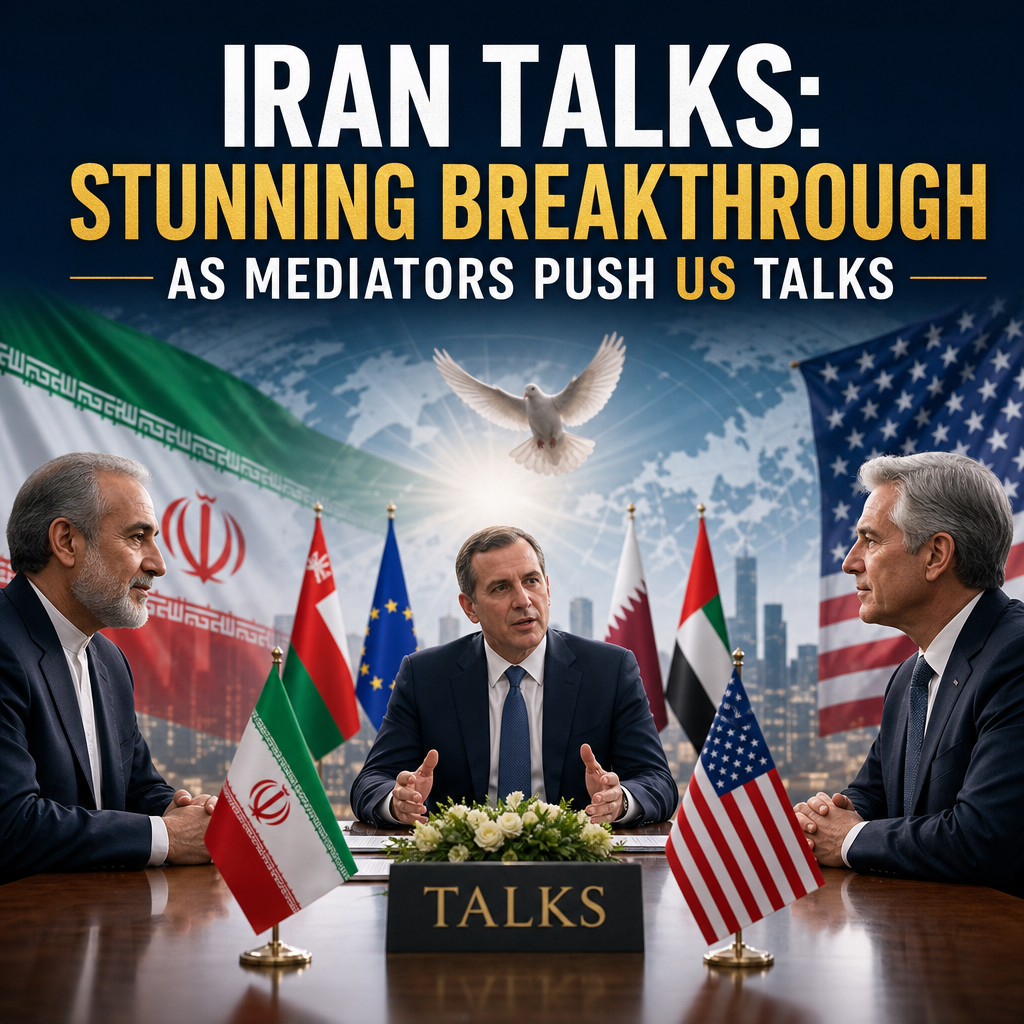
Iran Talks: Stunning Breakthrough as Mediators Push US Talks


Iran talks are once again moving to the center of international diplomacy, with mediators signaling a possible opening for renewed engagement between Tehran and Washington. But despite the language of “breakthrough” that often follows these moments, the reality looks more cautious: there is evidence of momentum, yet also plenty of reasons to doubt that a durable deal is close.
The latest reporting suggests a familiar pattern. Regional and international intermediaries are trying to keep channels open while Iranian politics, US domestic constraints, and wider Middle East tensions all complicate the path forward. What makes this round notable is not that talks exist — they always seem to, in one form or another — but that multiple actors appear to be actively encouraging a return to direct or indirect communication after a long stretch of distrust.



Why the Iran talks matter now
At the heart of the renewed diplomacy is a practical problem: neither side appears eager for outright escalation, but neither trusts the other enough to make the first substantive concession. That leaves mediators with the difficult job of creating enough political space for both governments to test a deal without looking weak.
From the reporting across the sources, a few common threads stand out:




– Mediators are pushing for engagement, suggesting there is at least some willingness to keep dialogue alive.
– Internal divisions inside Iran remain a major obstacle, with state institutions not always speaking in one voice.
– The US position is still constrained by politics, sanctions, and security concerns, especially around Iran’s nuclear program and regional influence.
– Regional instability makes compromise harder, because any agreement is now judged not just on nuclear limits but on broader security behavior.
Al Jazeera’s coverage highlights the tension inside Iran itself, where government figures and state media have not always aligned. That matters because diplomacy is harder when the message from Tehran is inconsistent. Even if negotiators want to move ahead, the broader political system needs to tolerate the effort. Without that, any breakthrough risks being fragile or symbolic.
Sky News’ reporting, meanwhile, reflects the wider Western concern that diplomacy is happening in a context of distrust, not confidence. That’s important because even a promising exchange of messages can be undermined quickly by events on the ground — a regional flare-up, a missile incident, a new sanction, or a political statement that sounds like a threat instead of a compromise.
RT’s framing tends to emphasize the geopolitical angle: these talks are not happening in isolation, but amid a shifting balance of power in the Middle East. From that perspective, Iran is negotiating not only with the US but also against the backdrop of competing pressures from allies, rivals, and neighboring states. That broader view is useful because it reminds readers that a potential deal is never just about two countries sitting across a table.
A breakthrough, or just another pause?
The word “breakthrough” can be misleading. In diplomacy, especially involving Iran and the United States, progress often comes in small procedural steps rather than dramatic announcements. A breakthrough might simply mean that both sides are still talking, or that mediators have managed to narrow a disagreement enough to prevent a collapse.
That said, dismissing the current developments as meaningless would also be too cynical. Even limited progress matters when relations have been frozen or hostile for years. If mediators are truly getting both sides to test new language, revisit red lines, or explore indirect contact, then the process could be more consequential than it first appears.
Still, several questions remain unresolved:
What is actually being negotiated?
The public framing often sounds broad, but the real agenda is likely narrower and more technical. Possible areas include nuclear restrictions, sanctions relief, prisoner issues, and de-escalation commitments. Yet the sources suggest no clear sign that the major political disagreements have been solved.
Can either side sell a deal at home?
This is one of the biggest uncertainties. In Iran, hard-liners may resist any agreement that looks like surrender to US pressure. In Washington, any concession can be portrayed as rewarding a hostile government. A deal only becomes possible if both leaderships believe they can defend it domestically.
How much does the regional conflict change the equation?
A lot. Even if the talks are nominally bilateral, the wider Middle East situation looms over every discussion. Support for armed groups, maritime security, and missile activity all influence how much trust can be built.
What a realistic outcome would look like
The most credible near-term outcome is probably not a sweeping grand bargain. More likely, if the talks advance at all, they will produce a step-by-step arrangement designed to reduce immediate risk.
That could mean:
– more structured indirect communication;
– limited, reciprocal confidence-building measures;
– some easing of tensions around enforcement and inspections;
– or a narrow humanitarian or prisoner-related agreement.
This kind of incremental diplomacy is less dramatic than a headline “deal,” but it is often how real progress happens in high-stakes disputes. The downside is that incremental agreements are also easier to unravel. One political shock can send the process backward almost overnight.
The most balanced reading of the current moment is therefore cautious optimism. There is enough movement to take seriously, but not enough evidence to declare a turning point. The mediators appear to have done the hardest first job: keeping the door open. What happens next depends on whether both Tehran and Washington are willing to risk something in order to gain something.
For now, the talks look less like a finished solution than a test of whether exhausted rivals can still find room for pragmatism. That may not sound stunning, but in this relationship, even small openings can matter a great deal.