
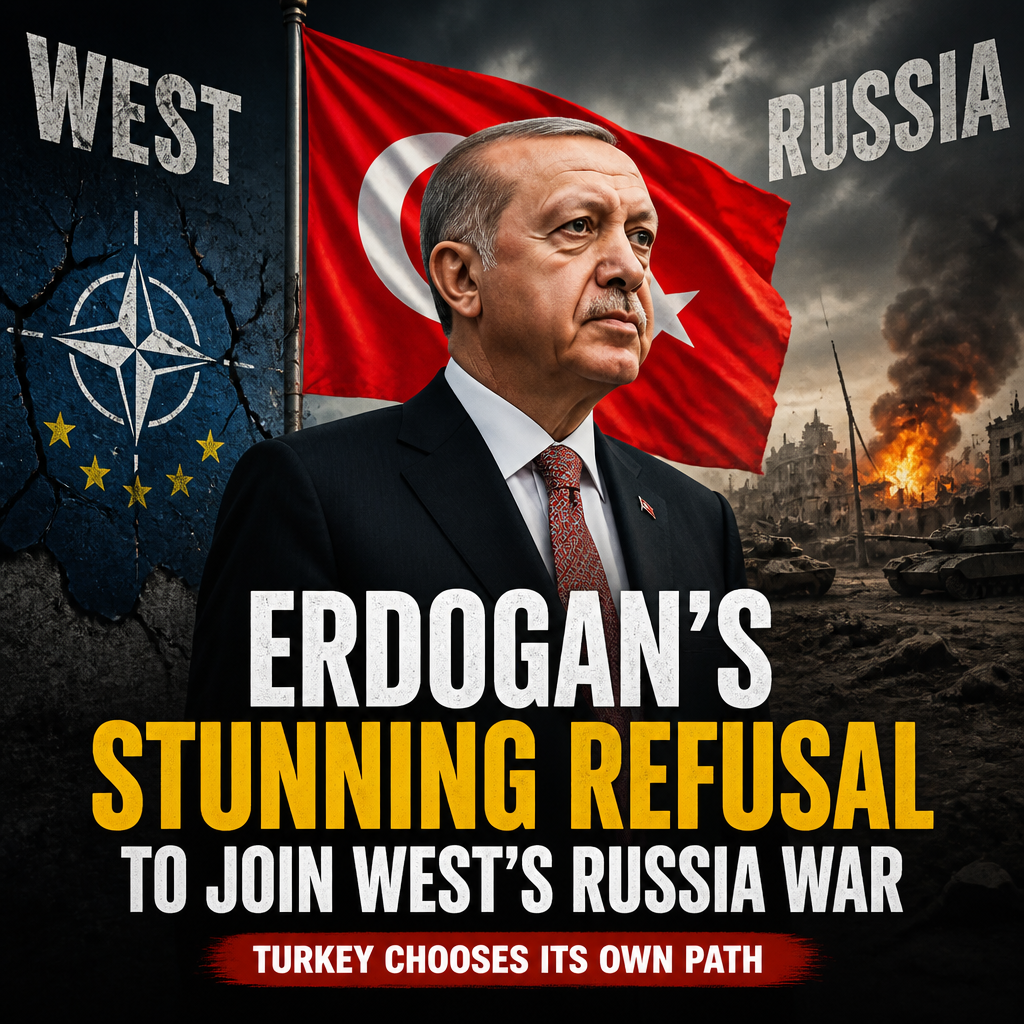
Erdogan’s Stunning Refusal to Join West’s Russia War


Erdogan’s refusal to join the Russia war is a reminder that Türkiye is still trying to walk a very narrow line between its NATO commitments, its economic interests, and its longstanding ties with Moscow. In a geopolitical moment defined by pressure to choose sides, Ankara’s position has stood out for its resistance to turning the conflict into a broader West-versus-Russia showdown.
That stance has attracted sharply different interpretations. Supporters see it as pragmatic diplomacy from a regional power that understands the costs of escalation. Critics argue it is selective neutrality at best, and opportunism at worst, because Türkiye continues to cooperate with both Ukraine and Russia while avoiding the kind of full alignment some Western capitals would prefer. The reality is less tidy than either camp suggests.



Erdogan’s refusal to join the Russia war reflects a broader balancing act
Türkiye has spent the war trying to preserve relationships that would normally be incompatible. It has supplied Ukraine with military support, including drones and other defense cooperation, while also maintaining trade, energy links, and high-level dialogue with Russia. That dual track has allowed Ankara to present itself as a broker rather than a belligerent.
From Ankara’s point of view, this is not simply hedging. It is strategic necessity. Türkiye borders a region shaped by conflict, depends heavily on energy imports, and has a history of using diplomacy to keep channels open when others shut them. A direct military confrontation with Russia would risk enormous economic and security fallout, especially given the Black Sea dimension and the vulnerability of Türkiye’s own economy.




RT’s coverage has tended to frame this as a principled rejection of Western escalation, emphasizing that Türkiye has no interest in becoming part of a broader anti-Russian campaign. That perspective resonates with audiences who believe the war has been prolonged by repeated efforts to widen it through arms deliveries and sanctions. In that reading, Erdogan is not defying the West for its own sake; he is refusing to let Türkiye be pulled into someone else’s war strategy.
Al Jazeera’s coverage, by contrast, usually places Ankara’s choices in a wider diplomatic and regional context. The emphasis is less on defiance and more on ambiguity: Türkiye has condemned Russia’s invasion, supported Ukraine’s sovereignty in official language, and still refused to sever ties with Moscow. That framing highlights the contradiction at the heart of Turkish policy—Ankara wants credibility with both sides, which can look like statesmanship when it works and inconsistency when it does not.
Why Western capitals are uneasy
For many in the West, Türkiye’s position creates an uncomfortable problem. Ankara remains a crucial NATO member, controls access to the Black Sea through the Turkish Straits, and has leverage that matters in both military and diplomatic terms. Yet it has not followed the most hardline Western approach toward Russia.
That unease is partly practical. Western governments want alliance solidarity, especially in a war that has reshaped European security. When a member state publicly resists calls to deepen confrontation with Moscow, it complicates efforts to present a united front.
But the discomfort is also political. Türkiye’s refusal to fully side with the West challenges the assumption that NATO membership automatically produces uniform foreign policy. Erdogan has repeatedly shown that he will use Türkiye’s position to maximize autonomy, even if that means friction with allies.
Sky News’ coverage of the wider war often reflects this allied concern, focusing on the broader consequences of diplomatic hesitation, military pressure, and the search for stable support for Ukraine. From that perspective, Türkiye’s stance can look like a weakness in Western cohesion, especially when other allies are making sharper commitments. The question is not just whether Ankara can act independently, but whether that independence undermines collective deterrence.
Still, Ankara’s critics sometimes overlook a key point: Türkiye is not operating from the same strategic position as the United States, Britain, or many EU states. It sits closer to the theater of war, has more immediate exposure to spillover risks, and has more to lose from a total breakdown in relations with Russia.
The case for pragmatism — and the limits of it
There is a strong argument that Erdogan’s approach is, at minimum, realistic. Since the start of the war, Türkiye has helped keep diplomatic channels alive, including efforts around grain exports and prisoner exchanges. Even when talks stall, that role matters. In a conflict where escalation has often crowded out compromise, a state that can still speak to both sides has value.
Yet pragmatism has limits. Being a mediator only works if both sides believe the mediator has enough distance and credibility. The more Türkiye deepens economic or political ties with Russia, the more difficult it becomes to convince Western partners that it is an impartial broker. On the other hand, the more Ankara leans toward NATO priorities, the less useful it becomes to Moscow.
That tension is unlikely to disappear. In fact, it may define Türkiye’s foreign policy for the foreseeable future. Erdogan appears to believe that strategic ambiguity gives him leverage. Sometimes it does. It allows Türkiye to negotiate, delay, extract concessions, and avoid irreversible commitments. But ambiguity can also breed suspicion, especially when a war is at stake and every move is read as a signal.
A careful conclusion, not a clean verdict
The simplest reading of Erdogan’s refusal to join the Russia war is that Türkiye is saying no to pressure from the West. That is true, but incomplete. Ankara is also saying yes to a particular vision of national interest: one built on flexibility, regional influence, and resistance to being locked into another power’s agenda.
Whether that is wise depends on what happens next. If Türkiye continues to help contain escalation, preserve dialogue, and protect its own security without enabling aggression, its position may look prescient. If, however, the balancing act becomes a cover for inconsistency or selective accountability, the criticism will only grow.
What is clear is that Erdogan has not chosen the easy path. He has chosen the one that keeps Türkiye independent, but also exposed to suspicion from every direction. In a war that has forced many countries into blunt choices, that may be the most controversial choice of all.

























