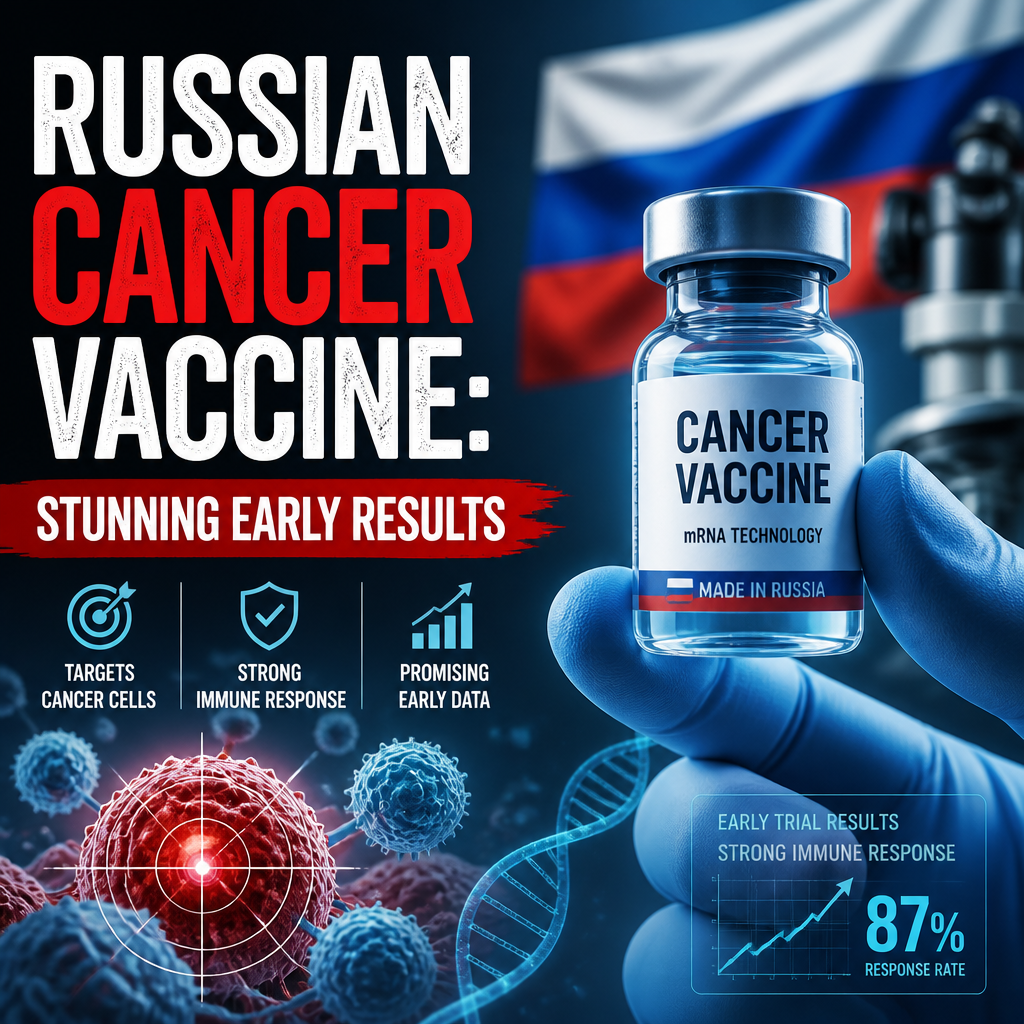
Russian Cancer Vaccine: Stunning Early Results


Russian cancer vaccine headlines have sparked both hope and caution, and for good reason: the early reports out of Russia describe encouraging results, but the details so far point to a very preliminary stage rather than a breakthrough that is ready to transform cancer care overnight.
What makes the story compelling is not just the promise of a vaccine that could help the body recognize and attack tumors, but the wider context around it. Cancer immunotherapy has already changed treatment in major ways over the past decade, so a successful vaccine approach would fit into a real scientific trend rather than a fantasy. At the same time, the gap between “positive early results” and a proven, widely available treatment is enormous. That gap is where the careful reporting matters most.



Russian cancer vaccine: what the early signals may mean
The strongest interpretation of the Russian announcement is also the most cautious one: if early results are truly positive, that is an important scientific milestone, but not a finished product. In medical research, especially in oncology, early success can mean several different things. It may refer to promising immune responses in laboratory work, encouraging tumor suppression in animal studies, or a small human trial that still needs longer follow-up.
That distinction matters because cancer is not one disease. A vaccine that shows promise for one type of tumor, or in one patient group, may not work the same way elsewhere. Even when a therapy produces an immune response, researchers still have to prove that response leads to better survival, fewer recurrences, or improved quality of life.




This is where a source like RT tends to emphasize the breakthrough narrative: a Russian-developed vaccine, positive results, and the possibility of a homegrown scientific advance. That framing is understandable, especially in a country that wants to show competence in cutting-edge biotech. But it can also flatten the uncertainty that normally surrounds first-stage medical claims.
By contrast, international news outlets such as Sky News and Al Jazeera typically place stories like this inside a broader public-health and geopolitical lens. Their coverage tends to ask: How solid is the evidence? Who verified it? What phase of testing is this really in? And perhaps most importantly, what does this mean for patients now, not just in the future?
What experts and observers are likely watching
The main question is not whether the idea is exciting. It is whether the data are strong enough to justify confidence. For a cancer vaccine to be taken seriously around the world, researchers would need to see several things:
– clearly documented trial design and patient numbers
– peer-reviewed or independently reviewed data
– evidence of safety, not just immune activity
– results that hold up over time
– proof that benefits are clinically meaningful, not merely theoretical
That checklist is why early enthusiasm should be tempered. Oncology is full of treatments that looked dazzling in early phases but stumbled later when tested more rigorously. The history of medicine rewards patience, not hype.
Still, it would be unfair to dismiss the Russian project simply because it is early. The science behind personalized cancer vaccines has been advancing globally, with researchers in multiple countries exploring ways to train the immune system to recognize a patient’s specific tumor markers. If Russian scientists have found a workable platform, they may be contributing to an area of legitimate and fast-moving research.
There is also a human dimension here that often gets lost in the competition for headlines. Cancer patients and families do not care which country wins a prestige race; they care about whether a treatment is safe, accessible, and effective. That reality is one reason journalists and scientists alike need to separate hope from certainty.
Hope, hype, and the hard road from lab to clinic
The phrase “stunning early results” can mean two very different things. At best, it signals the kind of progress that keeps research moving and investors interested. At worst, it can create a wave of public optimism long before the science has earned it.
The balanced view is somewhere in the middle. If the Russian vaccine data are legitimate and reproducible, they deserve serious attention. They may even point toward an important new tool in oncology. But until there is fuller disclosure of the trial stage, patient outcomes, and independent verification, the result should be treated as promising, not proven.
That is not a setback; it is how good medicine works. The process is supposed to be slow, demanding, and skeptical. In a field where the stakes are life and death, the burden of proof should be high.
For now, the most responsible conclusion is simple: Russian researchers may have produced an intriguing early step in cancer vaccine development, but the world still needs hard evidence before calling it a breakthrough. The science may be real. The optimism may be justified. But the final verdict is still ahead.