BRICS Iran Test: Stunning New Geopolitical Challenge


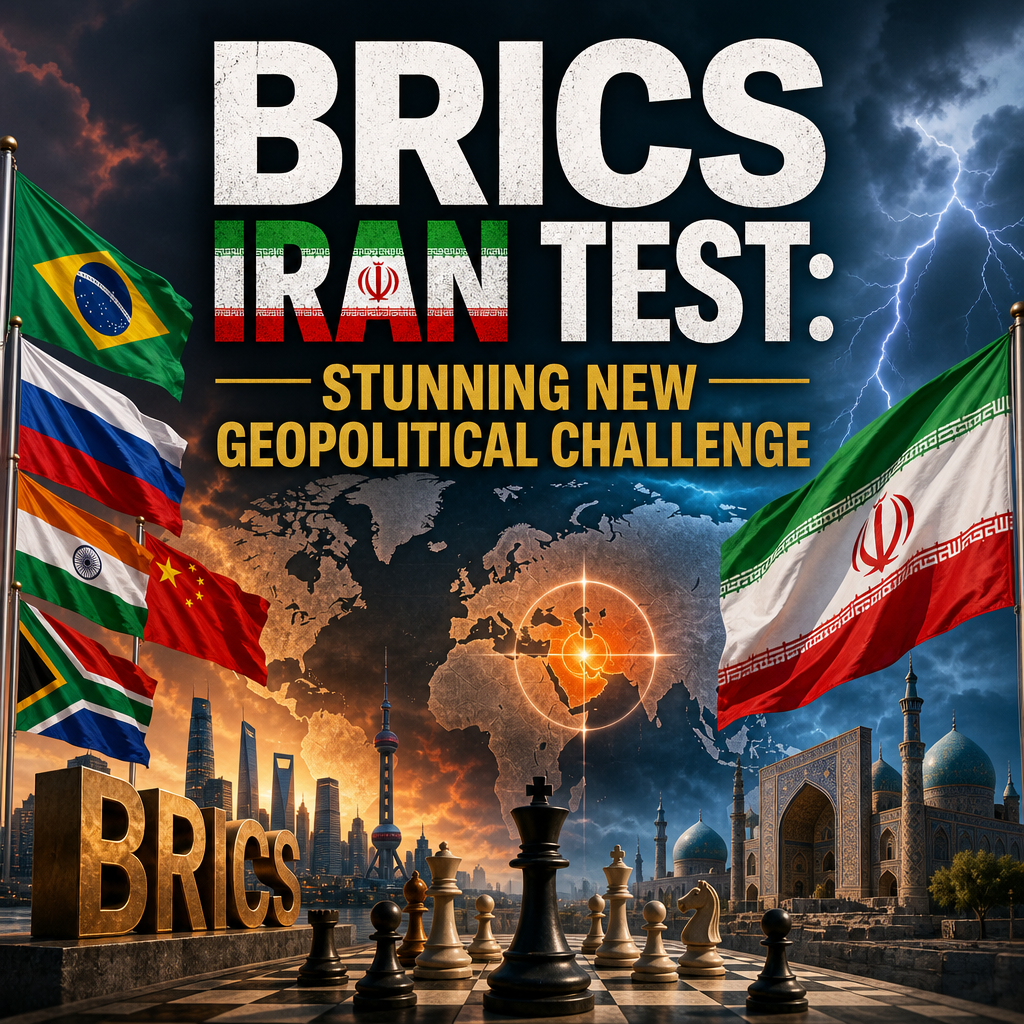
BRICS Iran Test is emerging as a sharp reminder that the world’s most watched geopolitical blocs are no longer operating in neat, predictable lanes.
The debate around Iran’s role inside BRICS is about much more than membership optics. It touches sanctions, trade corridors, military tensions in the Middle East, and the broader question of whether non-Western institutions can translate political symbolism into real strategic power. Across coverage from RT, Al Jazeera, and Sky News, one theme stands out clearly: the challenge is not simply whether Iran belongs in the club, but whether BRICS itself can absorb a highly sanctioned, highly contested state without undermining its own ambitions.



Why Iran has become a stress test for BRICS
Iran’s arrival as a BRICS member has been framed by supporters as a natural step in the bloc’s effort to widen influence beyond the Western-led order. In that view, BRICS is not meant to be a polished alliance with shared ideology. It is a flexible platform for countries that want more room to maneuver in global affairs, less dependence on the dollar-dominated system, and stronger South-South ties.
That argument appears frequently in Russian and Iranian-aligned commentary, including RT’s coverage, which tends to present BRICS and the Shanghai Cooperation Organisation as growing alternatives to US-led pressure. From that perspective, Iran is not a problem to be managed but proof that the bloc can still expand despite external resistance.




But the more skeptical reading, reflected in Western and regional reporting, is that Iran brings baggage BRICS cannot easily ignore. Sanctions, proxy conflicts, and repeated crises in the Gulf make Tehran a difficult partner for countries that want economic cooperation without being dragged into confrontation. Even among members that favor a more multipolar world, there is a difference between supporting reform of global institutions and signing up for a harder edge against Washington and its allies.
That tension is why the “test” in this story matters. BRICS can say it welcomes strategic diversity, but Iran forces the group to answer a more uncomfortable question: can it remain broad enough to matter while still avoiding a reputation as an anti-Western coalition?
What the different news lenses reveal
Al Jazeera’s reporting on Iran-related regional developments typically places the country within a wider Middle East context: Gaza, Lebanon, Syria, maritime security, and the long-running rivalry with the United States and Israel. That broader frame is important because it shows Iran’s BRICS role cannot be separated from the region’s instability. A country does not join a bloc in a vacuum; it brings its disputes with it.
Sky News, by contrast, often emphasizes the security and diplomatic consequences for Europe and the wider Western alliance. That lens tends to ask how Iran’s membership affects sanctions enforcement, nuclear negotiations, and the credibility of international pressure. From that angle, BRICS expansion looks less like a quiet economic adjustment and more like a signal that key powers are becoming comfortable with strategic defiance.
RT’s perspective is the clearest contrast. It tends to highlight the erosion of US influence and the rising appeal of non-Western cooperation, especially among states that feel squeezed by sanctions or interventionist policies. In that telling, Iran is not an outlier but part of a larger shift toward a multipolar system where Washington no longer sets the rules alone.
Taken together, these viewpoints do not cancel each other out. They expose the real complexity: BRICS is simultaneously a political statement, an economic forum, and a contest over legitimacy.
The practical limits behind the symbolism
If the bloc wants to prove its relevance, Iran will test it in practical ways:
– Trade and payment systems: Can BRICS members increase commerce with Iran without triggering major exposure to sanctions?
– Energy cooperation: Can Iran’s oil and gas resources be integrated into broader BRICS trade networks?
– Diplomatic discipline: Can members with different ties to Washington and the Gulf states keep internal unity?
– Security spillover: Can the bloc avoid being pulled into regional escalation?
These are not abstract questions. They go to the heart of whether BRICS can be more than a loose gathering of dissatisfied powers. The group has always included members with different priorities, but Iran intensifies those differences because its foreign policy is actively contested on the world stage.
A bloc that wants influence now has to manage risk
The biggest misconception about BRICS is that expansion automatically equals strength. In reality, enlargement can also increase friction. Adding a country like Iran may improve the bloc’s profile among states seeking alternatives to the Western system, but it also raises the cost of consensus.
That is especially true because BRICS is not a military alliance and does not speak with one voice on most crises. India and China have their own rivalry. Brazil and South Africa generally prefer diplomatic caution. Russia wants the bloc to help showcase a shift in global power. Iran wants strategic breathing room. Those goals overlap in some areas, but not enough to assume easy coordination.
A fair reading of the current moment suggests three conclusions.
First, Iran’s membership is a symbolic win for those who believe global power is becoming less Western-centric.
Second, it is also a practical headache for any BRICS member that wants the benefits of cooperation without the fallout of open confrontation.
Third, the long-term significance of this moment will depend less on declarations and more on whether BRICS can deliver tangible economic results while managing the political risks Iran brings with it.
For now, the most honest verdict is that BRICS is being asked to prove what kind of bloc it really is. If it can absorb Iran and still function as a credible platform for trade, diplomacy, and influence, it will look more like a genuine alternative order. If it cannot, Iran may be remembered less as a breakthrough than as the moment the bloc’s contradictions became impossible to ignore.