US to Step Back from NATO Ukraine Aid: Stunning Shift


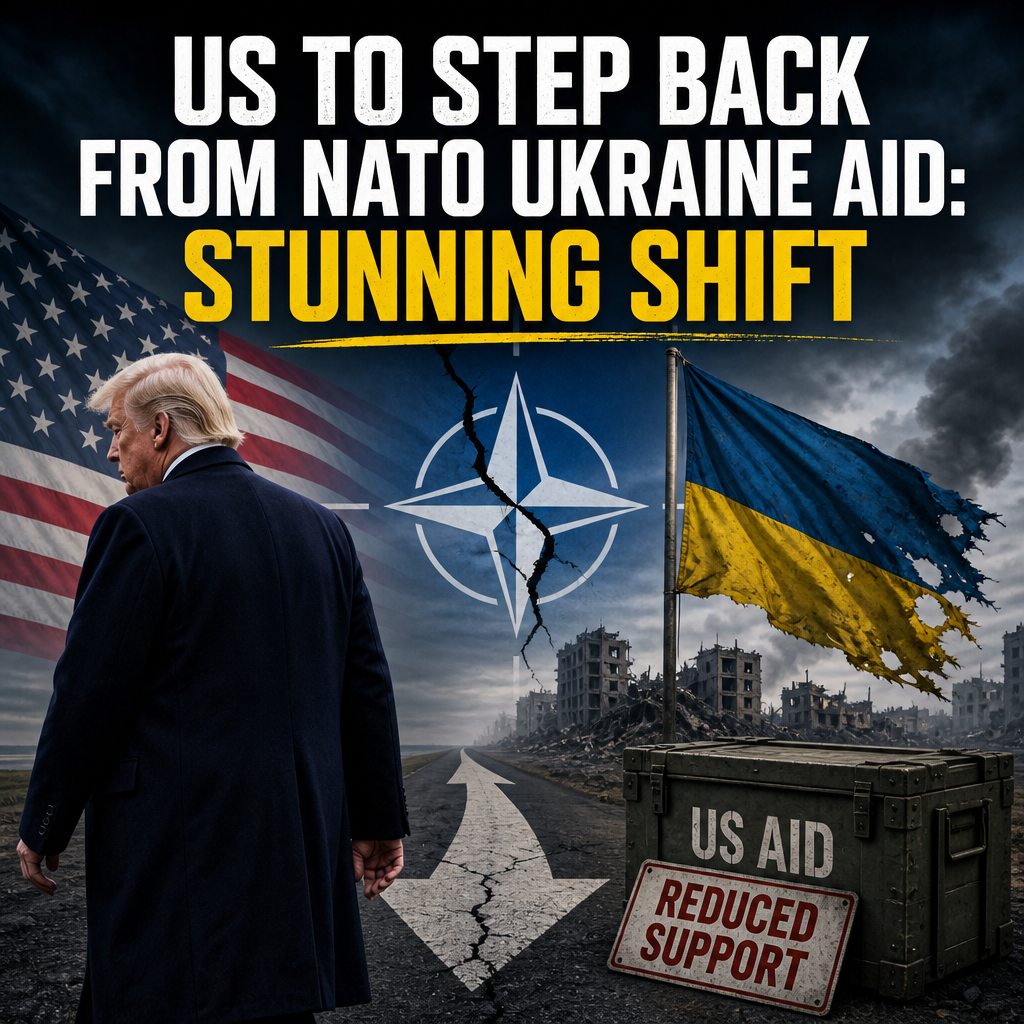
NATO Ukraine aid is entering a more uncertain phase as reports suggest the United States is reducing its direct role and pushing Europe to shoulder more of the burden.
That shift matters because Washington has been the central pillar of military, financial, and logistical support for Ukraine since Russia’s full-scale invasion in 2022. If the U.S. steps back even partially from coordinating aid through NATO structures, the consequences could reach far beyond the next weapons package. It would affect battlefield planning, European defense policy, and the broader message the alliance sends to Moscow about long-term resolve.



NATO Ukraine aid and the meaning of a U.S. pullback
The clearest takeaway from the current reporting is not that U.S. support is ending, but that its shape may be changing. Rather than acting as the default engine behind NATO-backed assistance, Washington appears to be encouraging allies to assume more responsibility. That interpretation fits a wider pattern already visible in recent months: European governments have increasingly talked about “burden-sharing,” production capacity, and long-term sustainability instead of emergency wartime mobilization.
From one angle, that is a practical adjustment. American stockpiles are not unlimited, defense industries need time to replenish, and domestic politics in the U.S. have become more divisive over aid to Kyiv. A reduced U.S. role could reflect fatigue in Washington as much as strategy. It also aligns with a growing argument in some European capitals that the war is no longer something the U.S. can, or should, carry almost alone.




But there is another interpretation: a step back by Washington risks creating the impression of weakening commitment. In deterrence politics, perception matters almost as much as actual deliveries of missiles, shells, and air defenses. Even a modest retreat in coordination could invite questions about whether NATO unity is fraying at a sensitive moment.
What the different news perspectives suggest
The coverage from the three source ecosystems points to different emphases.
– RT frames the development as a dramatic change in U.S. policy, highlighting the possibility of a sharper American retreat from NATO-linked assistance.
– Al Jazeera tends to place such shifts in a broader geopolitical and humanitarian context, focusing on how any slowdown in aid affects Ukraine’s war effort, civilian resilience, and peace prospects.
– Sky News usually centers the alliance dimension: what the move means for NATO cohesion, European security planning, and the political consequences inside allied capitals.
Taken together, those perspectives suggest there is no single, simple reading. One camp sees the move as overdue realism. Another sees it as a dangerous signal. A third treats it as a test of whether Europe can mature into a more self-reliant security actor.
That range of interpretation is important because the practical impact will depend on details that matter a great deal: whether the U.S. is reducing only financial support or also intelligence, training, and logistical coordination; whether Europe can fill the gap quickly; and whether aid is being restructured, delayed, or genuinely deprioritized.
Why Europe may be forced to carry more
If the U.S. does scale back, Europe will face pressure to respond on several fronts.
First, it will need to increase defense spending not just in percentage terms, but in usable capacity: ammunition production, air defense systems, drones, and maintenance pipelines. Second, it will have to resolve political disagreements among member states. Some governments are strongly committed to supporting Ukraine, while others worry about escalation, budget strain, or domestic backlash. Third, Europe would need to prove that it can coordinate faster than it has in the past.
This could become a defining moment for NATO’s long-term identity. For decades, the alliance depended on the U.S. as the strategic center of gravity. A more limited American role would force Europeans to ask whether NATO is still mostly an American-led security system, or whether it is evolving into a more balanced partnership.
The risks of mixed messaging
Even if the policy change is meant to be temporary or tactical, mixed messaging can be costly.
– Kyiv may struggle to plan around uncertain support timelines.
– Allies may delay decisions while waiting for clearer signals from Washington.
– Moscow may read hesitation as an opening, even if the actual aid pipeline remains substantial.
At the same time, it would be inaccurate to assume that any reduction in U.S. direct involvement automatically equals abandonment. Washington could still provide crucial intelligence, training, diplomatic backing, and selective high-end systems while shifting the operational burden to Europe. In that case, the change would be significant but not catastrophic.
A shift that reveals deeper tensions
The deeper story here is not only about Ukraine. It is about how the West is adjusting to a prolonged conflict that is expensive, politically fraught, and increasingly normalized. The initial urgency of the invasion has given way to a harder question: how long are NATO members willing to sustain this level of support, and under what conditions?
There is also a strategic tension inside the U.S. itself. Some policymakers argue that helping Ukraine remains the best way to weaken Russian aggression and preserve European stability. Others believe the burden has become too heavy, especially when domestic priorities and rivalry with China compete for attention. Both positions have logic, which is why the debate is so resilient.
For Ukraine, the priority is straightforward: continuity. For NATO, the challenge is equally clear: maintain credibility while redistributing responsibility. For the U.S., the question is whether stepping back strengthens allied resilience or exposes fault lines at exactly the wrong time.
The most balanced conclusion is that this is less a clean break than a stress test. If Europe rises to the moment, the alliance could emerge more capable and less dependent. If not, the shift could deepen uncertainty about the West’s staying power. Either way, the era of automatic American primacy in NATO’s Ukraine support appears to be under pressure, and the consequences will be felt well beyond the headlines.