Iran War Trophy Mocking Trump Appears in New York


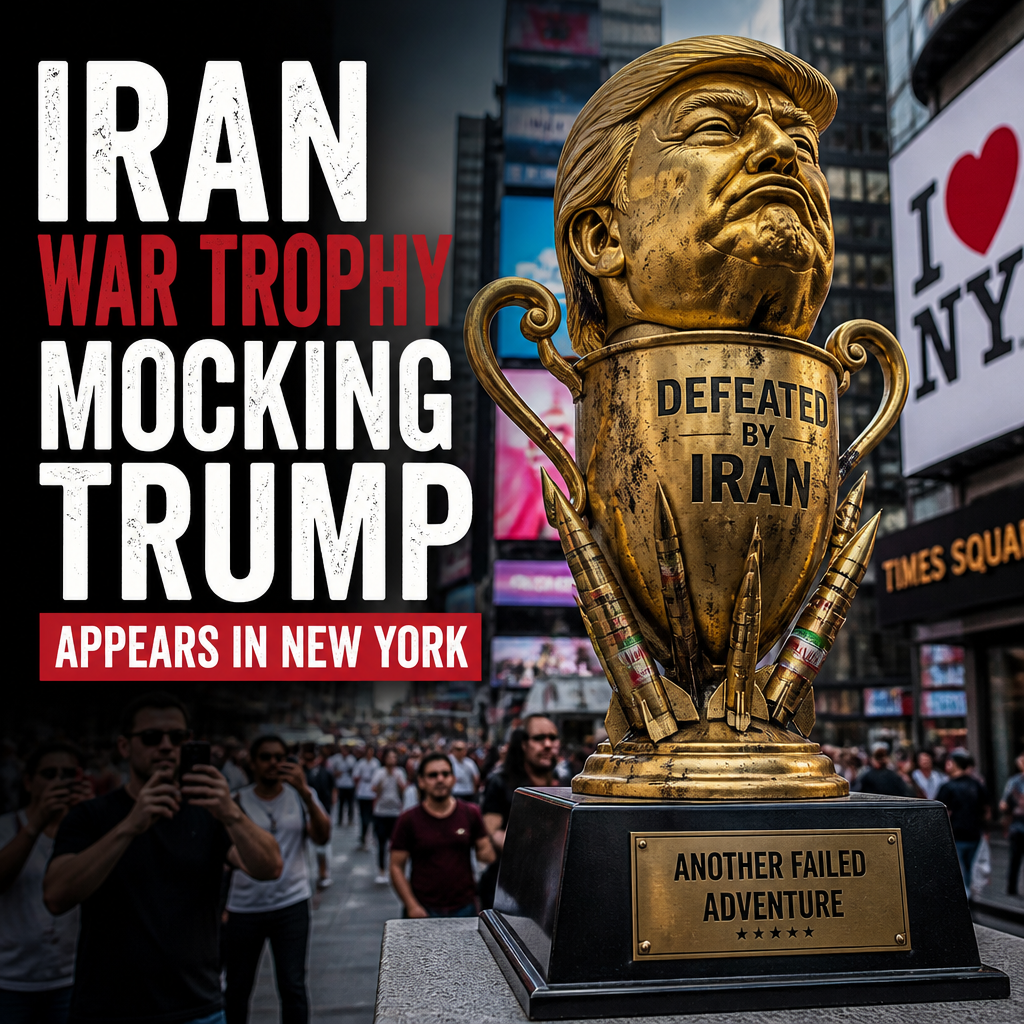
Iran War Trophy Mocking Trump Appears in New York as a provocative public display, and it has quickly become more than just another eye-catching political stunt. The piece, reported by Al Jazeera and circulated widely through social and international media, has stirred debate about satire, protest art, and how the Israel-Iran conflict is being framed in the United States. What looks at first like a spectacle aimed at one political figure also raises larger questions: who gets to define the meaning of war imagery in public spaces, and when does satire become partisan theater?
A symbol designed to provoke
The installation’s message is hard to miss. By combining references to war, mockery, and Donald Trump, the work seems built to trigger strong reactions from both supporters and critics of the former U.S. president. In the visual language of protest, that is often the point. Public art frequently uses exaggeration and irony to compress a complex political argument into a single image.



That is especially true when the subject is Trump, whose public persona has long attracted satirical treatment. For his detractors, a piece like this lands as a blunt criticism of his past foreign-policy posture and his broader approach to conflict. For his supporters, it may read as disrespectful, sensational, or even evidence of cultural hostility.
What makes the piece notable is not only its political target, but its timing. The imagery arrives amid continuing global tension over Iran and renewed public sensitivity about war rhetoric. In that context, the installation does not feel like a stand-alone joke. It feels like part of a wider argument about America’s role in Middle Eastern conflict, the memory of recent wars, and the way politicians use confrontation as a brand.




Iran War Trophy Mocking Trump in New York and the politics of public space
The reaction to the installation reflects how contested public space has become. New York has long been a city where political art, demonstrations, and street-level commentary coexist. But in the current media environment, a work can move from a sidewalk conversation to an international flashpoint in hours.
That matters because the same image can be interpreted very differently depending on political perspective:
– Critics of Trump may see a sharp indictment of his approach to Iran and his readiness to escalate tension.
– Supporters may view it as disrespectful, anti-American, or needlessly inflammatory.
– Neutral observers may see it as a test case for how much provocation public art can use before it becomes performative outrage bait.
Al Jazeera’s framing emphasizes the visual statement and its political edge, while coverage in other international outlets tends to place the incident within a broader cycle of Trump-centered controversy. That difference in emphasis is important. One way of reporting treats the work as a cultural object with geopolitical meaning; another treats it as part of the endless Trump news stream. Both angles are valid, but neither alone fully explains why the image resonates.
What the different news lenses suggest
Although the available reporting does not point to a single agreed interpretation, the contrast between outlets is revealing.
Al Jazeera: protest imagery with geopolitical weight
Al Jazeera’s coverage leans toward the symbolic and political dimensions of the installation. That approach makes sense, because a work referencing Iran, war, and Trump is not merely local color. It connects to U.S. foreign policy debates, regional conflict, and the domestic politics of anti-war sentiment.
From this perspective, the installation can be read as a critique of leaders who turn military tension into political identity. Whether or not one agrees with the message, the work clearly aims to insert itself into a serious conversation about power and conflict.
RT: emphasis on spectacle and conflict
RT’s news style often highlights confrontation and political theater, and that lens tends to amplify the controversy surrounding Trump-related stories. In practical terms, that means the installation is easy to frame as another example of Western political polarization. The risk, however, is that the deeper symbolic meaning can get lost behind the headline value.
Sky News: the broader public reaction
Sky News reporting generally helps locate such incidents within the larger public and media response, rather than treating them only as ideological statements. In a case like this, that broader framing matters. The real story is not only the object itself, but the fact that it can travel so quickly across social platforms and international news cycles, gathering new meanings as it goes.
Why the controversy matters beyond one installation
The strongest takeaway is that the work exposes how exhausted political discourse has become. An object that mixes war imagery and Trump mockery does not need to be subtle to succeed. It only needs to tap into existing anger, humor, and anxiety. That is why reactions are so immediate.
At the same time, it would be too easy to dismiss it as mere trolling. Public satire has a real function in democratic societies. It can puncture self-importance, sharpen debate, and force attention onto uncomfortable issues. But satire also has limits. When it depends entirely on outrage, it can flatten complex subjects into a binary of cheering and jeering.
In this case, the most balanced reading is that the installation is both effective and limited: effective because it captures attention and channels political frustration, limited because its message is likely to be received through preexisting loyalties rather than reasoned reflection.
The broader uncertainty is that the public no longer sees political art in isolation. Every image is instantly interpreted through partisan media, global conflict, and the identity politics of the moment. So while the installation may have been intended as a sharp anti-Trump statement, its real significance may lie in how quickly it became a mirror for the audience looking at it.