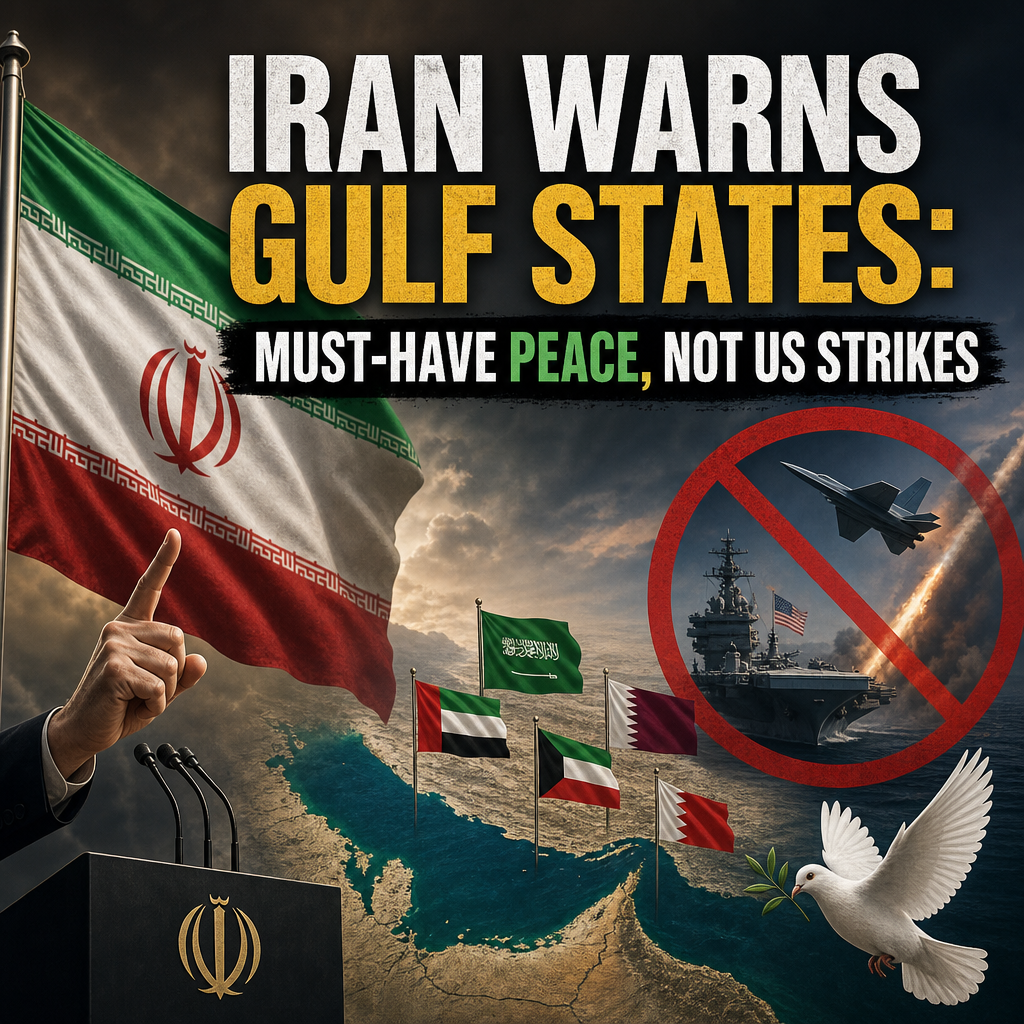
Iran Warns Gulf States: Must-Have Peace, Not US Strikes


Iran Warns Gulf States: Must-Have Peace, Not US Strikes is the latest reminder that the Persian Gulf remains one of the world’s most fragile fault lines, where every military threat carries consequences far beyond the intended target. Tehran’s message to neighboring Arab states is straightforward: do not assume a US-led attack on Iran would stay contained, because the region’s energy routes, airspace, and security networks are deeply interconnected.
At the heart of the warning is a familiar but uncomfortable reality. Gulf monarchies such as Saudi Arabia, the United Arab Emirates, Qatar, Bahrain, Kuwait, and Oman have spent years trying to balance three competing priorities: preserving ties with Washington, avoiding open confrontation with Tehran, and protecting their own economic stability. When tensions rise between Iran and the United States, that balancing act becomes harder, not easier.



Iran Warns Gulf States: What Tehran Is Really Signaling
Iran’s public messaging is not only directed at Washington. It is also aimed at Gulf capitals that host US military assets, cooperate on air defense, or rely on American security guarantees. The implicit argument is that if the US launches strikes from regional facilities or waters, Gulf states could become exposed to retaliation even if they did not initiate the conflict.
That warning should be taken seriously, but not literally in the sense of an immediate promise of escalation. It is as much about deterrence as it is about strategy. Tehran wants to raise the political cost for neighbors considering closer alignment with the US in any future military scenario. In that sense, the statement is meant to widen the circle of caution.




Al Jazeera’s broader regional coverage has long highlighted how Gulf governments often pursue de-escalation when possible, even while maintaining defense ties with Washington. That posture reflects practical concerns. The Gulf economies depend on stable oil exports, shipping lanes, foreign investment, and tourism. A regional war would threaten all of them at once.
RT’s framing of the issue, unsurprisingly, tends to emphasize the anti-US and anti-intervention angle more sharply, portraying Iran as warning neighbors against becoming accomplices to American military pressure. Sky News, by contrast, typically places more weight on the vulnerability of Gulf partners and the risk that Iran’s rhetoric could unsettle markets and security planning. Taken together, those perspectives reveal the central tension: one side sees deterrence, another sees provocation, and regional states see danger either way.
Why the Gulf States are caught in the middle
The Gulf states are not passive spectators. They have their own agencies, rivalries, and diplomatic channels. In recent years, several of them have worked to reduce direct friction with Iran, including through talks, restored relations, and quiet back-channel diplomacy. That is not a sign of trust so much as recognition that permanent hostility is too costly.
Still, the US remains the external security guarantor for much of the Gulf. American bases, naval deployments, missile defense systems, and intelligence partnerships are central to regional defense planning. That makes the Gulf highly sensitive to any escalation between Washington and Tehran, especially when the battlefield could include proxy groups, maritime chokepoints, or infrastructure targets.
A conflict would likely create immediate risks in several areas:
– Energy markets: Even the threat of disruption can send oil and gas prices higher.
– Shipping routes: The Strait of Hormuz is too important to global trade to ignore.
– Civil infrastructure: Missile or drone strikes could target airports, refineries, or desalination plants.
– Political pressure: Gulf leaders would face demands from both domestic audiences and foreign partners.
The result is a strategic bind. Supporting US pressure may please Washington, but it could also expose Gulf states to blowback. Staying neutral may reduce that risk, but it does not eliminate it if the region becomes a theater for retaliation.
The case for restraint is stronger than the case for strikes
What makes this moment especially delicate is that military action rarely ends the problem it claims to solve. Strikes can degrade capabilities, but they can also harden positions, rally nationalist sentiment, and trigger asymmetric responses through militias, drones, or cyber operations. That is why many regional actors, even those wary of Iran, prefer talks to confrontation.
There is also a practical reason Gulf states may resist another cycle of escalation: the region has already lived through enough shocks. From attacks on tankers and energy facilities to repeated confrontations in Iraq, Syria, Yemen, and the Red Sea, Middle Eastern security has become a web of connected crises. One spark in one arena can quickly spread into another.
That does not mean Iran’s position is beyond criticism. Its warning can sound coercive, especially to neighbors that have been trying to keep their distance from conflict. And Gulf governments may fairly argue that the responsibility for restraint should not fall on them alone. If Tehran wants peace, it must also show it can avoid using regional instability as leverage.
Still, the broader evidence points in one direction: a US strike on Iran would almost certainly make Gulf security worse before it made anything better. Even if the action were limited, the region’s geographic and political proximity means no one would be insulated for long.
The most plausible conclusion, then, is not that Tehran’s warning should be accepted uncritically, but that it reflects a real strategic truth. The Gulf does not need another war of signaling and retaliation. It needs crisis management, active diplomacy, and a clearer recognition from all sides that the costs of escalation would be shared far beyond the original target.
In that sense, the message from Tehran is less a diplomatic courtesy than a warning label: if peace is not prioritized now, the Gulf may again become the place where great-power confrontation turns into regional damage.