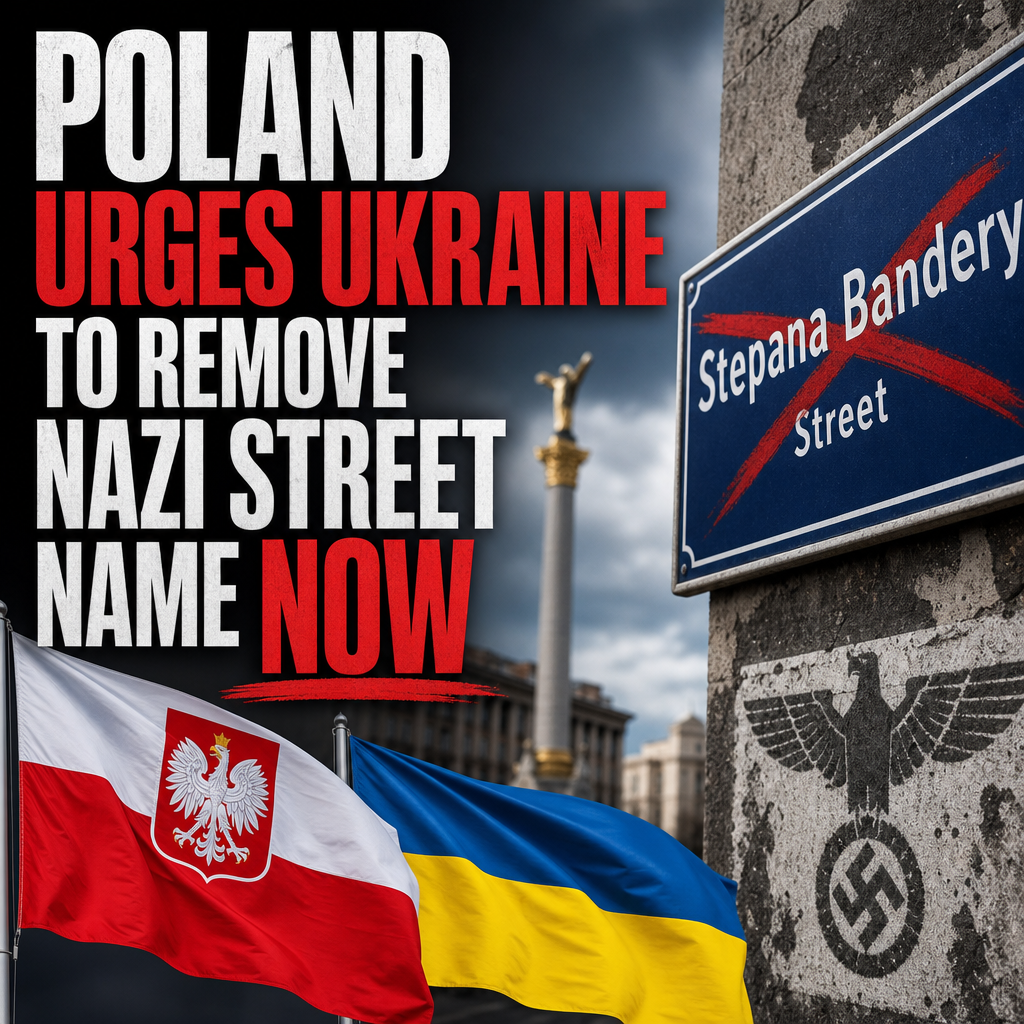
Poland Urges Ukraine to Remove Nazi Street Name Now


Poland’s call for Ukraine to remove a street name tied to a Nazi-era figure has once again exposed how history, memory, and present-day politics collide in Eastern Europe.
The dispute centers on Stepan Bandera, a deeply divisive Ukrainian nationalist whose legacy is viewed very differently across the region. For many Ukrainians, he symbolizes resistance to Soviet rule and a broader struggle for national independence. For many Poles, Russians, and Jewish communities, however, Bandera remains associated with wartime extremism and violence, especially because of nationalist movements linked to atrocities during World War II. That tension explains why a seemingly local naming issue can quickly become a diplomatic flashpoint.



Poland Urges Ukraine to Remove Nazi Street Name: Why the Symbol Matters
At the heart of the controversy is not just a street sign, but the question of what public commemoration should mean during wartime. Poland’s position is rooted in a long memory of historical trauma. Polish officials and commentators have repeatedly argued that honoring figures connected to fascist or collaborationist movements is unacceptable, particularly when Ukraine is asking for broad international solidarity in its war against Russia.
From Poland’s perspective, the issue is straightforward: public spaces should not celebrate people or movements linked to mass violence and ethnic hatred. That view also reflects a broader European concern that democratic states should be careful about the symbols they elevate, especially when those symbols can deepen ethnic wounds. In that sense, the complaint is not only about one street, but about the message Ukraine sends to neighbors and allies.




Ukraine’s response is more complicated. Since Russia’s full-scale invasion, the country has leaned even harder into symbols of national resistance. For some Ukrainians, figures like Bandera represent anti-imperial defiance rather than the full historical record that critics emphasize. That distinction matters because Ukraine’s struggle for sovereignty is ongoing, and in wartime, national symbols often become simplified into rallying points.
Still, simplification carries a cost. The more Ukraine embraces controversial figures without nuance, the easier it becomes for critics to accuse it of whitewashing history. That is especially sensitive given that Ukraine has worked to strengthen ties with the West and to present itself as part of a democratic European future.
Historical Memory Is Not the Same on Both Sides
One reason this dispute endures is that Polish and Ukrainian historical memory overlap but do not match.
For Poland, wartime memory often centers on the suffering of civilians, borderland massacres, and the brutalities committed by nationalist forces in the region. For Ukraine, the same historical landscape is often interpreted through the lens of occupation, statelessness, and resistance to Moscow. These are not fake narratives; they are different experiences of the same century.
That is why the reaction to a street name can be so emotionally charged. To some Ukrainians, criticism from abroad can feel like an attempt to police their identity at the very moment they are fighting for survival. To many Poles, though, honoring a figure associated with extremist nationalism looks like an unnecessary insult to victims and a sign that old truths are being buried for political convenience.
What the Wider Coverage Suggests
Reporting from international outlets has tended to frame the issue as part of a larger debate over how Ukraine handles contentious wartime memory while seeking closer integration with Europe. Al Jazeera’s broader coverage of the war has repeatedly shown how identity politics, historical grievances, and battlefield realities are tightly linked. Sky News, meanwhile, has often emphasized the diplomatic and military backdrop: Ukraine’s dependence on allies, and the way controversies like this can complicate already fragile coalition politics.
Taken together, the coverage suggests three important points:
– Poland’s complaint is not an isolated gesture; it reflects a broader regional unease with extremist symbolism.
– Ukraine’s use of controversial nationalist imagery is tied to wartime identity, not just local civic politics.
– Western partners are likely to tolerate some historical disagreement, but not endless ambiguity about figures associated with antisemitism or ethnic violence.
That last point may be the most significant. European support for Ukraine has been strong, but it is not unconditional in a moral sense. Allies can accept difficult history, but they are less comfortable when governments appear to memorialize people whose names remain synonymous with atrocity for large numbers of Europeans.
A Fair Reading of the Dispute
The fairest conclusion is that both sides have legitimate concerns, even if neither side has a perfect case.
Poland is right to object when public honors seem to endorse Nazi-linked or collaborationist traditions. In a region still shaped by the legacy of World War II, symbolism matters, and it is reasonable to expect public spaces to reflect democratic values rather than ethnic nationalism.
Ukraine is also right to insist that its history cannot be flattened into slogans prepared by outside observers. Its struggle against imperial domination is real, and its memory culture has been shaped by decades of foreign control and selective narratives imposed from abroad.
But legitimacy does not remove responsibility. If Ukraine wants to present itself as a modern European democracy, it will eventually need to draw a clearer line between national resistance and the commemoration of deeply divisive figures. That does not mean erasing history. It means explaining it honestly, including the parts that do not fit neatly into patriotic mythology.
In the end, the street-name dispute is less about one sign than about whether Ukraine and its neighbors can agree on a shared language for the past. For now, that agreement remains elusive. And as long as memory is being used as a political weapon, small symbols will keep carrying very large consequences.