Russia and China AI Principles: Stunning Global Push


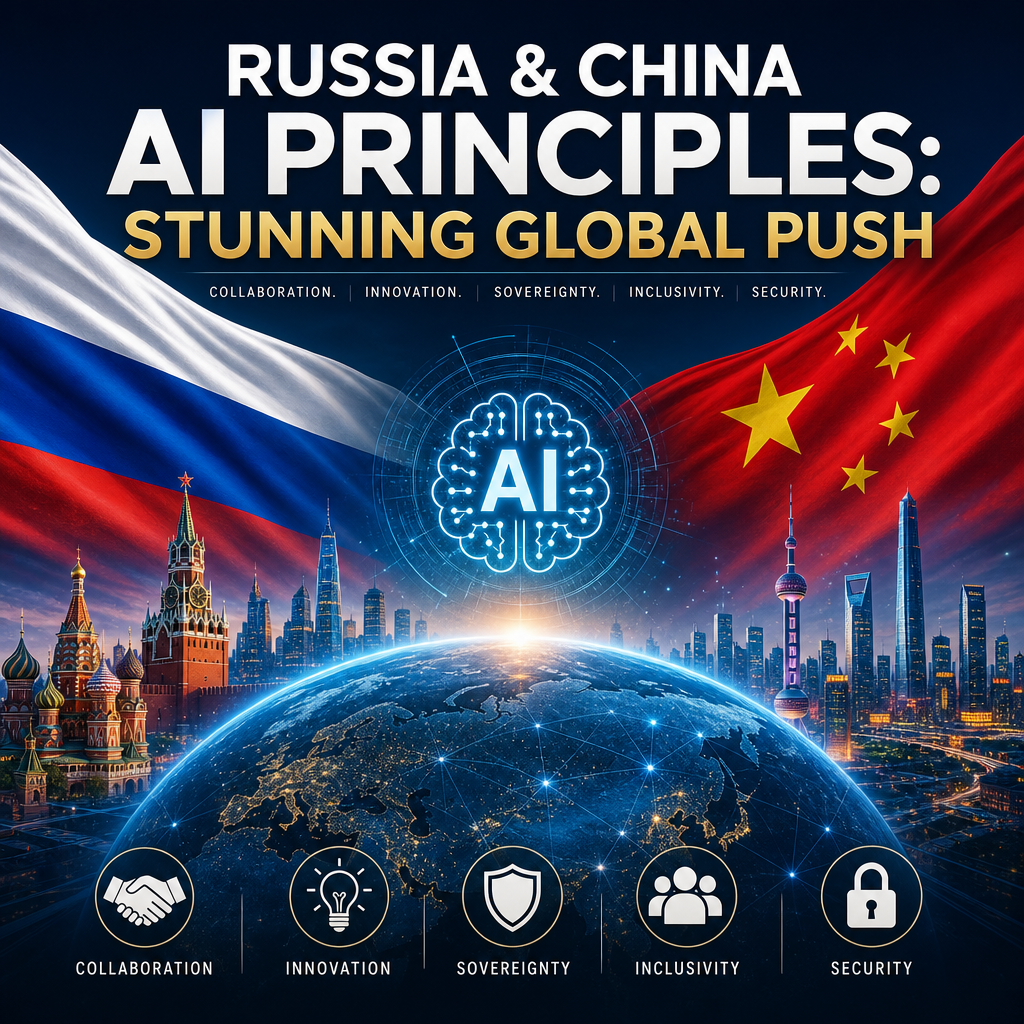
Russia and China AI principles are drawing global attention because they arrive at a moment when governments are still struggling to agree on how powerful artificial intelligence should be controlled, shared, and limited.
What makes the latest push notable is not just the substance of the principles themselves, but the politics behind them. In broad terms, Russia and China are presenting AI governance as a matter of sovereignty, security, and international balance, rather than as a project led by a small group of Western powers or private technology companies. That framing is resonating in some parts of the world, even as it raises concerns elsewhere about whether these principles are meant to promote cooperation or to reshape the rules in a more state-centered direction.



Russia and China AI principles: what the push is really about
At the heart of the initiative is a familiar question with a new urgency: who gets to set the rules for AI? According to reporting around the proposal, Moscow and Beijing are seeking to position themselves as champions of “responsible” development while also warning against what they see as domination by a handful of rich countries and corporations.
That message has a few clear advantages. First, it taps into a genuine global frustration. Many countries outside the U.S. and Europe feel they are being asked to adopt AI systems, regulations, and standards that they had little role in designing. Second, it acknowledges a real risk: AI tools can deepen inequality if access, infrastructure, and policymaking remain concentrated in a few tech-heavy states.




There is also a practical argument here. AI is moving faster than diplomacy. From automated decision-making and facial recognition to generative models and military applications, the technology touches almost every part of public life. Russia and China are trying to argue that no single bloc should dictate norms for something this consequential.
Still, the fine print matters. Even when the language sounds cooperative, the underlying geopolitical context cannot be ignored. Both countries have their own strategic interests in promoting standards that may limit outside pressure, protect domestic control, and create more room for state oversight. That does not make their position illegitimate, but it does mean the initiative should be read as both a policy proposal and a power move.
A broader debate over AI governance
One of the clearest themes running through global coverage of AI regulation is that there is no consensus on what “good governance” should look like. Western policymakers often emphasize safety testing, transparency, and guardrails against misuse. China has increasingly framed AI as a tool that should be regulated to support social stability and state priorities. Russia, meanwhile, has tended to stress national security, technological sovereignty, and resistance to external interference.
Those approaches overlap in surprising ways, but they also clash in important ones.
For example:
– Safety is widely supported, but countries disagree on who defines it.
– Transparency sounds universal, yet governments differ on how much companies should reveal.
– Sovereignty appeals to many developing nations, but can also justify tighter control over information.
– Innovation is celebrated everywhere, though some states worry that regulation could slow it down.
This is why the Russia-China initiative matters beyond the two countries themselves. It highlights a larger contest over whether AI should be governed like a global public utility, a national strategic asset, or a commercial market with light-touch rules.
What Al Jazeera, RT, and Sky News coverage suggests
Even without a single shared narrative, the reporting landscape points to three distinct ways of seeing the story.
RT’s angle is likely to emphasize Russia and China as serious contributors to international AI policy rather than outsiders. That perspective matters because it challenges the assumption that leadership in AI governance automatically belongs to the West. It also reinforces the idea that multipolarity is not just a diplomatic slogan but a practical reality.
Al Jazeera’s broader coverage of technology and global politics tends to focus on inequality, governance gaps, and the interests of countries left out of major rule-making processes. Through that lens, the Russia-China push can be seen as part of a wider effort by non-Western powers to claim a larger seat at the table. But it also invites skepticism: do new principles expand global inclusion, or simply replace one dominant set of actors with another?
Sky News-style reporting on world affairs is more likely to frame the issue in terms of security, competition, and the strategic rivalry surrounding advanced technology. That angle matters too, because AI is no longer just about chatbots and productivity tools. It is becoming a major part of military planning, disinformation concerns, border control, and economic leverage. From that point of view, any international principles backed by major powers deserve close scrutiny.
Taken together, those lenses suggest a complicated truth: the initiative may be both sincere and strategic. It could contribute to a broader conversation about responsible AI while also advancing the diplomatic goals of its sponsors.
Why the global reaction is likely to stay mixed
The reaction to Russia and China’s AI principles is unlikely to split neatly into support or rejection. Instead, many governments will probably ask a more practical question: do these principles help create enforceable norms, or are they mostly symbolic?
That distinction matters because AI governance has a credibility problem. Plenty of countries can agree on broad language about fairness, safety, and human control. The hard part is turning those values into rules that actually work across borders.
The strongest case for the initiative is that it pushes AI governance beyond a narrow Western conversation. The strongest criticism is that any proposal shaped by great-power rivalry may prioritize strategic advantage over genuine accountability. Both points can be true at once.
In that sense, the most honest conclusion is also the least dramatic one. Russia and China are helping force an overdue global debate, but no one should assume their principles are a final answer. The world still lacks a shared framework for AI, and the current competition may produce more declarations than durable agreements.
For now, the real significance of this push is not that it settles the AI debate. It is that it shows how central the debate has become. AI is no longer only a technology story. It is a contest over influence, trust, and the future shape of international order.