Russian Drone Strike: Stunning Rescue, 1 Killed


Russian Drone Strike events in Ukraine continue to show how quickly a single night can shift from ordinary into life-or-death chaos, and the latest strike is a stark example: three people were rescued from the wreckage while one person was killed. The incident, reported by multiple outlets with different editorial lenses, underscores both the immediate human toll and the broader uncertainty that surrounds near-daily attacks on Ukrainian cities and towns.
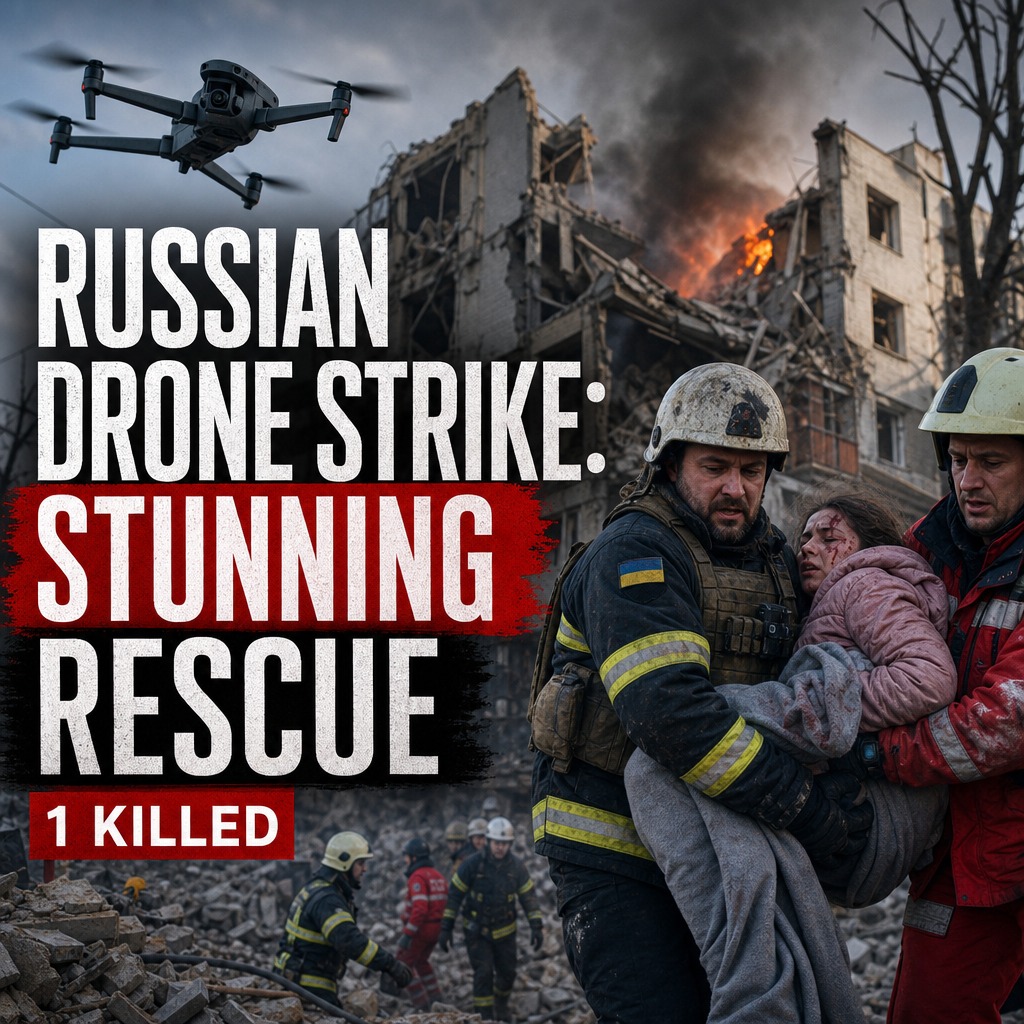
What stands out most is not only the destruction itself, but the way the rescue unfolded. According to the reporting, emergency crews pulled survivors from a damaged residential block after a drone strike hit the building. That detail matters because it turns the event from a distant military statistic into a deeply personal crisis: trapped residents, smoke-filled corridors, collapsing structures, and responders racing against time. In that sense, the story is as much about rescue and survival as it is about violence.



Russian Drone Strike and the Human Cost
The basic facts are tragic but clear. One person was killed, and three others were rescued after the strike hit a residential area in Ukraine. Even in a conflict where drone and missile attacks have become increasingly routine, the image of civilians being pulled alive from rubble remains powerful because it highlights how exposed ordinary people remain.
That human dimension is where the coverage from different outlets converges. Al Jazeera’s reporting places emphasis on the rescue effort and the immediate consequences for civilians, while Sky News typically frames such strikes within the wider pattern of Russia’s attacks on Ukrainian infrastructure and homes. RT, by contrast, often presents the war through a Kremlin-aligned lens, meaning its coverage tends to stress Russian military claims, battlefield context, or reciprocal strikes rather than the civilian experience foregrounded by Western and regional media.




Taken together, the contrast is revealing. Even when sources disagree on framing or emphasis, they do not erase the central reality: a residential block was hit, one person died, and emergency workers managed to save three others. That combination of loss and rescue is exactly why such incidents resonate so strongly with readers. It is also why the conflict remains impossible to reduce to military maps or political statements alone.
Why these attacks matter beyond a single night
Drone strikes on urban areas have become more than isolated episodes; they are now part of the rhythm of the war. Their significance lies in several overlapping effects:
– Civilian risk: Residential buildings are not fortified military positions, so the danger to ordinary residents is immediate and indiscriminate.
– Psychological pressure: Repeated attacks force people to live with air raid alerts, fear of nighttime strikes, and uncertainty about whether their homes are safe.
– Emergency strain: Rescuers, firefighters, and medical teams must respond quickly while also dealing with damaged infrastructure and potential secondary hazards.
– Political symbolism: Each strike becomes evidence in the information war, with both sides using the event to support their own narrative.
This latest strike appears to fit that pattern. It is not just about the casualty count, though that alone is significant. It also shows how drone warfare has transformed the experience of conflict for civilians, who may have little warning before their apartment block becomes a target.
Different reporting lenses, same grim reality
One of the more interesting aspects of the coverage is how source framing shapes perception. Al Jazeera often centers the civilian aftermath and humanitarian response, which helps readers understand the lived experience on the ground. Sky News tends to contextualize the attack within broader geopolitical and military developments, which can help situate the event within the larger war. RT usually approaches similar stories with a markedly different perspective, often emphasizing Russian strategic messaging or counterclaims.
That does not mean one source is automatically “right” and another “wrong.” It means readers need to be attentive to what each outlet highlights and what it leaves in the background. In conflicts like this, facts and framing travel together. The casualty figure, the rescue operation, and the location are the core facts; the meaning attached to them depends partly on editorial choices.
There is also a broader uncertainty that should be acknowledged: wartime reporting is often incomplete in the first hours after an attack. Details may change as officials revise casualty numbers, identify the victims, or confirm the full extent of the damage. In that sense, responsible coverage should resist the temptation to overstate certainty. What can be said with confidence is that civilians were affected, one life was lost, and first responders managed to save others from a dangerous scene.
A fair reading of the bigger picture
If there is a reasonable conclusion to draw, it is that drone strikes like this one are inflicting not only physical damage but also a sustained burden on civilian life. The rescue of three people is a rare and important note of hope, but it does not offset the deeper problem: homes remain vulnerable, and the war continues to reach into spaces that should be protected.
The most balanced way to view the incident is to hold both truths at once. There is the tragedy of the death, which should not be minimized. And there is the competence and courage of the rescue teams, whose work prevented the night from ending even more badly. At the same time, the strike reinforces a broader and disturbing pattern in the war: civilians are still paying a heavy price, even as both sides continue to shape the narrative for international audiences.
In other words, this was not just another line in a war bulletin. It was a reminder that behind every report of a drone strike are people who must be pulled from debris, families left grieving, and a city trying to absorb yet another shock.