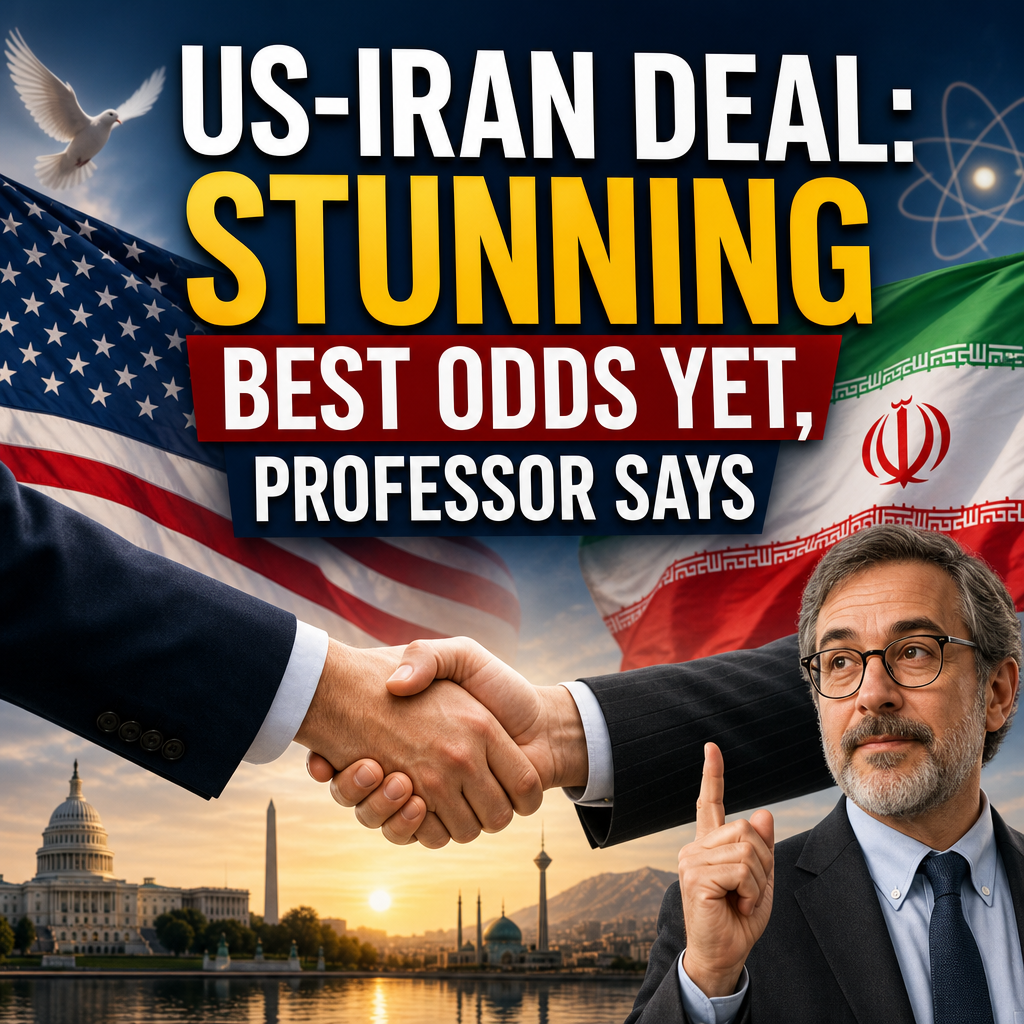
US-Iran Deal: Stunning Best Odds Yet, Professor Says


US-Iran deal prospects have improved in some analysts’ eyes, but the path from hopeful language to a real agreement remains narrow, uneven, and highly political.
Recent reporting and commentary around the issue suggest a cautious shift in tone rather than a breakthrough. One prominent Iranian academic and political analyst, Mohammad Marandi, has argued that the chances of a deal are better than they have been for some time. That view reflects a sense that both sides may have incentives to avoid another spiral of escalation: Washington wants to reduce regional tensions, while Tehran wants relief from sanctions and a way to stabilize its economy. But optimism is only one part of the picture. Other coverage, including from international outlets tracking Middle East diplomacy, continues to emphasize that trust is thin, competing regional crises are intense, and any agreement would have to survive deep political resistance in both countries.



US-Iran deal hopes rise, but the obstacles are still large
The idea of a new understanding between Washington and Tehran does not emerge in a vacuum. It is shaped by years of failed talks, sanctions pressure, nuclear disputes, and repeated flare-ups across the Middle East. Even when diplomats signal openness, the underlying issues remain the same: uranium enrichment limits, verification, sanctions relief, and security guarantees that neither side fully trusts the other to honor.
That is why Marandi’s more upbeat assessment should be read as a judgment about timing, not certainty. His position reflects the belief that Iran’s leadership may see a practical opening if the US is willing to move beyond symbolic gestures and offer meaningful economic relief. From that perspective, diplomacy is most likely when both sides are motivated less by goodwill than by necessity.




But there is another side to the story. Western reporting and commentary often highlight why “better odds” can still be a fragile idea. In the US, any bargain with Iran immediately runs into domestic politics, congressional scrutiny, and the legacy of previous agreements. After the collapse of earlier nuclear diplomacy, skeptics in Washington are wary of entering a new deal that could unravel with the next election cycle. That concern is especially acute because any future understanding would need to be durable enough to convince businesses, allies, and investors that sanctions relief is real.
What each side wants — and fears
At its core, the US-Iran deal debate is about whether both governments can find a small but credible overlap in their interests. The motivations are straightforward enough:
– Iran wants sanctions relief and economic breathing room.
– The US wants nuclear constraints and a reduction in regional tension.
– Both want to avoid open conflict, even if they disagree sharply on how to get there.
The challenge is that each side also fears being exploited. Iranian officials worry that offering too much without firm guarantees would leave the country vulnerable to renewed pressure later. American officials and allies worry that concessions could simply buy time without ending the underlying nuclear concern. That mutual suspicion is one reason every negotiation cycle tends to produce cautious statements but limited concrete movement.
Why regional tensions matter as much as the talks themselves
Any assessment of diplomacy between Washington and Tehran has to account for the broader regional setting. Coverage from outlets such as Al Jazeera has repeatedly shown that the Middle East is not just a backdrop to US-Iran talks; it is often the main reason those talks become harder. Conflicts involving proxies, border incidents, maritime tensions, and attacks on shipping or military positions all create pressure on negotiators. A single escalation can quickly harden attitudes and make compromise look politically impossible.
That broader context explains why some analysts remain skeptical even when the tone improves. The issue is not only whether the two governments can draft an agreement, but whether they can keep it insulated from the next crisis. In a region where escalation can travel fast, diplomacy often moves slower than events on the ground.
There is also the question of perception. In the US and among its allies, any sign of flexibility toward Iran is often interpreted through a security lens. In Iran, meanwhile, any delay or ambiguity from the US can be read as evidence that Washington is not serious about reciprocity. Those narratives matter because they shape public expectations and the room leaders have to maneuver.
The most realistic reading: progress is possible, but fragile
The most balanced conclusion is that the odds may indeed be better than in some recent periods, but “better odds” do not mean “good odds.” The diplomatic environment may be slightly more favorable if both sides believe a limited arrangement could serve their interests. Yet the agreement would still face several tests:
– Can sanctions relief be delivered in a way Iran believes?
– Can nuclear restrictions be verified in a way the US trusts?
– Can either side sell the deal at home?
– Can the agreement survive a regional crisis?
That is a lot to ask of two governments with a long record of mistrust.
Sky News-style reporting on international diplomacy often tends to underline the practical political question: even if negotiators find a formula, can they keep it alive long enough to matter? That skepticism is healthy. It prevents wishful thinking from masquerading as analysis. At the same time, it should not obscure the fact that diplomacy often begins with narrow openings that look unimpressive at first.
In that sense, the current moment may be less about a dramatic turning point than about a cautious recalibration. The US and Iran may both see reasons to talk, but both also have strong reasons to hedge. If a deal does emerge, it is more likely to be incremental than sweeping, built on limited commitments rather than a grand reset.
For now, the clearest conclusion is also the most modest one: the door to a US-Iran deal may be open a little wider than before, but it is still guarded by deep mistrust, domestic politics, and a volatile region that can change the mood in a single day.