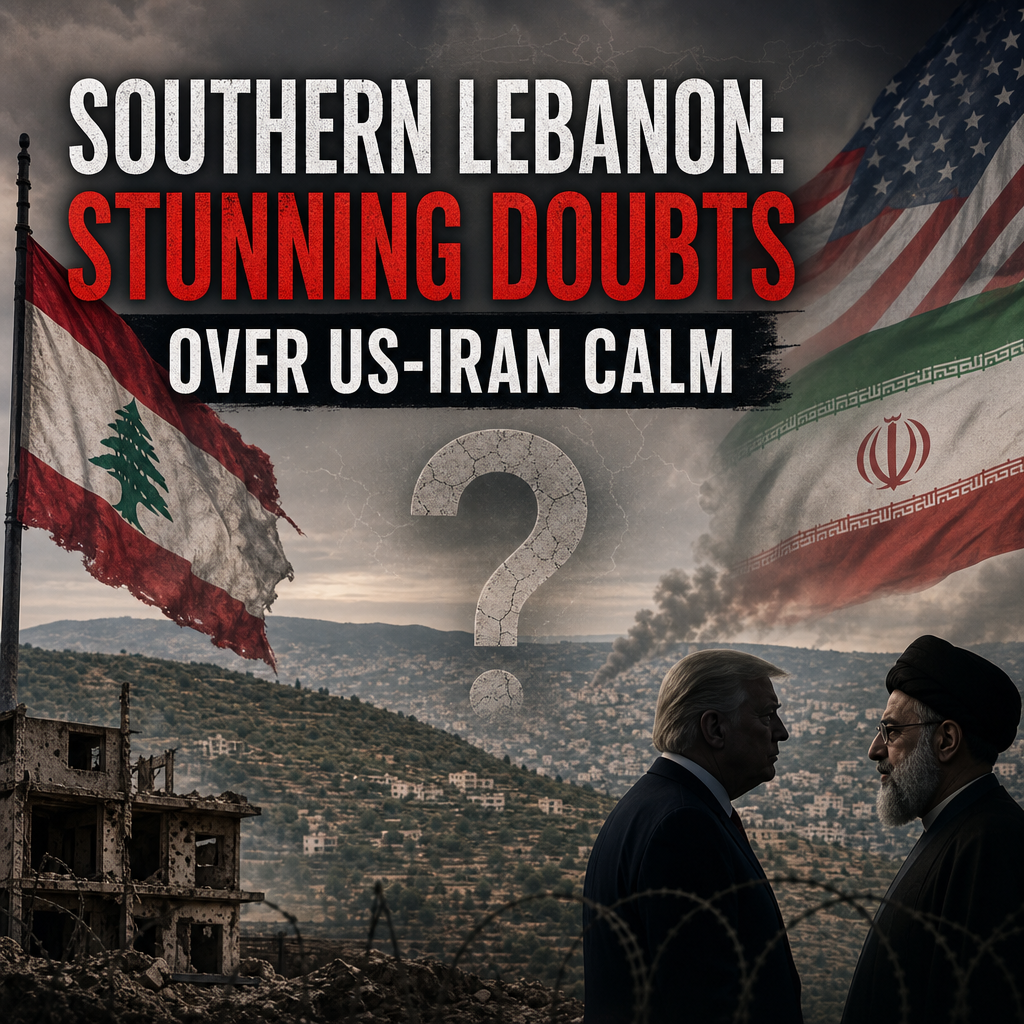
Southern Lebanon: Stunning Doubts Over US-Iran Calm


Southern Lebanon is once again a place where diplomacy is being judged against the hard realities of daily life, and many residents are openly skeptical that any US-Iran calm will last long enough to change what happens on the ground.
For people living near the border, the issue is not abstract. It is about whether an uneasy lull can survive the region’s familiar cycle of threats, retaliation, and political messaging. Reports from the area suggest that while international diplomacy may be producing cautious optimism in some capitals, local communities remain unconvinced. That gap matters, because Southern Lebanon has long been one of the places where regional tensions between the United States, Iran, Israel, and Hezbollah are felt most immediately.



Why Southern Lebanon remains doubtful
The doubts in Southern Lebanon are rooted in experience. Residents there have lived through years of escalation, intermittent conflict, and repeated warnings that were followed by renewed violence. Even when outside powers speak of de-escalation, local people tend to ask a simpler question: what changes on the ground?

That skepticism is understandable. Southern Lebanon sits at the intersection of several competing pressures:




– Hezbollah’s military and political role in Lebanon
– Israel’s security concerns along the border
– Iran’s influence across allied regional groups
– U.S. efforts to prevent a wider regional war
From a resident’s perspective, any perceived US-Iran understanding may sound encouraging in theory, but it does not automatically mean border stability. As Al Jazeera’s reporting from the south suggests, people there often see diplomacy as fragile and temporary unless it is matched by enforceable guarantees and visible restraint from armed actors.
There is also a trust problem. Many locals have heard promises of calm before. When violence resumes, it is ordinary families who pay the price through displacement, damaged homes, disrupted work, and constant uncertainty. That lived history explains why a “deal” or a diplomatic opening can be greeted with caution rather than relief.
US-Iran calm: diplomacy, deterrence, and local reality
The phrase “US-Iran calm” can mean different things depending on who is using it. To Washington, it may imply lower odds of regional escalation and fewer direct confrontations involving U.S. personnel or allies. To Tehran, it may suggest room to protect strategic interests without triggering a broader conflict. To people in Southern Lebanon, however, it may simply mean a pause that could end at any moment.
The diplomatic view
Some analysts and officials would argue that even a limited easing of tensions is valuable. In a region where miscalculation can spread quickly, reduced pressure between the U.S. and Iran can lower the risk of a wider war. That matters because Southern Lebanon is deeply exposed to any spillover from broader regional confrontation.
This is the hopeful side of the story: if rival powers hold back, local fronts may cool too. But that hope depends on whether the actors with the greatest military leverage also want restraint.
The skeptical view
Other observers, including many on the ground, say the bigger problem is not the existence of negotiations but their limits. A regional calm negotiated from afar can be fragile if it does not address the underlying drivers of conflict: border insecurity, militia activity, retaliatory strikes, and the political calculations of armed groups.
That is why skepticism in Southern Lebanon is not simply emotional; it is strategic. Residents understand that if one side believes deterrence is fading, it may act preemptively. They also know that local communities often have little control over those decisions.
The regional-security view
Coverage across international outlets, including Sky News and RT, tends to frame the story through broader geopolitical competition. One common thread is the idea that even when direct US-Iran friction appears to ease, regional flashpoints remain unstable because local conflicts can escalate independently. That framing is important because it reminds readers that “calm” is rarely the same as “resolution.”
In other words, a reduction in headline-grabbing confrontation does not necessarily mean the conflict architecture has changed. Southern Lebanon may still be vulnerable unless there is a sustained political and security process that reduces the chance of cross-border escalation.
What the uncertainty really means
The strongest conclusion is also the most cautious one: there is no clear reason to assume that US-Iran calm will automatically translate into security for Southern Lebanon. The regional picture may be moving toward restraint, but the local picture remains defined by mistrust, armed deterrence, and fear of sudden reversal.
That does not mean diplomacy is useless. It means diplomacy has to be measured by outcomes people can feel: fewer airstrikes, fewer threats, fewer displaced families, and fewer moments where a border village becomes the front line of a larger rivalry.
For now, Southern Lebanon appears to be waiting for proof rather than promises. Its residents are not rejecting diplomacy outright; they are simply refusing to mistake language for safety. In a region where the stakes are so high, that caution is less a sign of cynicism than a practical response to history.