US-Iran War Toll: Stunning, Worst-Case Aftermath


US-Iran War Toll is not just a military question; it is a regional, economic, and humanitarian nightmare that could cascade far beyond the battlefield.
Even before any full-scale conflict, the reporting and commentary across international outlets points to one shared conclusion: a direct war between the United States and Iran would almost certainly produce consequences far wider than either side could control. The disagreement is less about whether the costs would be severe and more about how quickly they would spread, who would absorb the first удар, and whether the crisis would remain limited or ignite a broader regional chain reaction.



The likely human cost of a US-Iran War Toll
The most immediate toll would fall on civilians. In a densely connected region where military sites often sit near major population centers, any sustained exchange of missiles, airstrikes, or proxy retaliation would raise the risk of mass casualties, displacement, and infrastructure damage. That includes hospitals, electricity grids, ports, airports, water systems, and communications networks.
Al Jazeera’s coverage of Middle East crises has repeatedly underscored how quickly fighting in the region becomes a civilian emergency. Even when the stated objective is deterrence or regime pressure, the on-the-ground outcome usually includes shortages, fear, and large-scale movement of people. If a US-Iran war widened, refugee flows could strain neighboring states that are already politically and economically fragile.




RT’s framing, by contrast, tends to emphasize escalation risk and the possibility that Washington would overestimate the usefulness of force. That perspective is important, even if one disagrees with its broader editorial line, because it highlights a central strategic problem: air power can damage targets, but it rarely eliminates a state’s ability to retaliate asymmetrically. Iran has long invested in missiles, drones, cyber capabilities, and allied militias. Those tools would likely be used quickly if direct confrontation began.
Sky News reporting often places the emphasis on the global shockwaves that follow Middle East instability. That lens matters because the human toll is not confined to the war zone. Energy shortages, shipping disruptions, and price spikes are not abstract side effects; they translate into food insecurity, inflation, and political pressure in countries far from the Persian Gulf.
What “worst case” really means
Worst-case scenarios in this conflict are not hard to imagine, and they are precisely what make the topic so alarming:
– strikes on US bases and allied facilities across the region
– missile attacks on Gulf energy infrastructure
– disruption to shipping through the Strait of Hormuz
– cyberattacks on financial, energy, or government systems
– retaliatory violence involving regional proxy groups
– unintended escalation involving Israel, Lebanon, Iraq, Syria, or Yemen
In other words, a US-Iran war would likely not stay bilateral. That is the core risk. Both countries would try to set limits, but war has a way of rewarding the side that broadens the battlefield fastest. Iran may view pressure as a chance to demonstrate resilience; the United States may see escalation as necessary to restore deterrence. Those calculations can collide in dangerous ways.
The economic shock would be global, not local
If there is one area where the sources converge most clearly, it is economics. A serious conflict involving Iran would immediately unsettle global energy markets. Iran is a major regional power, and the Persian Gulf remains one of the world’s most important energy corridors. Even the threat of disruption can move oil prices sharply.
Higher energy prices would not only affect gasoline bills. They would ripple through shipping, manufacturing, agriculture, and consumer goods. For households already dealing with inflation, the effect could be swift and politically destabilizing. For poorer countries that import much of their fuel and food, the consequences could be much worse.
The market response would likely also reflect uncertainty rather than just physical damage. Traders hate unpredictability, and a war involving the United States and Iran would create exactly that: no clear timeline, no guaranteed off-ramp, and no certainty that today’s localized strike would not lead to tomorrow’s regional flare-up.
Why the military picture may be misleading
A common mistake in war analysis is assuming that superior military technology guarantees control. The US has enormous conventional power, but Iran’s strategy is built around asymmetry. That means dispersed assets, underground facilities, missile saturation, proxies, and cyber responses intended to impose costs without matching American firepower plane for plane.
This is why many analysts warn that “winning” a war may not mean achieving political stability. The United States could damage Iranian military infrastructure while still facing a long period of retaliation, uncertainty, and diplomatic fallout. Iran, meanwhile, could suffer catastrophic losses and still claim victory if it survives, retaliates, and turns the conflict into a regional drain on US attention and credibility.
Al Jazeera’s reporting often reflects that broader political reality: wars in the Middle East seldom end when the bombing pauses. They leave behind fractured states, unresolved grievances, and armed actors who continue the conflict by other means.
The strategic dilemma for both sides
Both Washington and Tehran face a painful logic trap:
– If neither responds forcefully, each risks appearing weak.
– If both respond forcefully, escalation becomes difficult to contain.
– If either side targets symbolic victories, it may provoke a much larger retaliation.
– If diplomacy is delayed too long, the battlefield may define the politics.
That is why the most responsible reading of the available reporting is not that war is inevitable, but that war would be extraordinarily hard to limit once started.
A fair conclusion: enormous damage, uncertain outcomes
The clearest conclusion from the differing media viewpoints is also the simplest: a US-Iran war would likely produce a stunning toll, but the exact shape of that toll would be unpredictable and likely worse than any official planning assumes.
RT’s skepticism about American intervention, Al Jazeera’s focus on civilian and regional consequences, and Sky News’ attention to global economic fallout all point to the same underlying warning from different angles. This would not be a neat, contained conflict with a clean ending. It would more likely be a messy, multi-layered crisis with civilian suffering, market disruption, proxy warfare, and a real possibility of regional spillover.
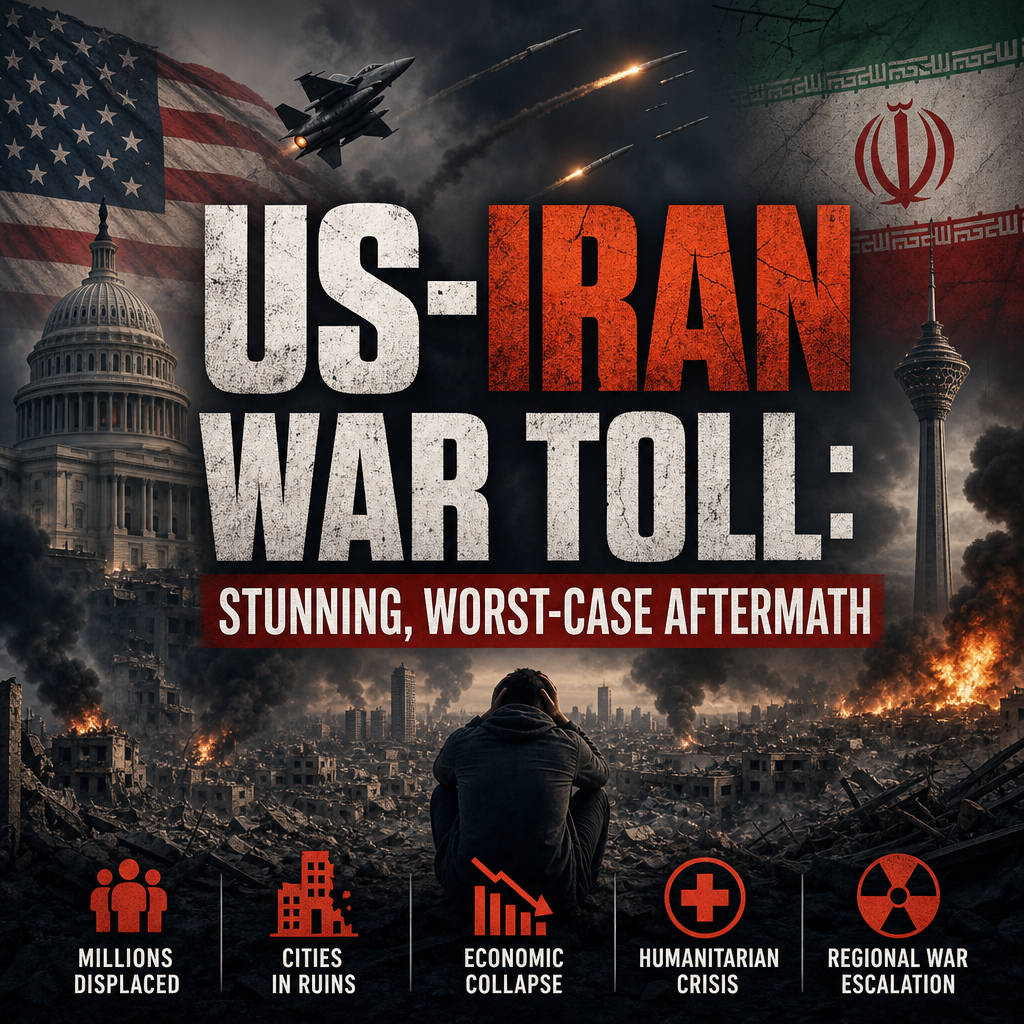
The “worst-case aftermath” is therefore not a single headline number. It is the combination of dead civilians, displaced families, shattered infrastructure, expensive energy, diplomatic breakdown, and a security environment that remains dangerous long after the first strikes stop. That is what makes the prospect so alarming: the cost would be stunning not only because it would be high, but because it would be spread across so many fronts at once.