US Vice President Slams Israel in Stunning Iran Deal Clash


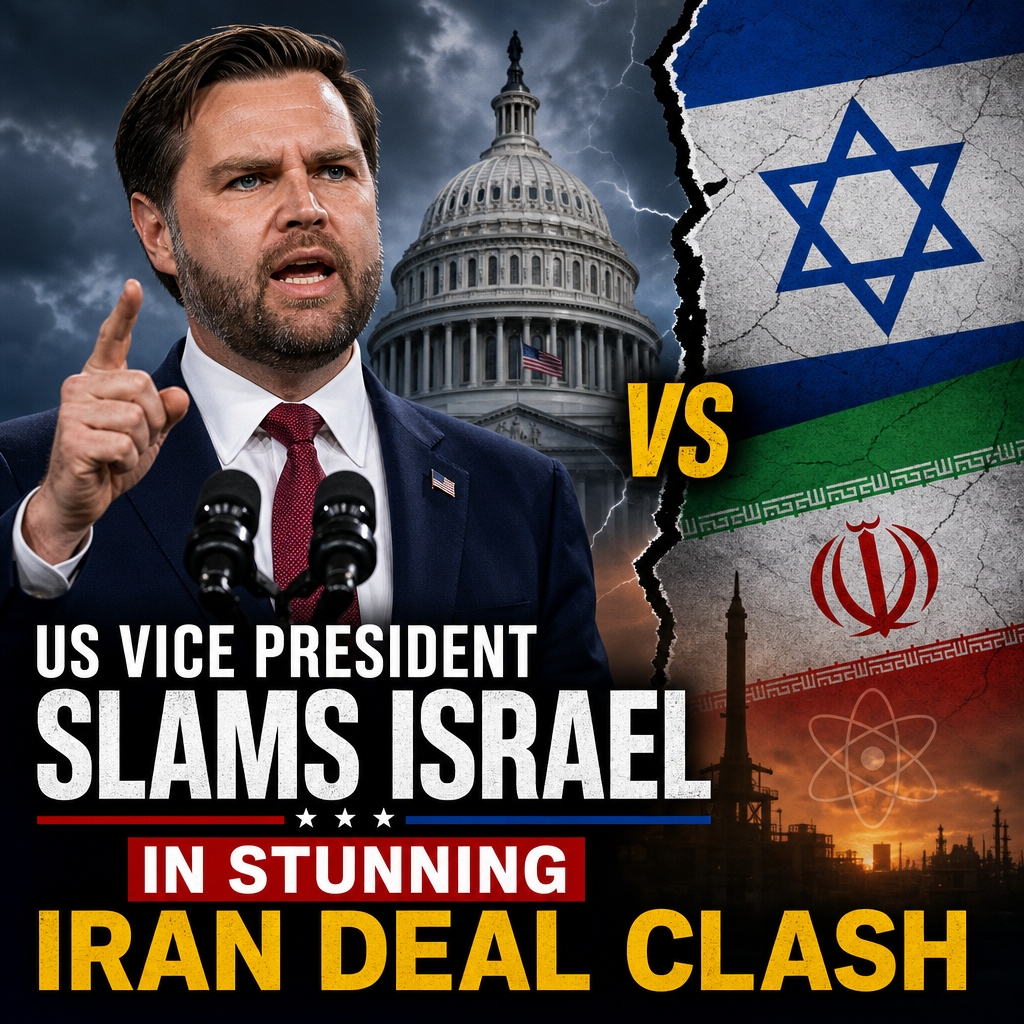
US Vice President Slams Israel in the latest flashpoint over Washington’s approach to Iran, exposing just how fragile the political and diplomatic balance has become around any potential deal. What might have looked like a narrow policy dispute has quickly widened into a broader argument about alliance management, nuclear risk, regional security, and whether the United States is prepared to strike a compromise that Israel sees as dangerous.
The immediate confrontation appears to have been triggered by criticism from Israeli officials and allies of Donald Trump’s reported Iran strategy. In response, the vice president delivered an unusually sharp rebuke, signaling that the White House is not inclined to let Jerusalem dictate the terms of US negotiations. That tone matters. Even when Washington and Israel publicly present themselves as close partners, disagreements over Iran often reveal where their interests diverge most sharply: Israel prioritizes removing any nuclear pathway for Tehran, while US policymakers may be more willing to consider limited concessions if they believe a deal reduces the chance of a wider war.



Why US Vice President Slams Israel in the Iran Deal Debate
At the center of the dispute is a familiar but unresolved question: what counts as a successful Iran policy? For Israel, the answer is straightforward—anything that leaves Tehran with enrichment capacity, sanctions relief, or room to maneuver is viewed as a strategic failure. Israeli leaders and many of their supporters argue that past agreements gave Iran breathing space without permanently neutralizing the nuclear threat.
The vice president’s pushback suggests the administration sees the issue differently. Supporters of engagement argue that diplomacy, even if imperfect, can slow escalation and create guardrails at a time when military confrontation would be costly and unpredictable. From that perspective, Israeli criticism can look less like a useful warning and more like an effort to box in American negotiators before a deal is even tested.




That tension is not new, but the public nature of the clash is notable. Al Jazeera’s coverage frames the episode as a direct confrontation over the Trump administration’s Iran approach, underscoring how quickly disputes over policy can become disputes over sovereignty and influence. The political symbolism is hard to miss: a US vice president openly pushing back against Israel suggests Washington wants to reclaim room to negotiate without appearing dependent on Israeli approval.
What Different Newsrooms Emphasize
The reactions reported across different outlets reveal how the story is being interpreted through distinct lenses.
– Al Jazeera emphasizes the diplomatic rupture and the regional stakes, focusing on the unusual spectacle of a US vice president challenging Israel so directly.
– Sky News tends to frame similar disputes in terms of alliance management and security consequences, highlighting concern that any deal could either restrain Iran or, if poorly designed, deepen skepticism among US partners.
– RT often spotlights the broader geopolitical friction, presenting the clash as evidence of a widening gap between Washington’s stated priorities and the expectations of its allies.
Taken together, those angles suggest one important conclusion: there is no single agreed-upon definition of “success” here. For some observers, the vice president’s comments show political courage and strategic realism. For others, they signal a willingness to dismiss Israeli security concerns at precisely the wrong moment. And for skeptics of the whole process, the conflict itself is proof that any agreement reached under such pressure will be politically brittle.
The Biden-era lesson and the Trump-era gamble
Even though the current spat is tied to Trump’s Iran deal posture, it reflects a problem that has haunted US policy for years: short-term diplomatic wins can create long-term political backlash. A deal can reduce immediate tensions, but if it is seen as allowing Iran to preserve too much nuclear capability, opponents will portray it as appeasement. On the other hand, rejecting diplomacy altogether risks leaving military escalation as the default option.
That is why the vice president’s comments are significant beyond the headline. They indicate an administration—or at least a senior faction within it—willing to absorb backlash from Israel in order to defend its own negotiating room. That could strengthen the US hand if the goal is to show Tehran that Washington will not be publicly steered by outside pressure. But it could also weaken trust with a key ally if the rhetoric becomes too confrontational.
What This Means for the Iran Deal and the Region
The broader regional picture remains uncertain. Iran is unlikely to make major concessions simply because Washington and Jerusalem are publicly divided. In fact, Tehran may see the argument as evidence that the US is under domestic and allied pressure, which could encourage it to wait for a more favorable bargaining position.
Israel, meanwhile, has strong incentives to keep sounding the alarm. Its leaders have long argued that even a constrained Iranian program is unacceptable if it leaves open the possibility of future breakout. That view is not fringe; it is deeply rooted in Israel’s security doctrine and shaped by the fear that any delay in confronting Tehran could eventually come at a higher cost.
Still, the vice president’s remarks suggest that Washington is trying to make a different calculation. The best-case argument for the deal camp is that imperfect diplomacy is better than an unchecked march toward confrontation. The worst-case argument is that a politically rushed compromise could lock in a weak framework that satisfies no one and postpones a bigger crisis.
For now, the most honest assessment is that this is less a settled policy shift than a high-stakes clash over who gets to define American interests in the Middle East. The vice president’s criticism of Israel may play well with those who want a firmer, more independent US line. But it also deepens the uncertainty around any Iran agreement by showing how much resistance exists not just from adversaries, but from allies as well.
If there is a lesson in this dispute, it is that diplomacy with Iran never happens in a vacuum. Every negotiation is shaped by military fears, alliance politics, domestic messaging, and the lingering memory of past deals that either failed to last or failed to satisfy. That complexity is exactly why the latest clash feels so striking: it is not just about Iran, but about how much friction the US is willing to tolerate in pursuit of a deal that remains, at best, deeply contested.