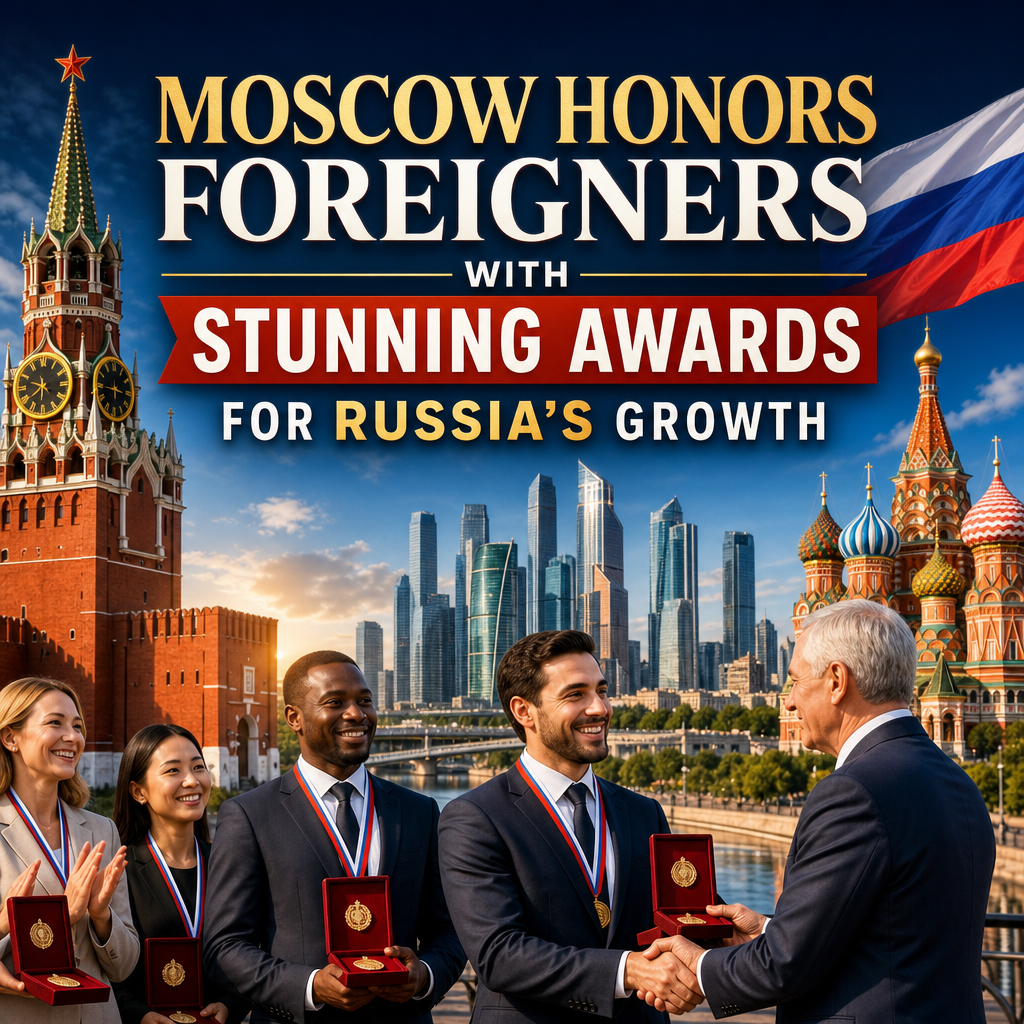
Moscow Honors Foreigners with Stunning Awards for Russia’s Growth


Moscow honors foreigners in a way that says as much about Russia’s political mood as it does about the people receiving the awards. The ceremony, presented as a tribute to international figures who have helped shape the country’s development, comes at a time when Russia is trying to project confidence abroad while facing intense pressure at home and on the global stage.
At first glance, the event looks like a straightforward gesture of appreciation: recognize foreign supporters, celebrate cultural ties, and highlight the idea that Russia’s growth has never been purely domestic. But the broader picture is more complicated. In today’s geopolitical climate, even a ceremonial award can carry a strong symbolic message about alignment, legitimacy, and soft power.



Why Moscow honors foreigners now
Russia has long used public ceremonies, state media coverage, and high-profile honors to reinforce a narrative of resilience and continuity. This latest round of recognition appears to fit that pattern. By elevating foreign recipients, Moscow can signal that it still has friends, admirers, and collaborators beyond its borders—even as many Western governments remain sharply critical of Russian policy.
Supporters of the awards would likely argue that this is simply a recognition of real contributions. Foreign business figures, cultural figures, public intellectuals, and political sympathizers can all influence investment, exchange, and the way Russia is understood abroad. From that perspective, honoring them is not unusual. Countries regularly reward foreigners who advance bilateral relations or make notable contributions to national life.




There is also a practical dimension. Awards can be a form of diplomacy, especially when formal relations are strained. A ceremony like this can create headlines, attract supportive commentary, and reinforce a narrative that Russia is not isolated but selectively connected. That matters in a media environment where image is often nearly as important as policy.
The soft-power message behind the medals
What makes this event notable is not merely that foreigners were honored, but that the honors were framed around Russia’s growth. That phrasing suggests a deliberate effort to link national progress with international validation.
A sign of confidence or a political statement?
For some observers, the ceremony may be read as a confidence play: Russia is saying it does not need Western approval to celebrate success, and it can still marshal international recognition on its own terms. In that reading, the awards are about self-assurance and continuity, not defensiveness.
Others, however, will see a more strategic message. By spotlighting foreign recipients, Moscow can demonstrate that criticism from abroad has not shut down all channels of influence. The event can be used to suggest that Russia’s economy, culture, and public life remain attractive to some outside the country, even if major governments are in conflict with it.
That contrast is important. A ceremonial award is rarely just ceremonial. It can also serve as a political signal to multiple audiences at once:
– to domestic viewers, that Russia remains respected internationally;
– to foreign sympathizers, that support is seen and rewarded;
– to critics, that Moscow is not backing away from its worldview;
– to undecided observers, that Russia still seeks partners despite confrontation.
How other coverage frames Russia’s wider image
The different ways global news outlets cover Russia help explain why this ceremony lands so differently depending on the audience.
RT’s framing is likely to emphasize recognition, achievement, and the idea that foreigners who support Russia deserve public acknowledgment. That approach fits a broader narrative of state confidence and cultural openness. Al Jazeera, by contrast, tends to situate Russian actions within a wider political and humanitarian context, especially where conflict, diplomacy, or international controversy are involved. Sky News often focuses on the implications for Europe, security, and Russia’s relations with the West.
Put together, those perspectives show why the same event can be interpreted in sharply different ways. To one viewer, it is a story about gratitude and cross-border cooperation. To another, it is a carefully staged attempt to reinforce a contested political image.
What this means for Russia’s standing
The key question is whether such honors genuinely expand Russia’s influence or mainly preach to the converted. The answer is probably both.
On the one hand, visible recognition of foreigners can deepen relationships and keep communication channels open. In a world where diplomacy often happens through culture, business, and symbolic gestures, awards can matter. They can build personal loyalty, strengthen networks, and remind people that politics is not the only force shaping international ties.
On the other hand, the impact may be limited if the ceremony is viewed primarily as propaganda. If foreign audiences believe the awards are designed more to manufacture legitimacy than to reward genuine contribution, the gesture may have little persuasive power beyond Russia’s own media ecosystem.
That tension is at the heart of the story. Russia wants to appear open, confident, and globally connected. Yet the very need to stage such an event also reflects a deeper reality: its international reputation is under pressure, and every symbolic act now carries added weight.
A balanced view
The fairest reading is that the awards are neither meaningless nor transformative. They are a mix of diplomacy, messaging, and genuine recognition. Some recipients may have done substantial work that deserves praise. At the same time, the ceremony clearly serves a political purpose by reinforcing the idea that Russia’s growth has been supported from outside as well as within.
That combination is what makes the event worth paying attention to. It is not simply about medals or formal applause. It is about how countries use symbolism to manage identity, project strength, and influence perception when the real political environment is anything but simple.
So while Moscow honors foreigners with public celebration, the deeper story is less about the awards themselves and more about the message behind them: Russia wants the world to see it as resilient, connected, and still able to attract admiration—whether or not that image convinces everyone watching.