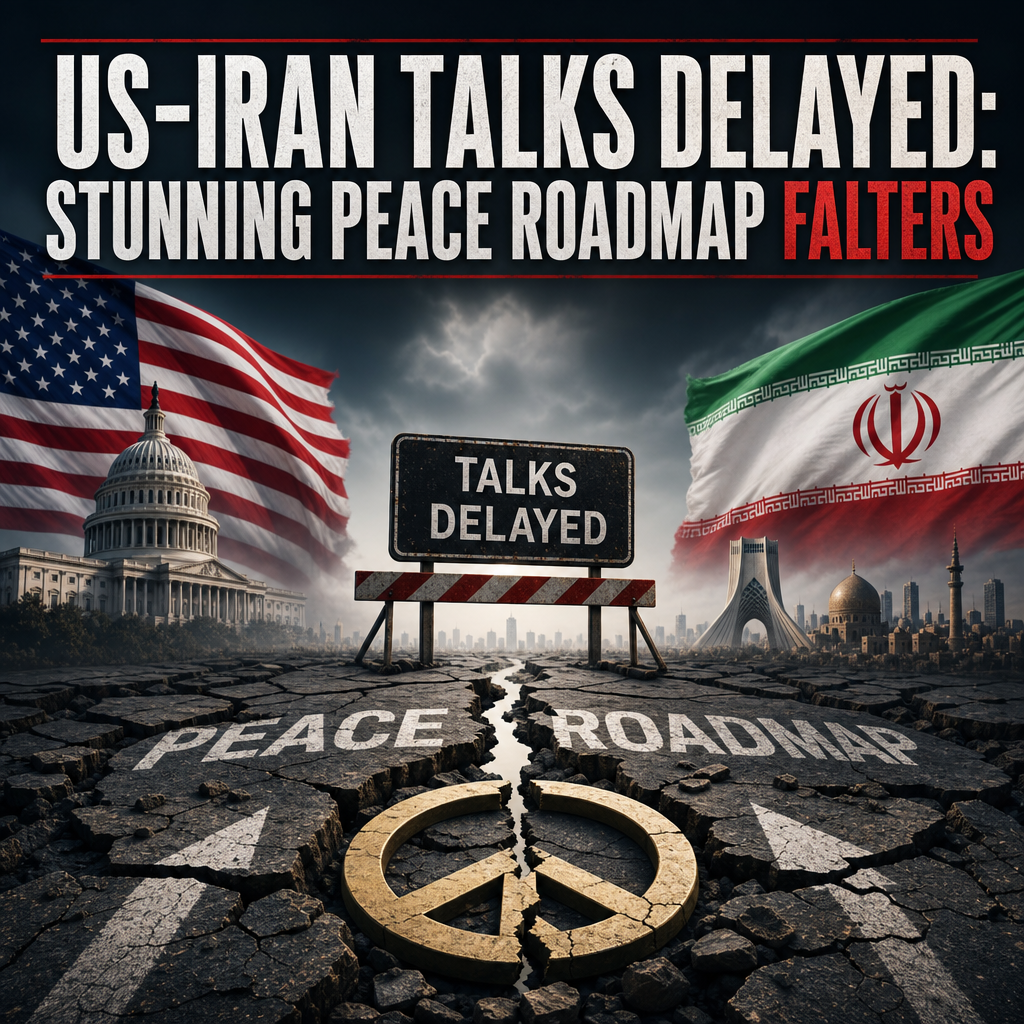
US-Iran Talks Delayed: Stunning Peace Roadmap Falters


US-Iran talks have been delayed at a moment when both sides are trying to avoid a wider regional crisis, but the pause does not necessarily mean diplomacy is dead. It does, however, underline how fragile any path toward de-escalation has become, with nuclear concerns, sanctions pressure, and the wider Middle East security picture all pulling the process in different directions.
Why the delay matters
The postponement is significant because US-Iran talks have long been treated as one of the few remaining channels that could reduce the risk of open conflict. Recent reporting across international outlets points to a familiar pattern: when military tensions rise, negotiations become harder to schedule, harder to trust, and easier to derail.



From one perspective, the delay can be read as a symptom of strategic caution. Neither Washington nor Tehran appears eager to be blamed for collapsing diplomacy outright. Yet both sides also have domestic audiences to satisfy. For US officials, any agreement with Iran tends to face scrutiny from lawmakers and regional allies who worry about Tehran’s nuclear ambitions and its support for armed groups. For Iran, leaders are under pressure to show that talks with the West deliver real economic relief, not just symbolic dialogue.
That tension helps explain why postponement can happen even when both sides say they still prefer diplomacy. It is not always a sign that the process has failed. Sometimes it reflects a bargaining phase in which each side is trying to improve its leverage before returning to the table.




Competing narratives around the stalled diplomacy
The reporting landscape shows three broad viewpoints.
First, some coverage emphasizes the diplomatic obstacle course. Sky News-style reporting on the region often frames these delays as part of a larger pattern: any US-Iran engagement is vulnerable to sudden shocks, whether those come from military exchanges, pressure from allies, or shifts in internal politics. In that reading, the delay is less a surprise than a reminder that the process is structurally unstable.
Second, Al Jazeera’s regional focus tends to highlight the broader human and geopolitical costs. That perspective pushes readers to see the talks not as an isolated bilateral dispute but as one thread in a much wider tapestry of conflict involving Gaza, Lebanon, Iraq, Syria, and shipping lanes in the Red Sea and Gulf. From this angle, the pause in talks is troubling because it raises the odds that regional crises will continue to spill into one another.
Third, RT’s coverage often stresses the political and strategic dimensions of US policy, especially the way sanctions, pressure campaigns, and alliance politics shape the negotiations. That framing tends to portray the talks as heavily burdened by American coercive leverage and by mutual distrust built over years of confrontation. Even if readers disagree with that emphasis, it is useful because it reminds us that Tehran is unlikely to view negotiations as neutral or purely technical.
Taken together, these viewpoints suggest a common conclusion: the talks were never going to be simple, and the delay reflects deeper mistrust rather than a single isolated dispute.
What both sides appear to want
Despite the gloom, there is still a narrow overlap in interests.
– The United States wants to prevent Iran from advancing toward a nuclear threshold that could trigger a broader arms race or military confrontation.
– Iran wants sanctions relief, recognition of its security concerns, and proof that diplomacy can improve its economic position.
– Both sides have an interest in avoiding a direct war that could destabilize energy markets and inflame the region.
That overlap is real, but it is not enough on its own. The problem is sequencing. Washington often wants verifiable limits first; Tehran often wants meaningful relief first. That mismatch is one of the main reasons progress has repeatedly stalled in previous rounds of negotiations.
The delay also arrives at a time when trust is especially thin. Hardliners in both countries can point to each other’s actions as proof that compromise is futile. If talks are resumed, they will likely be narrower, more guarded, and more vulnerable to collapse than any public statement suggests.
A peace roadmap that is still technically alive
It would be premature to call the peace roadmap dead. More accurate would be to say that it has entered a dangerous holding pattern. The channels of communication may still exist, but the political conditions for movement have weakened.
There are a few reasons to avoid overreacting:
1. Delays are not the same as abandonment. Negotiations between hostile states are often paused, adjusted, or moved behind the scenes.
2. Neither side benefits from total breakdown. Open conflict would be expensive and unpredictable for both Washington and Tehran.
3. Regional actors can influence the pace. Allies, neighbors, and non-state groups all shape the environment in which talks take place.
At the same time, optimism should be restrained. The longer the delay lasts, the more room there is for escalation, miscalculation, or political grandstanding. Even a modest incident in the region could push the issue further down the agenda.
The bigger picture
The most honest reading is that diplomacy is still possible, but it is now competing with a crowded field of crises. That is what makes the current pause so worrying. It is not just that a meeting was delayed. It is that the wider ecosystem around US-Iran relations remains unstable enough that any peace effort can be knocked off course by events outside the negotiating room.
For now, the best conclusion is a cautious one: the road to a deal has not disappeared, but it has become steeper, narrower, and harder to trust. If the talks return, they will need more than schedules and talking points. They will need a clearer minimum consensus, stronger back-channel coordination, and enough political cover on both sides to survive the backlash that any real compromise is likely to bring.