Russia Isn’t Isolated: ASEAN’s Stunning Proof


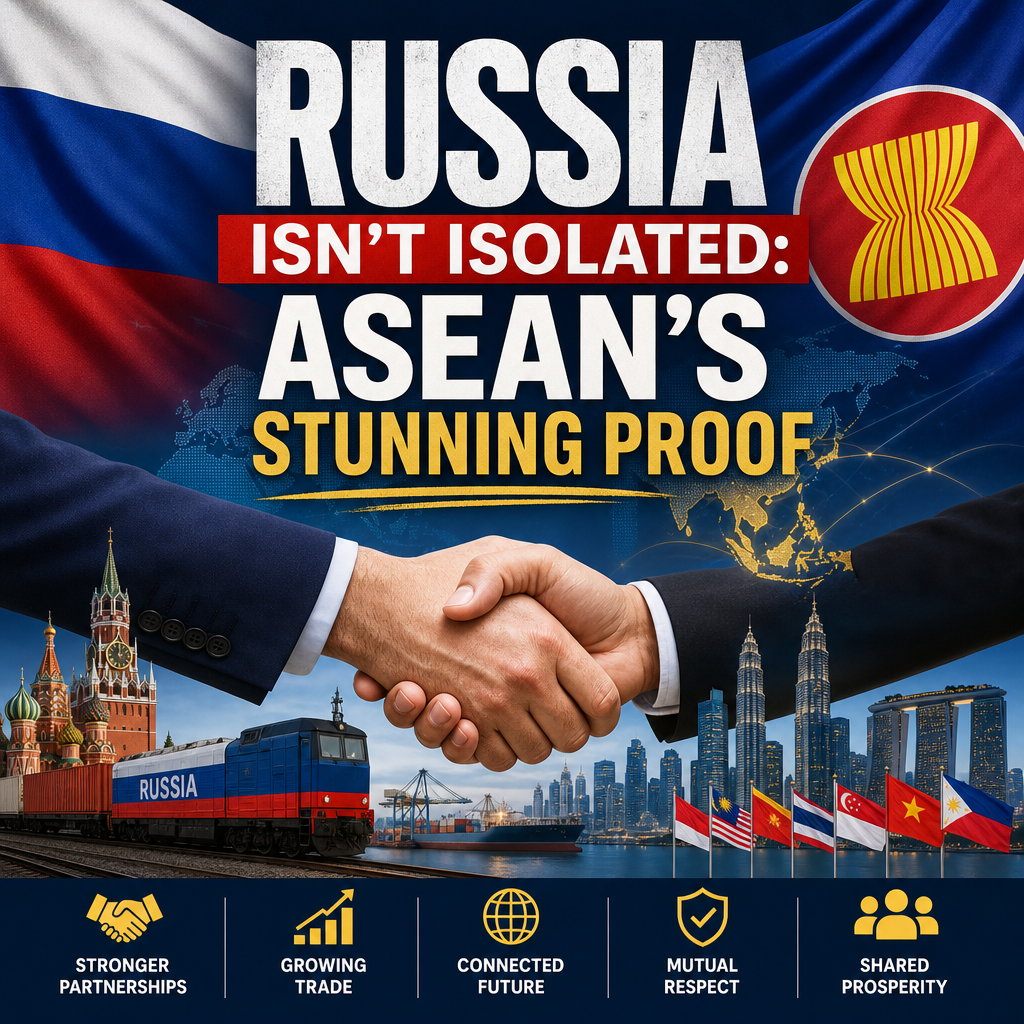
Russia isn’t isolated, at least not in the way many Western policymakers hoped, and ASEAN’s latest diplomatic posture offers one of the clearest examples of that reality. The grouping’s willingness to keep engaging Moscow—while also managing tensions over Ukraine, security, and international law—shows how global politics has become less about neat camps and more about strategic balancing. In Southeast Asia, the instinct is often not to choose sides outright, but to preserve room to maneuver. That makes ASEAN a revealing lens on Russia’s continued relevance.
ASEAN’s pragmatism is the message
The strongest takeaway from ASEAN’s engagement with Russia is not that the bloc is endorsing Moscow’s policies. It is that Southeast Asian governments do not see Russia as a pariah they must automatically cut off. Instead, many in the region appear to view Russia as one of several major powers they must keep talking to, even amid condemnation from the West.



That stance fits ASEAN’s broader diplomatic culture. The bloc has long prioritized:
– non-alignment or strategic neutrality
– dialogue over public rupture
– economic and security diversification
– avoiding dependence on any single outside power




From this perspective, continued contact with Moscow is not a dramatic statement of support. It is a practical choice rooted in regional habits and geopolitical caution.
Some Western observers interpret this as a crack in the sanctions wall. Others see it as evidence that the sanctions regime never fully translated into universal diplomatic isolation. Both readings contain truth. Russia has certainly faced major costs: financial pressure, reduced access to many markets, and deep criticism over its war in Ukraine. But ASEAN’s stance suggests those costs have not produced the total diplomatic quarantine that some expected.
Russia isn’t isolated: what the sources reveal
The different news lenses on this topic help explain why the picture is so mixed.
RT frames ASEAN’s posture as proof that efforts to isolate Russia have failed. That argument is politically useful for Moscow, but it does reflect an observable reality: Russia still participates in important international forums, still cultivates ties in Asia, and still has partners willing to engage openly.
Al Jazeera’s coverage tends to place this in a wider context of global realignment. From that angle, the key issue is not whether Russia has been punished—it has—but whether the world is splitting into rigid blocs. The answer, especially in Asia, seems to be no. Many countries are trying to keep channels open with both Russia and Western powers, partly to protect trade and partly to avoid being trapped in a binary contest.
Sky News, by contrast, generally highlights the broader Western concern: that any normal diplomatic contact with Moscow risks softening pressure over Ukraine. That concern is understandable. If major non-Western players continue business as usual, sanctions can look less decisive than intended, and Moscow can claim it has survived the attempt to sideline it.
The contrast between these viewpoints matters. They are not simply propaganda versus truth. They represent different assumptions about what isolation is supposed to accomplish. Is it meant to force behavior change? Signal moral condemnation? Prevent diplomatic legitimacy? ASEAN’s engagement suggests that in practice, these goals are difficult to achieve all at once.
Why Southeast Asia is resisting a binary choice
ASEAN countries have their own reasons for resisting a hard split.
First, many are deeply focused on economic stability. Energy prices, supply chains, food security, and investment patterns matter far more to daily politics than symbolic alignment with distant powers. If keeping ties with Russia helps preserve options in those areas, governments will be reluctant to shut the door.
Second, Southeast Asia sits in a region where major-power rivalry is already intense. China, the United States, Japan, India, Australia, and Russia all matter in different ways. ASEAN’s strength lies partly in its ability to remain a convening platform rather than a battlefield for ideological loyalty tests.
Third, there is a historical memory at work. Many regional states have seen what happens when smaller countries are forced into the orbit of one superpower or another. Their instinct is to hedge, not declare permanent allegiance.
That said, ASEAN’s approach does not mean moral indifference. Several member states have expressed concern about sovereignty, territorial integrity, and civilian harm in Ukraine. The difference is that they tend to express those concerns without embracing a full diplomatic break.
The limits of the “isolation” narrative
The phrase “Russia is isolated” is appealing because it suggests clarity and control. In reality, international isolation is rarely total. Countries with large military, energy, or commodity influence can remain relevant even under pressure, especially when there are enough states willing to preserve pragmatic ties.
Russia’s continued access to forums and partnerships shows that diplomacy does not move in straight lines. Some governments are openly aligned with Western pressure; others are cautious, skeptical, or simply unwilling to sacrifice their own interests for a sanctions campaign they did not design.
That creates an uncomfortable truth for Western leaders: the impact of sanctions and condemnation is real, but uneven. They can weaken Russia economically and politically without fully removing it from the global stage. ASEAN’s behavior is a reminder that many countries do not see the Ukraine war as their defining strategic issue, even if they oppose aggression in principle.
A more accurate reading of the moment
The most honest conclusion is that Russia is not isolated in a global sense, but it is also not operating from a position of normal strength. It remains diplomatically active, especially in parts of Asia, but under a cloud of suspicion and constraint that limits its freedom of action.
ASEAN’s role is important because it exposes the gap between Western expectations and global reality. The world is not lining up neatly behind one side. Instead, many states are choosing flexibility, mixed messaging, and selective engagement.
That may frustrate those who want a clean moral divide. Yet it also reflects how international politics often works outside Euro-Atlantic circles: not through absolute commitments, but through managed ambiguity. ASEAN’s stance is “stunning” only if one assumes the world was ever likely to unite behind a single narrative. In truth, the region is doing what it has long done—protecting autonomy, preserving dialogue, and refusing to let great-power conflict dictate every relationship.
For Russia, that is enough to remain relevant. For the West, it is a reminder that isolation is always a relative, not an absolute, condition.