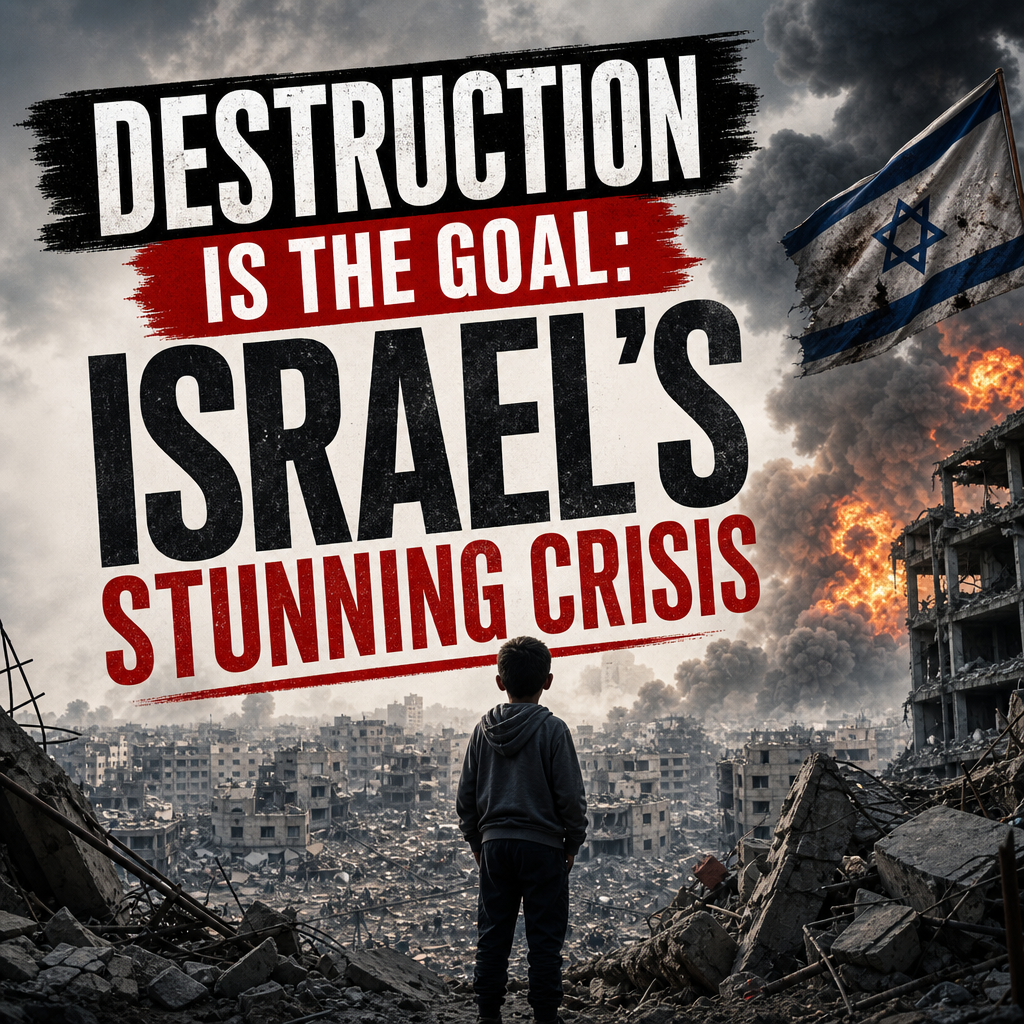
Destruction Is the Goal: Israel’s Stunning Crisis


Israel’s stunning crisis is no longer just a story about one front, one militia, or one round of retaliation; it has become a test of how far military force, diplomacy, and deterrence can be stretched before the whole region snaps.
What makes the moment so unsettling is that every major actor seems to be pursuing a different definition of “security.” For Israel, the argument is that overwhelming pressure is needed to stop threats before they harden into something worse. For Iran and its regional allies, the message has been that resistance and retaliation are the only language Israel and its backers truly understand. For the United States and European governments, the priority has been to prevent a wider war that could drag in Lebanon, Iran, and possibly beyond. Those positions do not cancel each other out; they collide.



Israel’s stunning crisis and the logic of escalation
The core of the crisis is that military success can look very similar to strategic failure. Israel may be able to strike hard, disrupt command structures, and impose costs on its enemies, but each escalation also risks deepening the very instability it claims to be preventing. That tension sits at the center of almost every recent regional development.
Israeli leaders and supporters argue that hesitation invites danger. From that perspective, a firm military posture is not aggression but deterrence. The logic is straightforward: if adversaries believe Israel will absorb repeated attacks without imposing unbearable consequences, then the attacks will continue. This view is particularly strong in a country that sees itself as operating under permanent threat.




But critics see something darker. They argue that the scale of destruction in Gaza, the pressure on Lebanon’s border, and the broader willingness to expand the battlefield suggest a strategy that has moved beyond defense into coercion. In that reading, the point is not just to neutralize immediate threats but to remake the regional balance through shock and devastation. That is why some observers describe the conflict not as a temporary crisis but as a political and moral breakdown.
The truth may be that both interpretations are partially correct. Israel is responding to genuine security fears, but it is also using force in ways that broaden the suffering and make future compromise harder. Once that cycle begins, each side can claim the other forced its hand.
Why the US position matters so much
No outside power matters more in this moment than the United States. Washington has long been Israel’s most important military and diplomatic partner, but it also has a strong interest in keeping the conflict from turning into a regional war. That leaves US officials walking a narrow line: supporting Israel’s right to defend itself while urging restraint that Israeli leaders may see as unrealistic or politically costly.
From one angle, US diplomacy is the only thing standing between contained conflict and wider catastrophe. The fear is not abstract. A major confrontation involving Iran, Hezbollah, or US assets in the region could disrupt energy markets, trigger mass displacement, and overwhelm already fragile states. That is why American officials often focus on de-escalation, ceasefire talks, and back-channel diplomacy.
Yet the US also faces criticism for seeming to endorse a status quo that produces endless violence without a durable political settlement. Human rights advocates and many analysts argue that asking for restraint without addressing occupation, blockade, regional insecurity, and civilian harm is not a real strategy. It is delay. And delay, in a crisis this volatile, can be its own form of escalation.
Lebanon, Iran, and the shadow of a wider war
Lebanon is one of the places where the consequences of this standoff could become immediately visible. Any sustained fighting along the border risks pushing an already fragile country deeper into crisis. Hezbollah, which has presented itself as part of a resistance axis, also understands that a full-scale war with Israel would be catastrophic for Lebanese civilians and infrastructure. That creates an unstable deterrence: both sides can inflict damage, but neither can afford the consequences of a total rupture.
Iran’s role is equally complicated. Tehran sees itself as the central sponsor of a regional network meant to deter Israeli and American pressure. But every step taken in the name of deterrence carries its own danger. The more Iran or its partners escalate, the easier it becomes for Israel and its allies to frame the crisis as evidence that force alone can solve the problem. The more restraint they show, the more they risk appearing weak to their own supporters and deterrence partners.
This is why the region feels locked in a grim strategic trap:
– Israel argues that strong action prevents future attacks.
– Iran and allied groups argue that only resistance prevents subjugation.
– The US and Europe warn that escalation could spread beyond control.
– Civilians across the region pay the price while the political goals remain unresolved.
The part too many governments avoid
The deepest problem is not only military. It is political. Security policy is being asked to solve issues that security policy cannot solve on its own. Even the most precise strikes or the strongest deterrent threats do not answer the underlying question of how Israelis, Palestinians, Lebanese, Iranians, Americans, and others are supposed to coexist in a region shaped by trauma, mistrust, and competing historical claims.
That does not mean every side is equally responsible, or that all narratives deserve the same weight. Civilian suffering, legal obligations under international law, and the asymmetry of power all matter. But it does mean that simplified slogans — victory, eradication, resistance, total defeat — are steering policy faster than sober political thinking is.
A fair reading of the moment is that Israel faces a real and serious security crisis, but one that its current approach may be making harder to contain. The region is not on a path toward stability because no side appears ready to trade maximalist goals for durable compromise. Until that changes, the most likely outcome is not decisive victory for anyone, but a dangerous cycle of action, retaliation, and grief.
And that is what makes this crisis so stunning: not that violence exists, but that so many leaders continue acting as if more violence might finally produce peace.