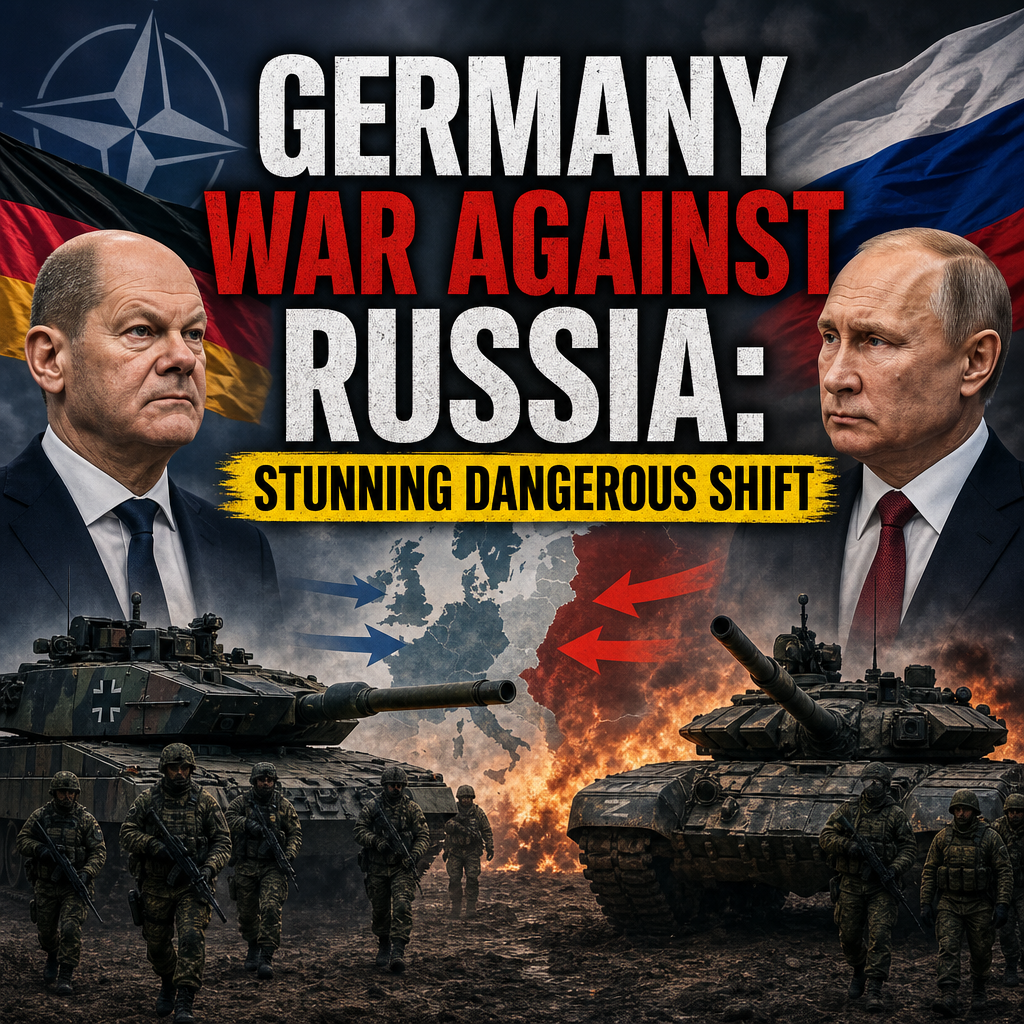
Germany War Against Russia: Stunning Dangerous Shift


Germany War Against Russia has become a phrase loaded with fear, politics, and propaganda, but the reality behind it is more complicated than a single headline suggests. Across recent coverage from Russian, Arab, and British news outlets, one theme stands out clearly: Germany is not formally at war with Russia, yet its military support for Ukraine, defense buildup, and tougher rhetoric toward Moscow are pushing relations to one of the lowest points in decades.
What makes this moment especially dangerous is not just what Germany is doing, but how each side interprets those actions. In Moscow, German arms deliveries and talk of deterrence are often portrayed as proof of hostile intent. In Berlin, the same policies are framed as necessary responses to Russian aggression and a wider European security crisis. Between those positions lies a very real risk of miscalculation.



Germany War Against Russia: Why the Rhetoric Has Intensified
The language around Germany and Russia has hardened because the war in Ukraine has changed Europe’s security landscape. Germany, once criticized for caution and dependence on Russian energy, has since moved toward a more assertive defense posture. That shift includes military aid to Kyiv, stronger coordination with NATO allies, and long-term plans to rebuild military readiness.
From the Russian perspective, these steps are often viewed through a hostile lens. RT’s coverage tends to stress that Germany is no longer a neutral observer but a participant in the broader conflict architecture around Ukraine. That framing resonates with audiences in Russia and among critics of NATO expansion, who see German policy as part of a wider Western campaign to weaken Moscow.




Western coverage is more restrained. Sky News and other international outlets generally present Germany’s actions as part of a defensive strategy rather than a direct declaration of war. The emphasis is on deterrence, alliance solidarity, and the concern that allowing Russian military gains to stand unchallenged could create a more unstable Europe. In this view, Germany is not seeking war with Russia; it is trying to prevent a larger one.
Al Jazeera’s reporting often sits somewhere between these poles, focusing on the geopolitical costs and the human consequences of escalation. Rather than treating the conflict as a binary contest, it highlights how each new military move can deepen insecurity, fuel diplomatic breakdowns, and extend the suffering already inflicted on Ukraine and the broader region.
What the Different Sources Agree On
Despite their different angles, the sources share a few important points.
– The relationship between Germany and Russia has deteriorated sharply.
– Military aid and rearmament have become central to German policy.
– Escalation risks are real, especially if rhetoric outruns diplomacy.
– Public opinion in Europe is divided over how far support for Ukraine should go.
That basic overlap matters. Even where the interpretation differs, there is broad agreement that Europe is in a more dangerous phase than it was before 2022. The debate is less about whether tensions exist and more about whether Germany’s response is stabilizing the situation or making it more volatile.
There is also a shared recognition that words matter. When political leaders speak in martial language, especially about a country with nuclear weapons and deep historical grievances, the chance of misunderstanding rises. That is why some analysts worry that even if Germany does not intend confrontation, its actions may be read by Moscow as preparation for one.
The Real Risk Is Escalation, Not Formal War
It is important to distinguish between political confrontation and actual war. Germany has not declared war on Russia, and there is no evidence that Berlin seeks a direct military clash. The danger is more subtle: a gradual slide in which support for Ukraine, cyber tensions, military deployments, sanctions, and counter-sanctions all create a climate in which accidents become harder to avoid.
This is where the strongest concern lies. History shows that major conflicts often begin not with a deliberate decision to go to war, but with a chain of assumptions, pressure, and signaling that gets out of control. In a Europe already strained by energy shocks, refugee flows, and economic uncertainty, another layer of confrontation could have consequences far beyond the battlefield.
Germany’s challenge is that it must balance two pressures at once. On one side is the expectation from allies that it stand firm against Russian aggression. On the other is the responsibility to avoid steps that could make a direct NATO-Russia crisis more likely. That is a narrow and difficult path, especially when domestic politics, public fear, and wartime emotions are all involved.
A Fair Assessment of Germany’s Position
A balanced reading of the current situation suggests three conclusions.
First, Germany is not pursuing war with Russia in any formal sense. Its government has consistently described its actions as defensive and alliance-based.
Second, Russia has reasons to view German policy as threatening, even if those fears are shaped by its own strategic priorities and domestic messaging. In international politics, perception can be as powerful as intent.
Third, the biggest danger is not an announced war, but the erosion of trust so severe that diplomacy becomes nearly impossible. Once that happens, every military shipment, every statement, and every exercise can be treated as a provocation.
Germany’s shift is therefore stunning not because it signals an immediate march to war, but because it marks the end of an old assumption: that post-Cold War Europe could rely on interdependence to keep great-power conflict at bay. That assumption has collapsed. What replaces it is still being negotiated, and the outcome will affect not only Germany and Russia, but the entire European security order.
For now, the smartest conclusion is also the most cautious one: the rhetoric is dangerous, the risks are real, and the line between deterrence and escalation is thinner than many leaders would like to admit.