Israel’s War Backfires in Stunning US-Iran Deal Shift


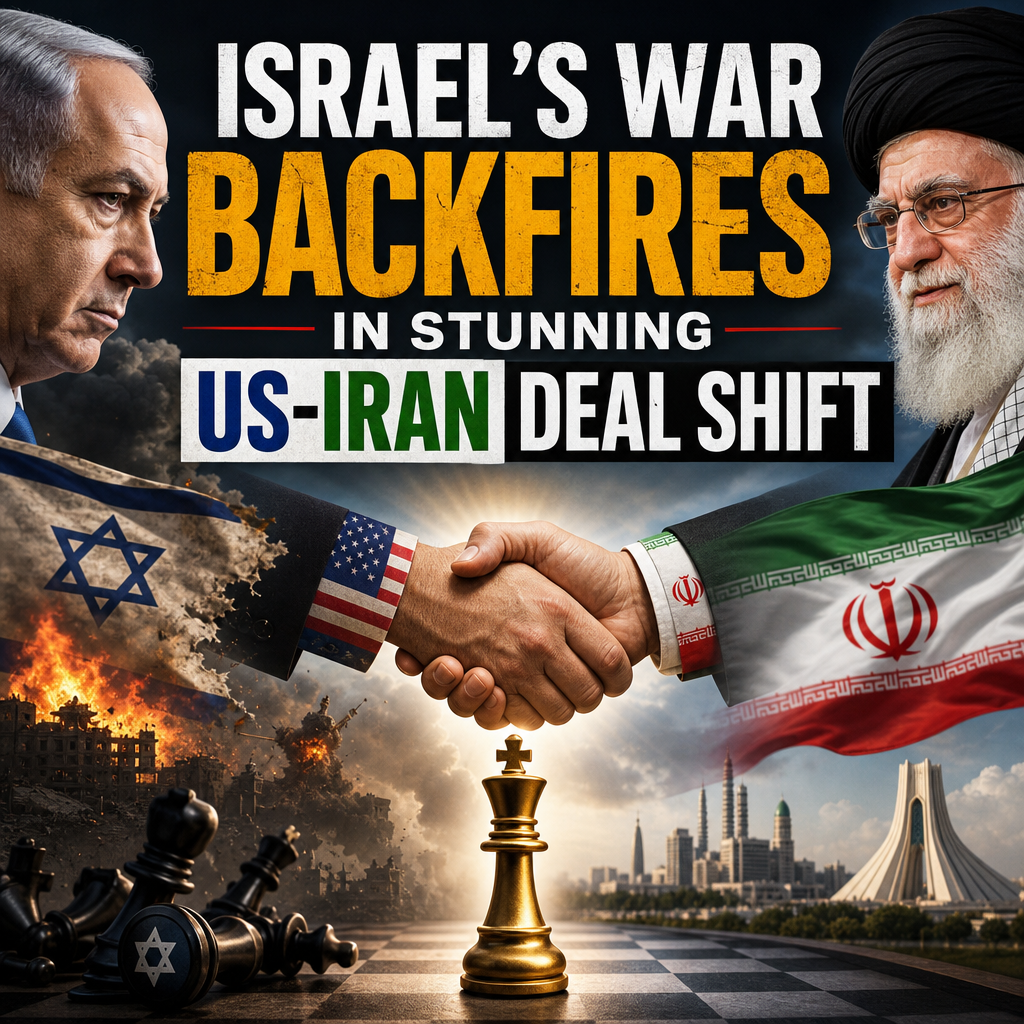
Israel’s war is now triggering a diplomatic rethink in Washington and the Gulf, where a sharper sense of risk appears to be pushing the United States and Iran toward a more practical deal-making posture than many expected just weeks ago.
What makes this shift striking is not simply that talks are happening, but that they are happening against the backdrop of a war that was supposed to strengthen deterrence and isolate Iran. Instead, the opposite seems to be emerging: regional governments worried about escalation, disrupted trade, and the possibility of a wider conflict are leaning toward de-escalation, even if that means tolerating a more limited, imperfect understanding with Tehran.



A war meant to redraw the region is producing diplomatic backlash
The basic logic behind Israel’s military campaign was clear: increase pressure on adversaries, restore deterrence, and force regional actors to rethink their alignment. But the fallout has exposed a different reality. A growing number of governments appear less interested in symbolic confrontation and more focused on preventing a spillover that could hit shipping lanes, energy markets, and domestic stability.
Al Jazeera’s reporting points to a “hard-headed pragmatism” now shaping Gulf calculations. That phrase captures an important dynamic: states such as Saudi Arabia, the UAE, Qatar, and others do not necessarily trust Iran, but they may trust instability even less. In that sense, the war has not unified the region around a harder anti-Iran line. It has instead reminded many capitals how expensive open-ended confrontation can become.




Sky News’ coverage of the broader Middle East crisis has similarly emphasized the pressure on the United States to contain the conflict before it expands. Washington has to balance solidarity with Israel, protection of its forces and partners, and the need to avoid a direct US-Iran clash. That is a difficult triangle to manage, especially when Israeli operations risk pulling the United States into commitments it may not want.
RT’s framing, meanwhile, tends to highlight the strategic blowback for the West and Israel: the idea that aggressive military moves often accelerate the very diplomacy they were meant to prevent by making regional actors seek a stabilizing counterweight. Even allowing for RT’s familiar skepticism toward US policy, the core argument is not hard to understand. When conflict becomes too destabilizing, opponents of escalation gain political ground.
Why a US-Iran deal now looks more attractive to Gulf states
The most important change may be the Gulf’s attitude. For years, many regional players treated Iran as a threat to be contained through sanctions, military posture, and informal alignment with Washington and, increasingly, Israel. But the current crisis has sharpened a different calculation: even an imperfect US-Iran arrangement may be preferable to a regional war that no one can fully control.
What the Gulf wants most
The priorities appear consistent across several regional perspectives:
– Avoid a wider regional war
– Protect oil and shipping infrastructure
– Reduce the risk of missile and drone attacks
– Keep relations with both Washington and Tehran workable
– Preserve room for economic diversification and investment
That list explains why diplomacy can gain momentum in moments of extreme tension. A ceasefire or memorandum of understanding may not solve the underlying disputes, but it can buy time and reduce the risk of miscalculation. For Gulf governments, that may be enough to justify backing a US-Iran channel.
There is also a deeper strategic motive at work. If Israel’s war becomes synonymous with perpetual escalation, Arab states will have stronger incentives to distance themselves from Israeli preferences and pursue more independent diplomacy. That does not amount to a pro-Iran shift so much as a pro-stability one.
The limits of the new pragmatism
Still, it would be premature to call this a decisive realignment. A memorandum of understanding between the US and Iran, even with Gulf support, does not erase the basic mistrust that has defined relations for decades. Iran still faces sanctions, security concerns, and domestic pressures. The US still needs guarantees that any understanding will not simply give Tehran more room to maneuver. Israel, for its part, is unlikely to see diplomacy as a substitute for security guarantees or military deterrence.
That is why the current moment is best understood as a tactical shift rather than a strategic settlement. The Gulf may be signaling that it prefers reduced tension now, but it is not necessarily embracing Iran’s long-term regional role. Likewise, Washington may see a limited deal as the least bad option, not as proof that the conflict is ending.
There is also the question of trust. Diplomatic deals made under pressure can be fragile, especially when each side believes the other is buying time. A memorandum may lower temperatures temporarily, but it may not resolve nuclear concerns, proxy warfare, or the broader contest over influence across the Middle East.
The bigger picture: force is losing to risk management
The broader lesson is uncomfortable for advocates of military coercion. Wars often do not produce clean political outcomes; they produce exhaustion, hedging, and improvisation. In this case, the war has not delivered a simple strategic victory. Instead, it has accelerated a regional re-evaluation in which stability is beginning to outrank confrontation.
That does not mean Israel’s security concerns are illegitimate, or that Iran’s behavior has suddenly become benign. It does mean that the regional response to war is often more complicated than the initiating side expects. When neighbors see the risk of escalation rising faster than the chance of decisive victory, diplomacy starts to look less like weakness and more like insurance.
The surprising part of the current shift is not that the US and Iran might talk. It is that Israel’s campaign may have helped create the conditions for those talks by making everyone else more anxious about the alternative. In Middle East politics, that kind of reversal is not rare—but it is always revealing.