
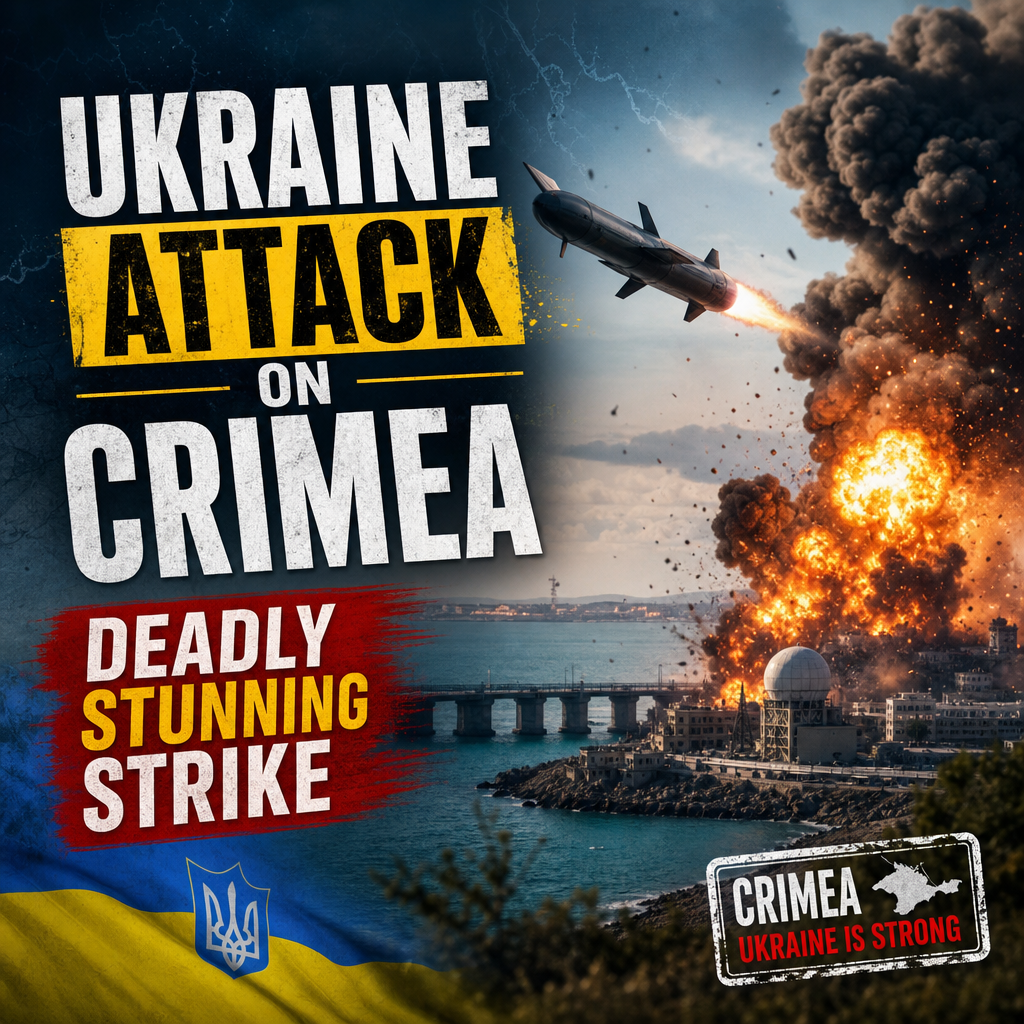
Ukraine Attack on Crimea: Deadly Stunning Strike


Ukraine Attack on Crimea has once again exposed how the war is spilling beyond the eastern front and into one of the conflict’s most symbolically charged territories, with Russian officials saying a Ukrainian strike killed five people on the peninsula. The report, carried by Al Jazeera and echoed in the broader war coverage across international outlets, comes at a moment when both sides are still trying to shape the narrative of momentum, resilience, and legitimacy.
The immediate facts are stark but still limited. Russian authorities said the attack caused fatalities and damage, while Ukraine has increasingly used long-range strikes to pressure Russian military infrastructure, logistics, and command networks tied to the annexed peninsula. As with many developments in this war, the basic outline is clear enough, but the full operational picture is still partly obscured by the fog of conflict and the competing claims of wartime communication.



Ukraine Attack on Crimea and the escalating logic of the war
Crimea remains one of the most sensitive flashpoints in the entire conflict. Russia annexed the peninsula in 2014, an act rejected by Ukraine and most of the international community. Since the full-scale invasion began in 2022, Crimea has also become more than a political symbol: it is a military hub, a transport corridor, and a launch point for Russian operations in southern Ukraine.
That is why any Ukrainian strike there carries both tactical and psychological weight. From Kyiv’s perspective, attacks on Crimea can serve several purposes at once:




– disrupt Russian logistics and military coordination
– remind Moscow that rear-area security is no longer guaranteed
– demonstrate that occupied territory is not beyond Ukrainian reach
– sustain domestic and international confidence in Ukraine’s ability to contest Russian control
Russian officials, meanwhile, tend to frame such strikes as evidence of Ukrainian “terrorism” or reckless escalation. That language matters because it is aimed not only at domestic audiences but also at foreign governments weighing continued military support for Kyiv. In other words, the battlefield is physical, but the messaging war is just as important.
What makes this latest strike especially notable is not just the reported casualties, but the timing. Both Al Jazeera’s coverage and broader international reporting suggest the attack is part of an ongoing pattern rather than an isolated event. The war has moved into a stage where Ukraine increasingly seeks asymmetric advantages: drones, missiles, sabotage, and precision strikes against facilities Russia assumed were relatively safe.
What the different source angles reveal
The reporting ecosystem around such incidents often splits into three broad viewpoints, and this case is no exception.
Russian official accounts stress civilian suffering, damage, and the need for retaliation. Their goal is to show control and cast Ukraine as the aggressor.
Ukrainian framing usually emphasizes military necessity, with the implicit message that strikes on occupied territory are part of liberation rather than escalation.
International outlets such as Sky News and Al Jazeera tend to focus on the humanitarian and geopolitical stakes, while noting that confirmation is often incomplete and that casualty figures in wartime reporting can shift.
That range of perspectives matters because it prevents a simplistic reading. The attack is neither just a headline-grabbing blow nor merely a propaganda episode. It is part of a larger campaign in which each side is trying to alter the other’s calculations without necessarily changing the front line overnight.
Why Crimea remains so important to both sides
Crimea’s strategic value is hard to overstate. It hosts military assets, supports Black Sea operations, and connects Russia’s southern military posture. It also has enormous symbolic value for Vladimir Putin’s government, which has portrayed the peninsula as an integral part of Russia despite international rejection.
For Ukraine, Crimea is equally central, but for the opposite reason. Recovering or even destabilizing Russian control there is tied to national sovereignty and public morale. That makes the peninsula both a military objective and a political statement.
The problem is that strikes in such a heavily militarized area almost always carry risks of collateral damage. Russian reports of deaths often blur the line between military and civilian casualties, and wartime reporting rarely gives independent verification in real time. That uncertainty should make analysts cautious, not indifferent. Even if the target was military-linked, the human cost of these attacks remains real.
The broader implications
This attack also highlights three bigger trends in the war:
1. The conflict is becoming more long-range and less predictable.
Ukraine has repeatedly shown an ability to strike deep into occupied territory, forcing Russia to defend a wider area.
2. Occupied Crimea is no longer a safe rear zone.
That changes Russian logistics and may force redeployment of air defenses and personnel.
3. Public narratives are now part of the battlefield.
Every strike is instantly translated into messages about strength, weakness, revenge, or endurance.
The key uncertainty is whether such attacks produce durable strategic gains or mainly add another layer of retaliation. Ukraine’s supporters argue that pressure on Crimea complicates Russian operations and undermines occupation. Critics warn that high-profile strikes can provoke harsher Russian responses without forcing a meaningful shift in the war’s trajectory.
A measured reading of the strike
The most responsible conclusion is that this was a significant attack with immediate human consequences, but not one that can be understood in isolation. It underscores Ukraine’s continuing ability to challenge Russian control in Crimea, yet it also reveals how the war has settled into a cycle of strike, claim, counterclaim, and escalation.
In practical terms, the strike suggests Kyiv remains committed to keeping pressure on occupied territory. Politically, it reminds the world that Crimea is still a live front, not a frozen issue. Humanly, it is another reminder that the war continues to exact a toll far from any negotiating table.
What remains uncertain is whether incidents like this will bring the parties closer to serious diplomacy or push them further into confrontation. For now, the evidence points more toward the second outcome. Crimea, once again, is not just a peninsula on the map. It is a test of endurance, legitimacy, and the limits of force.

























