
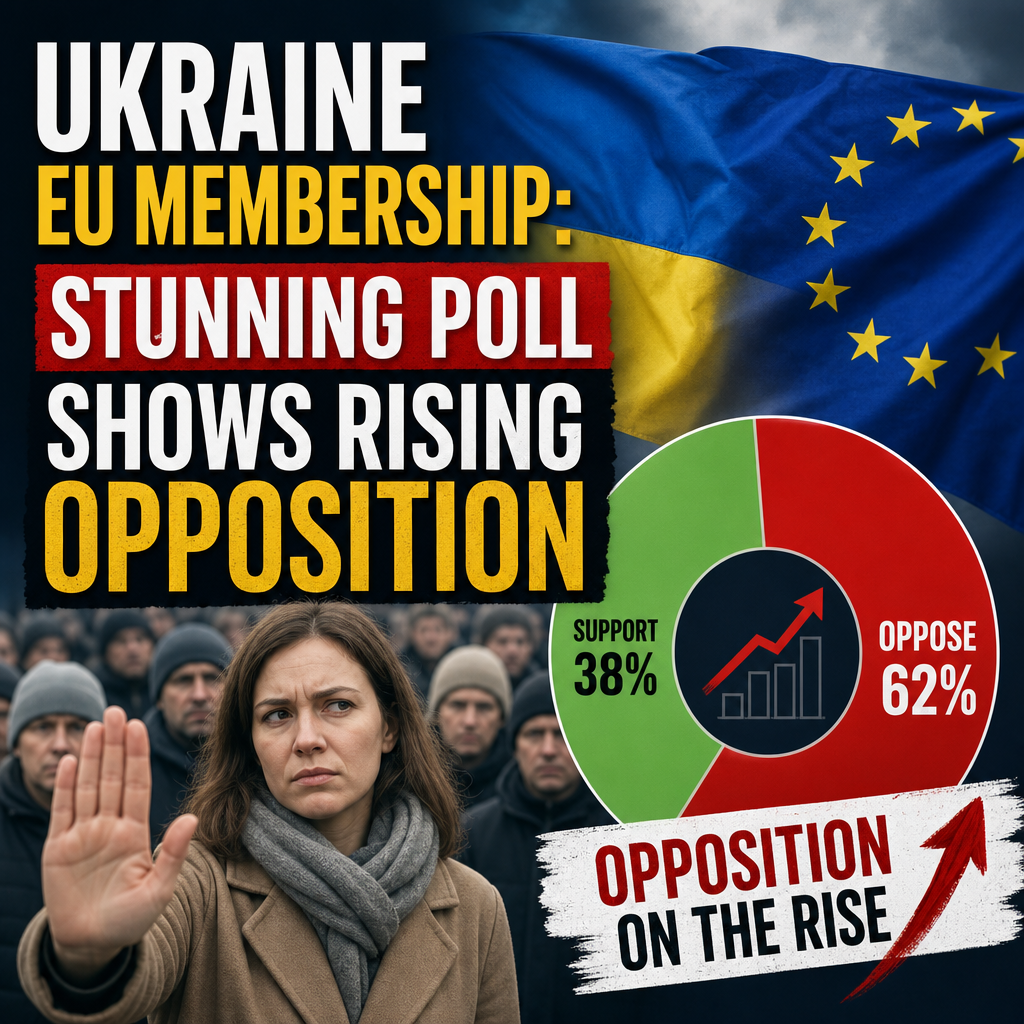
Ukraine EU Membership: Stunning Poll Shows Rising Opposition


Ukraine EU Membership is becoming a more politically complicated issue as attitudes shift across Europe, with a new poll in Poland pointing to growing resistance just as Kyiv continues to frame EU accession as a strategic necessity. The latest debate is no longer only about whether Ukraine belongs in the bloc in principle, but whether European voters and governments still have the patience, money, and political unity to make enlargement happen.
A sharper mood in Poland, and what it may signal
The most striking development comes from Poland, where reporting on a recent poll suggests opposition to Ukraine’s EU entry has risen significantly. That matters because Poland has been one of Kyiv’s most vocal regional supporters since Russia’s full-scale invasion. If public sentiment is cooling there, it may be an early warning for other EU countries that have backed Ukraine diplomatically but are increasingly sensitive to domestic costs.



The reasons behind that shift are not hard to see. In many European countries, voters are juggling inflation, farm protests, migration concerns, and war fatigue. Ukraine’s membership would likely mean a major reordering of EU spending priorities, especially around agriculture, reconstruction, and security. Even people sympathetic to Ukraine may hesitate when they imagine the practical consequences of admitting a large, war-torn country into a system built around careful compromise.
At the same time, polls are snapshots, not verdicts. Public opinion can move quickly depending on battlefield developments, political messaging, or the state of negotiations with Brussels. A rise in opposition does not necessarily mean the door is closing; it does suggest the road ahead will be much bumpier than Kyiv’s supporters once hoped.




Ukraine EU Membership: between strategic promise and political reality
From Kyiv’s perspective, EU membership is about more than symbolic alignment. It represents a long-term anchor for reforms, investment, and security guarantees in a region where sovereignty has been violently contested. Ukrainian officials have repeatedly argued that integration with Europe is the clearest path to locking in democratic institutions and reducing the country’s vulnerability to future pressure from Moscow.
That argument continues to resonate in many Western capitals. Reporting across major international outlets, including Al Jazeera and Sky News, has often highlighted how European leaders describe Ukraine as part of the continent’s future, especially after the invasion reshaped assumptions about security. The moral case remains strong: Ukraine has paid an enormous human and economic price, and many Europeans see support for accession as a way of backing a country under attack for choosing a pro-European path.
But the political case is more fragile. Expansion is expensive, slow, and technically demanding. EU membership requires years of legal harmonization, anti-corruption reforms, judicial changes, and economic adjustments. Those requirements are not unique to Ukraine, but they are harder to satisfy in a country fighting a war, with territory occupied and institutions under strain. Even sympathetic observers acknowledge that accession cannot be rushed without risking either lowered standards or disappointment later.
Three viewpoints shaping the debate
The sources point to at least three distinct perspectives:
– The skeptical voter’s view: More cautious Europeans worry about costs, competition for EU funds, and whether the bloc can absorb a country as large and damaged as Ukraine.
– The Ukrainian and pro-enlargement view: Supporters argue that keeping Ukraine in a gray zone is worse, both strategically and morally, than offering a realistic membership path.
– The institutional EU view: Brussels and many member states appear caught in the middle, trying to keep accession credible while recognizing that the process must remain conditional and politically sustainable.
These viewpoints are not mutually exclusive. In fact, the tension between them may define the next phase of Ukraine’s European future.
What the wider European context suggests
Sky News and Al Jazeera coverage of the wider war has consistently shown that European support for Ukraine remains strong in principle, even as fatigue grows in practice. That distinction matters. Governments may continue supplying aid, weapons, and diplomatic backing while becoming much more cautious about promising full membership on any specific timeline.
This is where the current debate becomes especially delicate. If EU leaders push accession too aggressively, they risk provoking backlash in member states where voters already feel overstretched. If they slow the process too much, they risk sending the opposite signal: that Europe applauds Ukraine’s sacrifices but is unwilling to offer a real political destination.
That uncertainty leaves room for both optimism and frustration. Optimists argue that enlargement has always been messy, and that once war pressure eases, public opinion can recover. Skeptics counter that Ukraine’s entry may be a generational project rather than a near-term policy goal, no matter how often leaders repeat their support.
A fair reading of the trend
The most responsible conclusion is that rising opposition does not equal rejection, but it does expose the limits of rhetorical support. Europe’s commitment to Ukraine remains real, yet the transition from solidarity to membership is where the politics become much harder. Polls in Poland may not decide the outcome, but they are a useful reminder that EU enlargement depends not only on geopolitical logic, but also on the consent of ordinary voters.
In other words, Ukraine’s path toward Europe is still alive — but it is no longer a simple story of momentum. It is a negotiation with history, institutions, and public opinion all at once.

























