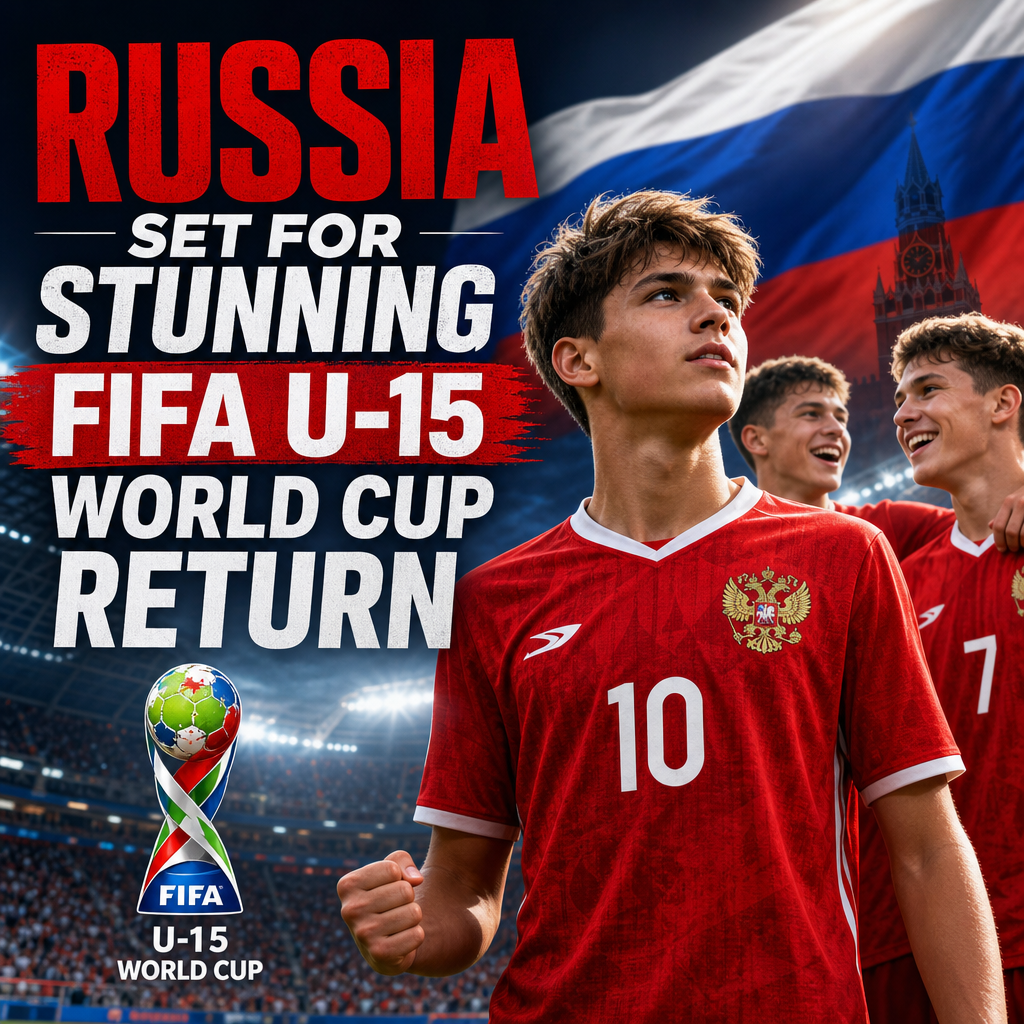
Russia Set for Stunning FIFA U-15 World Cup Return


Russia’s return to FIFA competition through the planned inaugural U-15 World Cup has sparked excitement, skepticism and a fresh round of debate over whether sport can move ahead while politics remains unresolved. The report marks a notable shift after years of isolation for Russian teams in international football, and it arrives at a moment when the sport’s governing bodies are still trying to balance competition, neutrality and geopolitical pressure.
Russia’s FIFA Return: What’s Actually Being Reported?
According to reporting from Al Jazeera, Russia is set to be included in FIFA competition again through the new youth tournament, which would represent its first appearance under the governing body’s umbrella since sanctions followed the full-scale invasion of Ukraine in 2022. The key detail here is that the tournament is for under-15 players, which matters because it places the focus on development rather than senior national-team prestige.



That distinction helps explain why this news is being framed as a breakthrough, but not necessarily as a full normalization of Russia’s place in world football. A youth event is still a FIFA event, yet it is a very different stage from the World Cup or European Championship. In practical terms, the move could allow young Russian players to re-enter international pathways that have been closed off for several years.
There is also a clear symbolic layer. For supporters inside Russia, the return would likely be seen as a sign that sporting isolation is beginning to ease. For critics, especially those who view sanctions as part of broader accountability for the war in Ukraine, the decision may feel premature or inconsistent. That tension is central to understanding why this story matters beyond football.




Why the U-15 World Cup Matters Beyond Youth Football
The creation of an inaugural U-15 World Cup is significant in its own right. Youth tournaments often receive less attention than senior competitions, but they shape future generations of elite players, coaches and footballing cultures. If Russia is involved from the start, it gains access to the same international development environment as other participating nations.
That could have several consequences:
– young Russian players would face international opponents again, helping restore match experience;
– scouts and federations would gain a fresh chance to evaluate Russian talent;
– FIFA would reinforce the idea that youth competition should remain more insulated from political disputes than senior football.
Still, the decision is not without controversy. Critics may argue that any return to FIFA-sanctioned competition gives Russia a reputational lift before there has been a broader political settlement. Others may counter that children should not be punished indefinitely for decisions made by governments and institutions. Both arguments have weight, and the issue is unlikely to disappear just because the competition is for teenagers.
RT’s coverage tends to frame these developments in a more celebratory tone, emphasizing Russia’s re-entry into the FIFA ecosystem as a sporting comeback. That approach reflects a very different perspective from outlets that foreground the war and sanctions context. Sky News, by contrast, has generally treated Russian reintegration into sport as part of a broader international debate, where each step is scrutinized for its political meaning as much as its athletic value.
The Balancing Act for FIFA
FIFA has long claimed that football should remain a global and inclusive game, but the Russia case shows how difficult that principle becomes in practice. When sanctions were introduced, the rationale was clear: the invasion of Ukraine changed the ethical and political environment around Russian participation. Since then, FIFA and other governing bodies have had to navigate a question with no easy answer: how long should exclusion last, and what criteria should determine readmission?
This youth-tournament return suggests that FIFA may be testing a narrower path back for Russian teams, one that avoids the immediate controversy of senior international football. That might be a sensible compromise from an administrative perspective. Youth sport is about development, and there is an argument that teenagers should not be blocked forever from international experience because of decisions made by adult officials.
But compromise is not the same thing as consensus. The broader football community will likely remain split on whether this is an appropriate move. Some will see it as a humane, practical step. Others will see it as a softening of pressure without a corresponding change in circumstances.
The central questions remain
– Does youth participation signal a genuine thaw, or only a limited exception?
– Can FIFA separate development football from geopolitical accountability?
– Will this lead to wider Russian reintegration, or stay confined to age-group tournaments?
The answer, for now, is uncertain.
A Return With Limits, Not a Clean Break
The most balanced reading is that this is not a full Russian comeback, but rather a carefully bounded re-entry into international football. That nuance matters. It suggests FIFA may be willing to restore access in stages, starting with youth events where the political heat is lower and the sporting justification is easier to defend.
Even so, the story is unlikely to fade quickly. If Russia does take part in the U-15 World Cup, it will be seen by some as evidence that the wall around Russian football is cracking. For others, it will be a reminder that sport rarely escapes the political realities around it.
In that sense, the development says as much about FIFA’s current dilemma as it does about Russia’s ambitions. The organization wants to preserve football’s global reach, but every return, every exception and every exception to the exception can carry meaning far beyond the pitch. For young players, the prospect is simply a chance to compete. For the rest of the football world, it is another test of how much politics can be separated from the game—and whether that separation is ever complete.