Trump Whataboutism: Stunning Response After US Troop Deaths


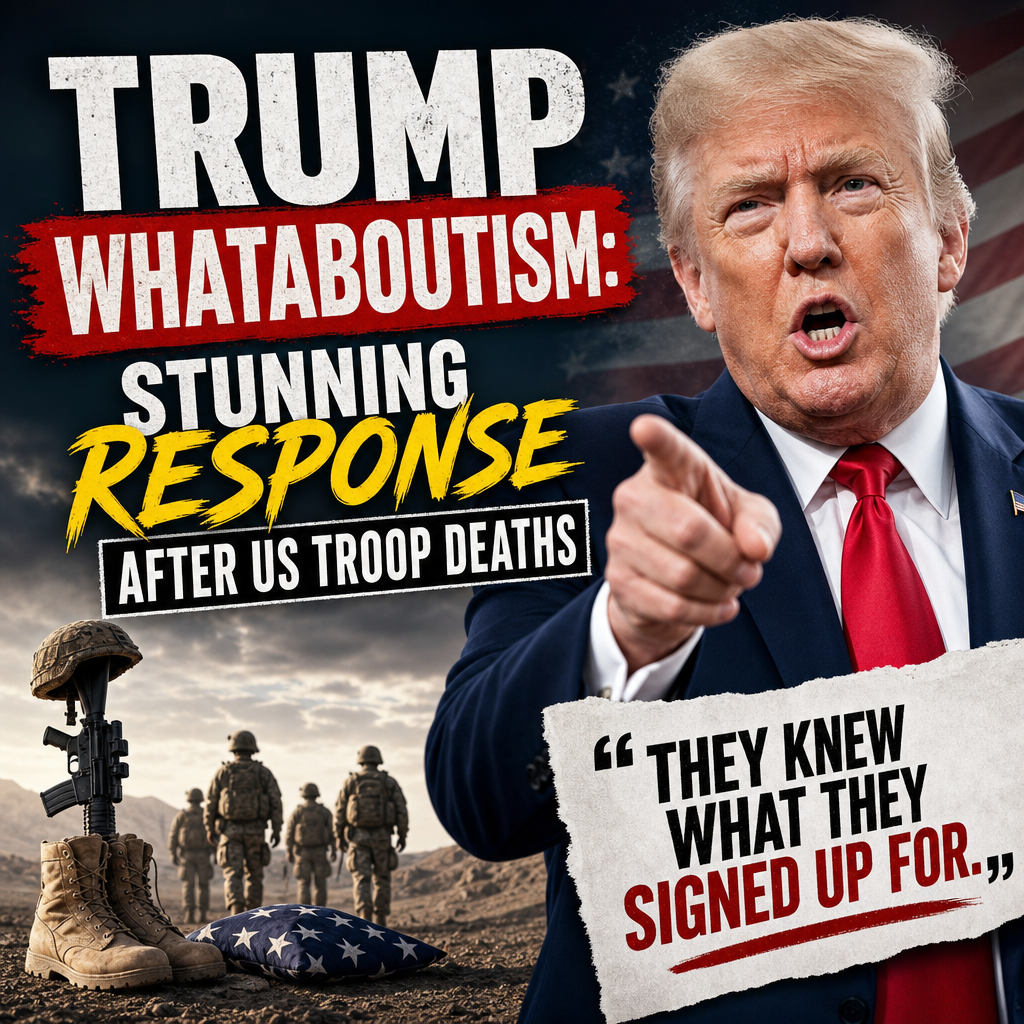
Trump whataboutism has once again put the former president’s instinctive style of crisis response under the spotlight, after the deaths of US troops prompted a sharp, deflective reaction that blended grievance, blame-shifting and political attack.
The incident matters not only because American service members were killed, but because of what followed: instead of a tightly focused statement on the attack itself, Trump’s response immediately broadened into a familiar political frame. He turned the moment into an argument about past wars, Democratic leaders, and what he portrays as systemic weakness in US foreign policy. That pattern is being read in very different ways — as political theater by supporters, and as a troubling refusal to meet a national tragedy with restraint by critics.



Trump whataboutism and the politics of deflection
The core of the controversy is less about one quote than about a well-established communication strategy. Trump often responds to damaging events by changing the subject: if he is pressed on one issue, he reaches for another; if confronted with criticism, he points to another administration, another war, another failure. In this case, the comparison to Vietnam and Afghanistan was especially striking, because it shifted attention away from the immediate loss of US lives and toward a larger argument about American military history.
That move can be effective politically. For Trump’s audience, it frames him as someone unwilling to accept the premises of his opponents’ criticism. It also allows him to connect a current event to a broader narrative that many of his supporters already believe: that the US has been led by weak or incompetent elites, and that “forever wars” have been disastrous for ordinary Americans.




But the same maneuver also has clear costs. When a president — or a former president acting as if he were one — responds to troop deaths by pivoting to old grievances, the public conversation can feel less like leadership and more like score-settling. That is the heart of the “whataboutism” critique: it does not answer the original moral or strategic question, but redirects it.
Different reactions from the press and public
Coverage across international outlets reflects that divide. RT’s framing emphasized Trump’s argument that Democrats and prior wars bear responsibility for America’s military losses abroad, presenting his response as a challenge to the mainstream narrative around US intervention. In that telling, Trump is not evading the issue but exposing what he sees as hypocrisy: leaders who criticize him while presiding over costly, long-running conflicts.
Al Jazeera’s broader coverage of the region and of US foreign policy tends to place these moments in a wider geopolitical context. From that perspective, the deaths of American troops are not just a domestic political talking point; they are tied to the consequences of intervention, escalation, and the unresolved tensions between Washington and its adversaries. That lens makes Trump’s comparison to Vietnam and Afghanistan more than rhetoric — it becomes part of an ongoing debate about whether US military power has been used wisely, or recklessly, for decades.
Sky News, meanwhile, has typically focused on the political and diplomatic fallout: how such remarks play with allies, how they affect perceptions of US resolve, and whether they sharpen concerns that the American political system is increasingly incapable of speaking with one voice in moments of crisis. In that framing, the issue is not only Trump’s tone, but the message it sends abroad. If the US response to the death of its troops quickly becomes a partisan shouting match, adversaries may infer confusion where clarity is needed.
What the argument is really about
At the center of all this are a few unresolved questions:
– Should leaders respond to troop deaths with immediate solemnity, or is political context unavoidable?
– Is Trump making a legitimate historical comparison, or using history as a shield?
– Does his rhetoric expose real failures in US policy, or simply exploit them?
There is no single answer that satisfies everyone, because the event sits at the intersection of grief, strategy and politics. Trump’s defenders argue that he is doing what he has always done: refusing to speak in the polished, careful language of Washington. They see bluntness, not disrespect. Critics see something more damaging — an inability to treat military loss as a moment that should rise above partisan combat.
Why this moment feels familiar
What makes the reaction so resonant is that it fits a larger pattern. Trump has often responded to public pressure by reframing criticism as evidence of corruption, bias or weakness elsewhere. In ordinary political disputes, that can be an effective counterpunch. After troop deaths, however, the stakes are different. The expectation from many Americans is not agreement, but gravity.
That expectation is partly cultural. The US has long reserved special solemnity for military casualties, even when the wars themselves are controversial. A presidential response is supposed to recognize both the human loss and the broader national weight of the event. When the response instead becomes a comparative indictment of Democrats, past wars, or rival administrations, it may still be politically coherent — but it feels emotionally misaligned with the moment.
At the same time, it would be too simple to say the criticism is purely about tone. Trump’s comments tap into a real and unresolved American argument about military intervention, accountability, and whether political leaders have been honest about the costs of war. Many Americans do believe that Vietnam, Afghanistan and other conflicts left deep scars and that both parties share responsibility. Trump’s language resonates because it gives that frustration a target.
The trouble is that resonance is not the same as leadership. A response can contain a kernel of truth and still fail as a public act. That is the paradox of Trump whataboutism: it can be politically sharp, even persuasive, while also seeming deeply inadequate to the demands of the moment.
In the end, the controversy is not only about one set of remarks after US troop deaths. It is about a governing style — or at least a political style — that turns every crisis into an argument about someone else’s failures. For supporters, that is candor. For critics, it is evasion. For everyone else, it is another reminder that in American politics, even grief is rarely allowed to remain just grief.